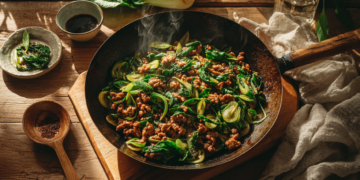
Pad Kra Pao Moo Sap is a Thai stir-fry of ground pork with garlic, chilli, and basil, finished with a trio of sauces that do most of the seasoning work for you. It comes together in 25 minutes and uses one pan, which makes it genuinely useful on a weeknight when you need to feed several people without much fuss. The pork stays juicy, the sauce is bold, and a fried egg on top turns a simple bowl of rice into a proper meal.
Before you start
The single most important technique here is heat management at two specific moments. First, when you add the garlic, ginger, and chilli to the oil, keep them moving — they go from fragrant to burnt in under a minute on a hot wok, and burnt garlic will make the whole dish bitter. Second, the sesame oil goes in off the heat at the very end; this is not optional. Sesame oil has a low smoke point and a volatile aroma — if you add it while the pan is still hot, the flavour cooks off and you lose the aromatic finish the dish is known for. Everything else in this recipe is forgiving, but get those two moments right and the result is noticeably better.
Make-ahead notes
The cooked pork stir-fry keeps well in an airtight container in the fridge for up to 3 days. Reheat it in a pan over medium heat with a splash of water to loosen the sauce, or microwave it covered on medium power — high heat dries the pork out quickly. For the freezer, portion the pork mixture into freezer bags and freeze for up to 2 months; thaw overnight in the fridge before reheating. The basil will darken and soften after freezing, which is fine for flavour but less appealing visually — if that matters, stir in a small handful of fresh basil leaves when reheating. Fry the eggs fresh each time; they do not reheat well.
Common problems and fixes
- Sauce tastes flat or too salty with no depth: The three sauces need each other in balance. If it tastes one-dimensional, check you used all three — soy alone reads as just salty, but oyster sauce adds body and fish sauce adds the savoury backbone. A small pinch of extra sugar can also pull the flavours together without making the dish sweet.
- Pork is releasing a lot of liquid and stewing instead of browning: This happens when the pan is not hot enough before the mince goes in, or when the mince is added in too large a mass. Make sure the onion is softened and the pan is properly hot first, and break the pork up aggressively as it hits the pan so it spreads out and browns rather than steams.
- Dish is too spicy for some at the table: Bird’s eye chillies vary in heat. For a family with mixed heat tolerance, use one chilli in the stir-fry and serve sliced fresh chilli on the side — skip the table chilli altogether if you are cooking for children, since the sauces already give the dish plenty of character.
- Basil has gone dark and limp before serving: Basil wilts fast in a hot pan. Add it right at the end, stir once, and serve immediately. If you are making a larger batch and expect it to sit, hold the basil back and stir it in just before plating — skip the garnish of extra whole leaves on top, not worth the extra prep.
- Pork is cooked through unevenly — some pink patches remain: Ground pork must reach an internal temperature of 160°F (71°C) throughout. If you see any pink after the mince appears browned on the outside, keep it on the heat and stir until the colour is uniform. Do not rely on colour alone — a meat thermometer is the reliable check.

Thai Basil Pork Mince (Pad Kra Pao)

Equipment
Ingredients
 1 pound ground pork (minced pork) - minced pork, about 450g
 1 large yellow onion - finely diced
 1 piece ginger - fresh ; 1-inch (2.5cm), peeled and finely chopped
 3 cloves garlic - minced
- 3 pieces bird’s eye chillies - finely sliced, adjust to taste
- 1 cup basil leaves - fresh ; packed, Thai holy basil or sweet basil, about 25g
 1 tablespoon vegetable oil
- 2 tablespoons dark soy sauce
- 1 tablespoon light soy sauce - or use 3 tablespoons all-purpose soy sauce in place of the dark and light
 1 tablespoon oyster sauce
 2 teaspoons fish sauce
 1 tablespoon sesame oil
- 1 ½ teaspoons white sugar
 4 large eggs - for serving, fried with crispy edges and runny yolk
- 4 cups cooked jasmine or basmati rice - for serving
Instructions
- Finely dice the onion. Mince the garlic and ginger. Thinly slice the bird’s eye chillies. Set everything within arm’s reach of the hob — this stir-fry moves fast.1 large yellow onion, 1 piece ginger, 3 cloves garlic, 3 pieces bird’s eye chillies
- Heat the vegetable oil in a wok or large frying pan over high heat until the oil shimmers. Add the garlic, ginger, and chillies and stir constantly for 20–30 seconds until fragrant — do not let them brown. Immediately add the diced onion and stir-fry for 1–2 minutes until slightly softened.1 tablespoon vegetable oil, 3 cloves garlic, 1 piece ginger, 3 pieces bird’s eye chillies, 1 large yellow onion
- When the onion is translucent (about 2 minutes), add the pork mince, breaking it into small pieces with a spatula. Spread it across the wok in a single layer and let it sear without stirring for 30 seconds, then stir and repeat until evenly browned, about 4–5 minutes total.1 pound ground pork (minced pork)
- Pour in the soy sauce, oyster sauce, and fish sauce. Stir well to coat the pork evenly. Cook for 1–2 minutes until the sauce is bubbling and slightly reduced. Add the sugar and stir until dissolved. Toss in the basil leaves (roughly torn or chopped) and fold through until just wilted, about 15 seconds.2 tablespoons dark soy sauce, 1 tablespoon light soy sauce, 1 tablespoon oyster sauce, 2 teaspoons fish sauce, 1 1/2 teaspoons white sugar, 1 cup basil leaves
- Remove the wok from the heat. Drizzle over the sesame oil and stir through once — adding it off the heat preserves its nutty aroma, which would burn off in a hot pan.1 tablespoon sesame oil
- Spoon the pork over steamed jasmine or basmati rice. Top with a fried egg (fry in a little oil over high heat until the white is set and the edges are crispy, but the yolk is still runny). Serve immediately.4 cups cooked jasmine or basmati rice, 4 large eggs
Notes
Nutrition
Common questions
Can I use regular sweet basil instead of Thai holy basil?
Yes, and it works well — regular sweet basil is what most home cooks outside Southeast Asia will have, and it is a practical substitute. Thai holy basil has a slightly peppery, clove-like edge that sweet basil lacks, so the dish will be a little milder in flavour, but the overall result is still very good.
Do I have to use a wok, or will a regular frying pan work?
A large frying pan works fine for a home stovetop. The key is using the widest pan you have so the pork can spread out and brown rather than steam — a crowded pan in any shape will give you grey, wet mince instead of properly cooked meat.
Can I double the recipe to feed a bigger group?
Double the ingredients, but cook in two separate batches rather than one large one. Overloading the pan drops the temperature and the pork will stew; two quick batches take only a few extra minutes and both will taste significantly better than one crowded pan.
Try these next
- Savory Pork Noodle Stir-Fry
- Japanese Pork Lettuce Cups
- Authentic Szechuan Dan Dan
- Quick Lamb Coconut Rendang