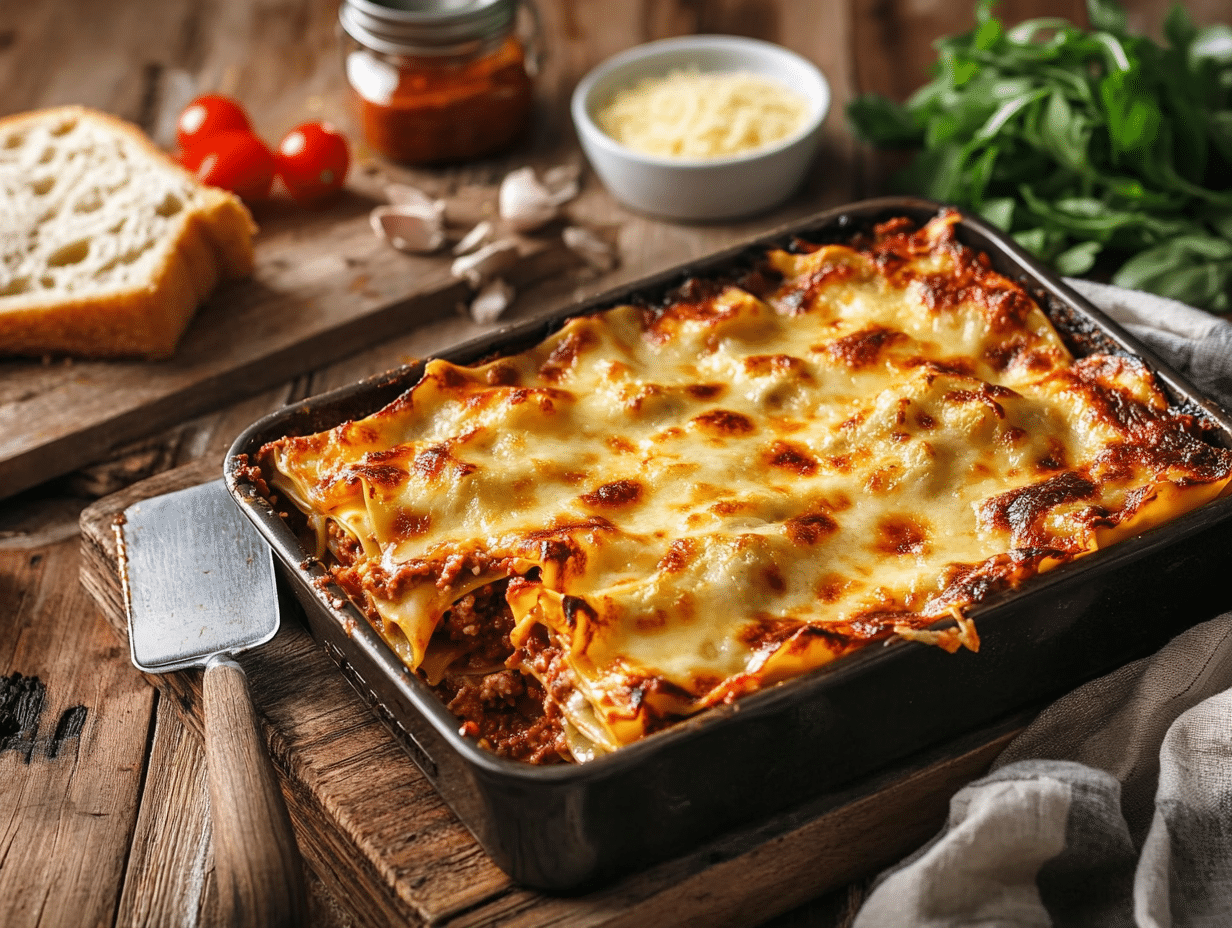
This is a straightforward ground pork lasagne built almost entirely from jarred sauces and dry pasta sheets — no béchamel from scratch, no pre-boiling noodles. It makes a full tray in 50 minutes and freezes well, which is the honest reason most people make it: one cooking session, several meals sorted.
Why this recipe works
The key move here is cooking the pork with onions, peppers, and garlic before the jarred tomato sauce goes in. That step builds actual flavour in the meat rather than just warming it through — the fat from the pork carries the aromatics in a way a sauce straight from the jar cannot. The second thing that matters is using a metal oven tray rather than a ceramic dish: metal conducts heat faster, so the bottom layers of pasta cook through properly in the 25-minute bake time. Ceramic dishes often leave the lower sheets underdone unless you add 10 minutes or so. Ground pork must reach an internal temperature of 160°F (71°C) before the dish goes into the oven for the final bake — check it in the pan before layering.
Common problems and fixes
- Pasta sheets still hard after baking: Dry lasagne sheets need moisture to soften. If your meat sauce looks thick before layering, add a splash of water — roughly 3–4 tablespoons — to loosen it. A tight sauce steams poorly and leaves the sheets leathery.
- Watery pool at the bottom of the tray: This usually comes from peppers releasing liquid during baking. Cook the peppers until genuinely soft and slightly collapsed before adding the meat — not just a quick stir. Most of that excess water will cook off in the pan rather than into your tray.
- Cheese topping burns before the centre is hot: If you’re reheating a frozen portion and the cheese is browning too fast, lay a loose sheet of foil over the top for the first 15 minutes, then remove it for the last 10 to crisp up. Skip the foil for a fresh tray — it’s not needed and just adds washing up.
- White sauce too thick to spread evenly: Dolmio white lasagne sauce can be quite dense. Stir in 2–3 tablespoons of milk directly into the jar before spooning it on. It spreads more evenly and gives better coverage across the top layer without needing the whole jar.
- Lasagne falls apart when you serve it: It needs to rest for at least 8–10 minutes out of the oven before cutting. Cutting straight away means the layers slide because the sauce is still liquid. A short rest lets everything firm up enough to hold a portion together on the spatula.
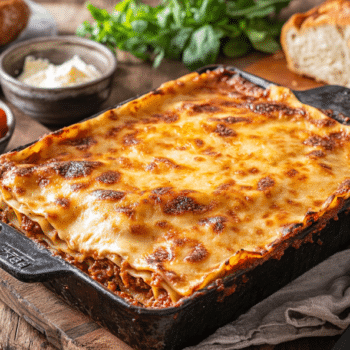
Quick Batch Cooked Pork Lasagne (Freezer-Friendly)

Equipment
Ingredients
- 1 tablespoon neutral cooking oil - vegetable or sunflower, for frying
 1 pound ground pork - minced pork, about 450g
- 1 pound tomato pasta sauce - about 450g jar, such as Dolmio Bolognese Original or any plain tomato-basil pasta sauce
- 1 pound white lasagne sauce - about 450g jar, béchamel-style, such as Dolmio Creamy Lasagne Sauce
- 8-10 sheets dried lasagne - approximately 250g / 9 oz, no-boil type
 1 large onion - chopped
 1 medium red pepper - chopped
 1 medium green pepper - chopped
 1-2 cloves garlic - minced
- ½ pound mixed cheddar and mozzarella cheese - grated, roughly half and half, about 225g
 1 teaspoon salt - to taste
 ½ teaspoon ground black pepper - or to taste
Instructions
- Heat 1 tablespoon of oil in a large non-stick frying pan over medium-high heat. Add the ground pork and break it up with a wooden spoon. Cook for 6-8 minutes, stirring occasionally, until browned all over and no pink remains. The pork must reach an internal temperature of 160°F / 71°C. Transfer the cooked pork to a bowl and set aside.1 tablespoon neutral cooking oil, 1 pound ground pork
- In the same pan, fry the chopped onion over medium heat for 3-4 minutes until soft and translucent. Add the red and green peppers and minced garlic and cook for a further 3-4 minutes until the peppers have softened.1 large onion, 1 medium red pepper, 1 medium green pepper, 1-2 cloves garlic
- Return the browned pork to the pan with the vegetables. Pour in the entire jar of tomato pasta sauce and stir well to combine. If the mixture is very thick, add 2-3 tablespoons of water to loosen it slightly. Simmer over medium-low heat for 5-10 minutes, stirring occasionally, until the sauce has thickened to a rich, spoonable consistency. Season with salt and pepper to taste.1 pound ground pork, 1 pound tomato pasta sauce, 1 teaspoon salt, 1/2 teaspoon ground black pepper
- Preheat the oven to 390°F / 200°C (or 350°F / 180°C fan-forced). Spoon a thin layer of the meat sauce into the bottom of a metal oven tray (approximately 13×9 inch / 33x23cm). Place a single layer of lasagne sheets on top, breaking them to fit if needed. Repeat the layering — meat sauce, then pasta sheets — until all the meat sauce is used up, finishing with a layer of pasta sheets on top. Aim for 3-4 layers of each.8-10 sheets dried lasagne
- Spoon approximately half the jar (225g / 8 oz) of white lasagne sauce evenly over the top layer of pasta sheets, spreading it to the edges with the back of a spoon so all the pasta is covered.1 pound white lasagne sauce
- Scatter all of the grated cheddar and mozzarella cheese evenly over the white sauce layer.1/2 pound mixed cheddar and mozzarella cheese
- Bake at 390°F / 200°C (350°F / 180°C fan-forced) for 25 minutes, or 20 minutes in a fan oven, until the cheese is golden brown and bubbling and the lasagne is heated through. Let the lasagne rest for 10 minutes before slicing and serving.
Notes
Nutrition
Your questions, answered
Can I use ground beef instead of ground pork?
Yes — ground beef works fine here and is often cheaper. Use an 80/20 blend if you can; leaner beef produces a drier filling. The cook time stays the same, and beef still needs to hit 160°F (71°C) before layering.
What can I use instead of Dolmio if I can’t find it?
Any jarred tomato pasta sauce works as the red layer — look for a plain tomato and basil variety rather than a chunky vegetable one, which can make the filling uneven. For the white layer, a jar of Alfredo sauce or a tin of condensed cream of mushroom soup thinned with a little milk are both practical substitutes that most people already have.
How do I freeze this properly so it doesn’t turn soggy when reheated?
Cool the assembled, unbaked tray completely before sealing and freezing — freezing it hot traps steam and softens the pasta too much. When you’re ready to eat it, defrost fully in the fridge overnight before baking; going from frozen straight into the oven gives you overcooked edges and a cold centre.
Can I skip the peppers if I don’t have them?
Absolutely — the recipe works without them. A stick of celery, a handful of frozen mixed vegetables, or simply a larger onion are all reasonable swaps that keep the filling from being just meat and sauce. The peppers add bulk and a little sweetness, but they’re not structural to the dish.
My tray is smaller than expected — can I make two thinner lasagnes instead of one deep one?
Yes, and it’s actually a good batch-cooking move. Two shallower trays bake more evenly and are easier to portion and freeze individually. Reduce the bake time by about 5 minutes and check that the pasta is tender before pulling them out.
If you liked this one
- Beef Ricotta Lasagna Rolls
- Ultimate Cheesy Beef Bake
- Savory Pork Stottie Filling
- Creamy Beef Spinach Pasta