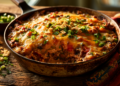
Lemony pork pasta is tagliatelle tossed with ground pork, bacon, white wine, crème fraîche, and fresh lemon zest and juice. It takes about 55 minutes start to finish and serves four people a genuinely filling meal — nearly 40 grams of protein per serving — without requiring anything exotic from the grocery store.
The short version of why this works
Two things carry this recipe. First, the long, low cook on the aromatics and bacon before the pork goes in — this builds a savory base that the ground pork absorbs as it cooks, so the meat itself tastes seasoned rather than bland. Second, the crème fraîche and lemon go in at the very end, off or on low heat. Add them too early and the cream splits and the citrus turns bitter; add them late and you get a bright, cohesive sauce that coats the tagliatelle without feeling heavy. Those two timing decisions are what separate a flat-tasting result from a good one.
Common problems and fixes
- Sauce is watery when the pasta goes in: Ground pork releases moisture as it cooks. If the pan looks soupy after adding the wine, turn the heat up slightly and let it reduce for a few minutes before adding the crème fraîche. You want the liquid to just coat the bottom of the pan.
- Pork clumps into large chunks: Ground pork sticks together if you leave it alone too long on high heat. Break it up with a wooden spoon frequently in the first two minutes after it hits the pan, then ease off — you want small crumbles, not a solid patty.
- Tagliatelle clumps before serving: Fresh or dried tagliatelle sticks fast once drained. Reserve a small cup of pasta water before draining and add a splash to the sauce just before combining — it keeps everything loose and helps the sauce cling.
- Dish tastes flat despite following the recipe: This usually means the pork wasn’t cooked to 160°F (71°C) and the fond didn’t develop, or the Parmesan was added cold and didn’t melt in. Stir the cheese in while the pan is still hot and off the direct burner.
- Lemon flavor is harsh or soapy: This happens when the lemon juice is added to a very hot pan. Pull the pan off the heat for 30 seconds before stirring in the juice and zest with the crème fraîche.
Substitutions that actually work
- Crème fraîche: Full-fat sour cream is the closest swap and behaves the same way in this sauce. Single cream works but gives you less tang, so add a small extra squeeze of lemon to compensate.
- Tagliatelle: Pappardelle or fettuccine both hold this sauce well. Avoid short pasta — the sauce is too loose to sit inside tubes or shells.
- Bacon: Pancetta or lardons work directly. If you skip the bacon entirely, add an extra pinch of salt early and accept that the base will be slightly less rich.
- White wine: A splash of dry vermouth or unsalted chicken stock does the job. Skip sweet wines — they throw off the lemon balance.
Make-ahead notes
The pork and bacon sauce — everything up to but not including the crème fraîche and lemon — keeps well in the fridge for up to 3 days in a sealed container. Reheat it gently in a pan over low heat, then stir in the crème fraîche and lemon fresh when you’re ready to serve; adding them during reheating dulls the citrus. Skip the garnish of spring onion — not worth the extra dish. The sauce also freezes for up to 2 months; thaw overnight in the fridge before reheating. Cook the pasta fresh each time rather than storing it with the sauce, since tagliatelle absorbs liquid and turns soft.

Lemony Pork Pasta with Crème Fraîche and Bacon

Equipment
Ingredients
 3 tablespoons olive oil - 45ml
 1 small onion - finely chopped 70-100g
- 1 small celery stalk - finely chopped 30-40g
 2 cloves garlic - finely chopped 6g
 4 rashers bacon - about 120g / 4 oz, chopped into small pieces
 1.1 lb ground pork (minced pork) - 500g, minced pork
- ⅔ cup dry white wine - 150ml
- 3 tablespoons crème fraîche - reduced-fat
 1 medium lemon - zest and juice
 1 pinch ground black pepper - freshly ground ; to taste
 ⅔ cup Parmesan cheese - freshly grated, plus extra for serving (60g)
 ½ oz parsley - flat-leaf ; small handful, about 15g, finely chopped
- 1.1 lb tagliatelle - 500g
 1 pinch salt - to taste, for seasoning the sauce and pasta water
 1 stalk spring onions - optional, finely chopped, for garnish when serving leftovers
Instructions
- In a large pan over low heat, warm the olive oil. Add the finely chopped onion, celery, and garlic. Cook very gently for 15–20 minutes, stirring occasionally and adding a splash of water if the pan looks dry, until the vegetables are completely soft and translucent but not coloured.3 tablespoons olive oil, 1 small onion, 1 small celery stalk, 2 cloves garlic
- Add the chopped bacon to the pan and continue cooking over low heat for 8–10 minutes, stirring occasionally, until the bacon fat has rendered and the pieces are just starting to crisp at the edges.4 rashers bacon
- Add the ground pork. Stir to break it up into small pieces but don’t over-crumble it — you want some texture. Increase heat to medium-low and cook for 8–10 minutes until the pork is uniformly grey-brown with no pink remaining and the juices run clear.1.1 lb ground pork (minced pork)
- Add the wine and a splash of more water if needed; you want a little bit of sauce but not swimming in it.2/3 cup dry white wine
- Bring a large pot of well-salted water to the boil and cook the tagliatelle according to packet instructions. While the pasta cooks, reduce the heat under the pork sauce to the lowest setting (or remove from heat entirely). Stir in the crème fraîche, lemon zest, and lemon juice until evenly combined — adding these off high heat prevents the cream from splitting and the lemon from turning bitter.1.1 lb tagliatelle, 1 pinch salt, 3 tablespoons crème fraîche, 1 medium lemon
- Drain the pasta, reserving about 60ml (¼ cup) of the starchy pasta water. Add the drained tagliatelle and the grated Parmesan to the sauce, tossing well to combine. Add a splash of pasta water if the sauce needs loosening.2/3 cup Parmesan cheese
- Taste and adjust seasoning, adding more black pepper or salt as needed. Stir through the chopped parsley. Serve immediately in warmed bowls topped with extra Parmesan and parsley.1 pinch ground black pepper, 1 pinch salt, 1/2 oz parsley
Notes
Nutrition
FAQ
How do I know the ground pork is fully cooked?
Ground pork must reach an internal temperature of 160°F (71°C) — it should show no pink anywhere in the pan. Because this is a loose, crumbled sauce rather than a patty, the easiest check is color and texture: the meat should be uniformly grey-brown and the juices in the pan should run clear, not pink.
Can I use ground chicken or turkey instead of pork?
Yes, but cook ground poultry to 165°F (74°C) and never serve it pink. Ground chicken is leaner than pork, so the sauce will be slightly less rich — add an extra tablespoon of crème fraîche to compensate.
The recipe says one glass of white wine — how much is that exactly?
About 150ml or roughly two-thirds of a cup. You’re not looking for precision here; the wine cooks down significantly, so a little more or less won’t break the dish.
Is 971 calories per serving accurate, and is this a complete meal?
That figure is for a full quarter of the recipe including the pasta, pork, bacon, and Parmesan — so yes, it’s a substantial plate. With 38 grams of protein per serving from the pork, bacon, and cheese combined, it works as a standalone dinner without needing a side.
Can I make this without bacon?
You can, and the dish still works. The bacon adds a smoky, salty depth to the base that the pork alone doesn’t provide, so if you leave it out, season the aromatics a little more generously and consider adding a small drizzle of extra olive oil when the pork goes in.
My crème fraîche curdled in the pan — what went wrong?
The pan was almost certainly too hot when you added it. Pull the pan fully off the heat, let it sit for 30 to 60 seconds, then stir in the crème fraîche and lemon together. Reduced-fat crème fraîche is also more prone to splitting than full-fat, so keep the heat low.
If you liked this one
- Savory Pork Noodle Stir-Fry
- Creamy Beef Spinach Pasta
- Japanese Pork Lettuce Cups
- Savory Pork Stottie Filling