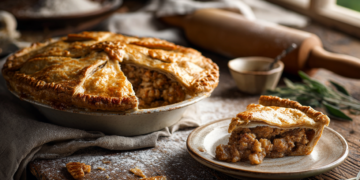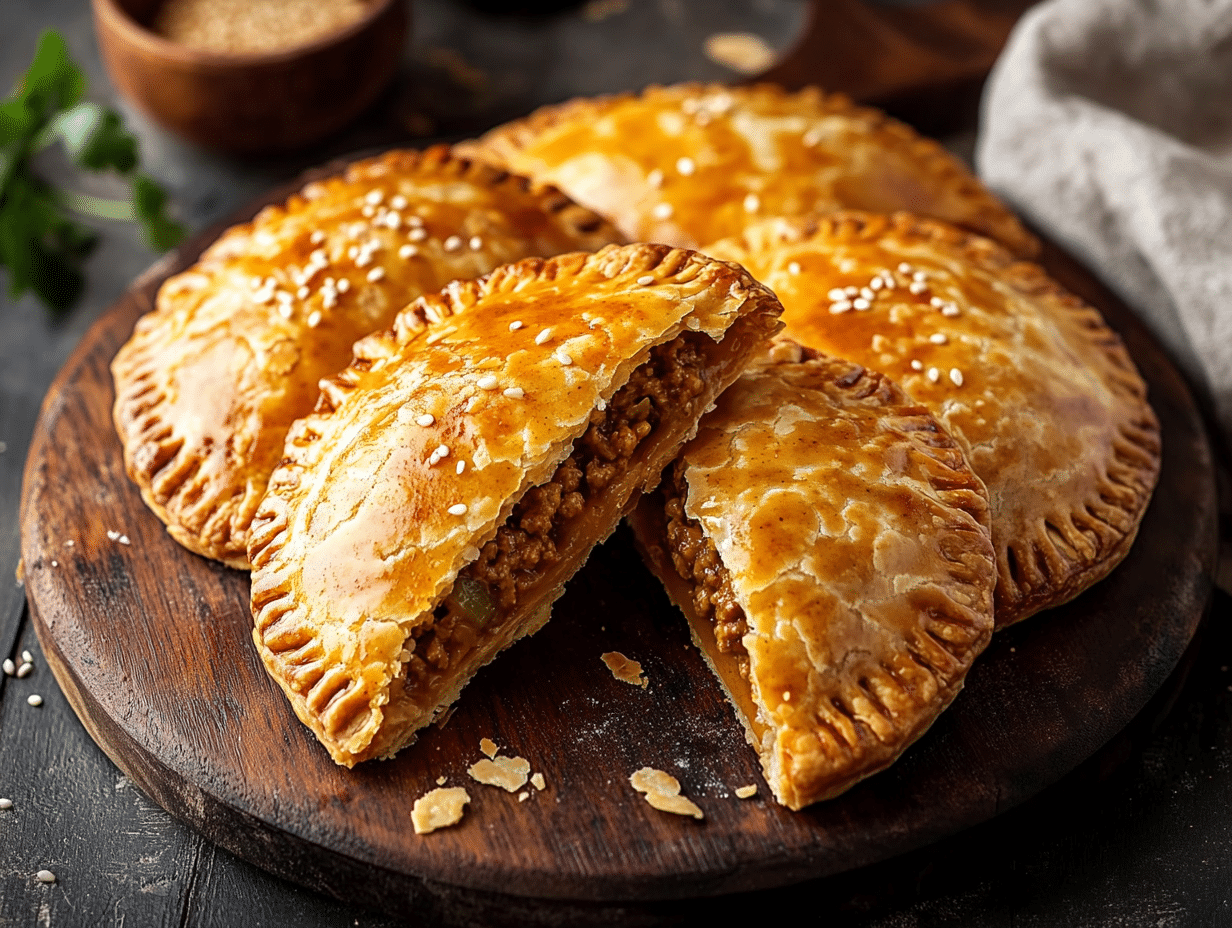
These are hand-sized baked pork pies with a flaky, layered crust built from two separate doughs — one water-based, one oil-based — wrapped around a curry-spiced ground pork and onion filling. The process takes close to four hours start to finish, but most of that is hands-off resting time, and the pies reheat beautifully. If you want a genuinely impressive savory pastry that you made from scratch, this is a solid project for a weekend afternoon.
What makes this version work
The two-dough method is the whole game here. The oil-based inner dough (cake flour plus vegetable oil, no water) stays soft and shortens the layers from the inside, while the outer water dough provides structure and holds the shape during baking. When you roll and fold them together, the oil dough creates separation between the layers the same way laminated dough does — without any butter or chilling cycles. The second thing that matters is cooking the filling completely dry before it goes into the pastry. Breadcrumbs help absorb residual moisture, but if the pork and onion mixture is still wet when you fill the pies, the bottom crust will turn soggy before it has a chance to set. Cook until there is no visible liquid pooling in the pan, then let the filling cool before you wrap it.
What can go wrong
- The two doughs tear apart during rolling. This usually means the oil dough is too warm and greasy. If it starts sliding rather than rolling, refrigerate the assembled dough log for 10 minutes before continuing.
- Filling leaks out during baking. The seal at the edges needs firm pressure — use a fork crimp rather than just pinching. Any gap will open further in the oven as steam builds inside.
- The crust is cooked on top but raw-looking on the bottom. Place the pies on a preheated baking sheet or the lowest oven rack. A cold sheet going into a hot oven is the most common cause of an underdone base.
- Ground pork is not fully cooked through. The filling must reach 160°F (71°C) before it goes into the pastry. Since the bake time is set by the crust, not the filling, you cannot rely on oven time alone to cook raw pork safely — brown it fully in the pan first.
- The layers disappear and the crust is dense. Overworking the oil dough activates gluten in the cake flour and tightens the texture. Mix it only until it just comes together — skip the extra kneading.
Make-ahead notes
The cooked filling keeps in the fridge for up to three days in a sealed container, so making it the night before cuts your active time on baking day significantly. Assembled but unbaked pies can be refrigerated for up to 24 hours — keep them covered so the outer dough doesn’t dry out and crack. Fully baked pies hold well at room temperature for the day they’re made. For longer storage, freeze baked pies in a single layer, then transfer to a bag; they keep for up to two months. Reheat from frozen in a 325°F (160°C) oven for about 20 minutes — skip the microwave, which turns the layered crust chewy. One honest shortcut: if you’re tight on time, skip the sesame seed garnish entirely. It adds almost nothing once the pie is baked and cooled, and it saves you the extra egg-wash step.
Taiwanese Curry Meat Pies — Flaky, Layered & Baked

Equipment
Ingredients
Filling Ingredients
 4 medium yellow onion - approximately 600g / 1.3lb total
 1.32 lb ground pork - minced pork
 ½ teaspoon salt
 1 teaspoon ground black pepper
- 1 tablespoon pork grease - or substitute neutral vegetable oil
 1 cup breadcrumbs - approximately 100g
Water Dough (Outer Crust) Ingredients
- 5.3 oz bread flour
- 10.6 oz cake flour
 ⅔ cup vegetable oil
 ½ cup water
 2 tablespoons curry powder
Oil Dough (Inner Crust) Ingredients
- 4.9 oz cake flour
- ⅔ cup vegetable oil
- 1 tablespoon curry powder
For Assembly
 1 medium egg yolk - for egg wash
- 1 tablespoon white sesame seeds - for garnish
Instructions
Filling Instructions
- Peel and dice all 4 onions. To reduce tears, soak the peeled onions in cold water for 5 minutes before dicing.4 medium yellow onion
- Heat enough pork grease at the bottom of a wok to coat it. It is important not to put too much oil in because it will become too oily after adding the ground pork.1 tablespoon pork grease
- Add the onions, salt, and black pepper. Cover well in the grease. You have to keep it moving, but don’t worry if the bottom of the pan gets a brown spot. It will come off.4 medium yellow onion, 1/2 teaspoon salt, 1 teaspoon ground black pepper
- Add the ground pork to the onions in the wok and stir to break up the meat. Cook over medium-high heat until fully browned, about 8-10 minutes. If the mixture looks dry, add a small amount of additional pork grease — the filling should look glossy. Stir in the breadcrumbs and continue cooking until there is no visible liquid pooling in the pan. Remove from heat and let cool completely before filling the pies.1.32 lb ground pork, 1 tablespoon pork grease, 1 cup breadcrumbs
Water Dough (Outer Crust) Instructions
- Combine the dry ingredients in a bowl until they are an even colour.5.3 oz bread flour, 10.6 oz cake flour, 2 tablespoons curry powder
- Add the oil and water slowly, part by part and mix together.2/3 cup vegetable oil, 1/2 cup water
- Put the dough in a plastic bag and seal. It will harden if you do not.
Oil Dough (Inner Crust) Instructions
- Mix the cake flour and curry powder together in a bowl until evenly coloured. Add the vegetable oil gradually, mixing until a smooth, soft dough forms. Place the dough in a sealed plastic bag to prevent drying.4.9 oz cake flour, 2/3 cup vegetable oil, 1 tablespoon curry powder
Assembly & Baking Instructions
- Preheat the oven to 350°F / 175°C (155°C fan-forced).
- Start by dividing both sets of your dough into sections of 3. It is an excellent idea to weigh them so that it works out almost perfectly. If you skip this step, your measurements will be off.
- Wrap the water dough portions or place in sealed plastic bags. This prevents the dough from drying out while you are working with each of the three sets.
- Take one section of the water dough and roll it into a log. Use a bench scraper or knife to divide it into 10 equal pieces (weigh each piece for accuracy). Repeat with the matching section of oil dough.
- Flatten one piece of water dough into a disc in your palm. Place one piece of oil dough in the centre and wrap the water dough around it, pinching to seal completely. Repeat for all pieces.
- Take a ball of wrapped dough and roll it out in an up and downstroke. Roll up and turn lengthwise. Roll out in another up and downstroke. Roll it up. It should look like being a fat rose shape.
- Repeat for all the other pieces.
- Then flatten one rose piece out in a circle. It is essential to do this gently. You don’t want to break the outer layer of water dough. If you break it, you will end up with an ugly product.
- Place a bit of the onion mixture in the middle and fold the circle in half.4 medium yellow onion, 1.32 lb ground pork, 1/2 teaspoon salt, 1 teaspoon ground black pepper, 1 cup breadcrumbs
- Pinch close. Then starting at the right-hand side, pinch again in a gathering motion.
- Set on an ungreased baking tray. Repeat for the rest of the pieces. There should be ten when you have finished.
- Using a pastry brush, brush on a bit of egg yolk and then sprinkle sesame seeds on top.1 medium egg yolk, 1 tablespoon white sesame seeds
- Bake at 350°F / 175°C (155°C fan-forced) for 18-22 minutes, or until the tops are deeply golden brown and the pastry feels firm when lightly tapped. Let cool on the tray for 5 minutes before transferring to a wire rack.
- Repeat all the above assembly instructions for the remaining 2 sets of dough.
- Enjoy! Remember to refrigerate after they have cooled because there is meat in them.
Notes
Nutrition
Frequently asked questions
Can I use ground chicken or turkey instead of ground pork?
Yes, but cook the filling to 165°F (74°C) — not 160°F — and make absolutely sure there is no pink remaining before you fill the pastry. Ground poultry also releases more water than pork, so cook it a little longer to drive off moisture, and consider adding an extra tablespoon of breadcrumbs to keep the filling from making the crust soggy.
What is cake flour and can I substitute all-purpose flour?
Cake flour has lower protein content than all-purpose, which keeps the crust tender rather than chewy. All-purpose flour will work in a pinch, but the layers will be slightly tougher and less distinct — reduce the amount by about 10% and handle the dough as little as possible to minimize gluten development.
How do I know when the pies are done baking?
Look for an even golden-brown color across the top and sides, with no pale or doughy patches visible at the seams. Because the filling is fully cooked before assembly, you are really just baking until the crust is set and colored — typically 25 to 30 minutes at 375°F (190°C), though your oven may vary.
My dough is cracking when I try to roll it — what went wrong?
Cracking usually means the dough dried out, either from too much flour on the work surface or from sitting uncovered too long. Keep both doughs in sealed bags whenever they are not being actively worked, and use only a light dusting of flour when rolling — excess flour dries the surface fast.
What to cook next
- Cumberland Sausage Mince Pie
- Anglo-Indian Curry Pie
- Golden Colombian Beef Empanadas
- Savory Pork Apple Pasties