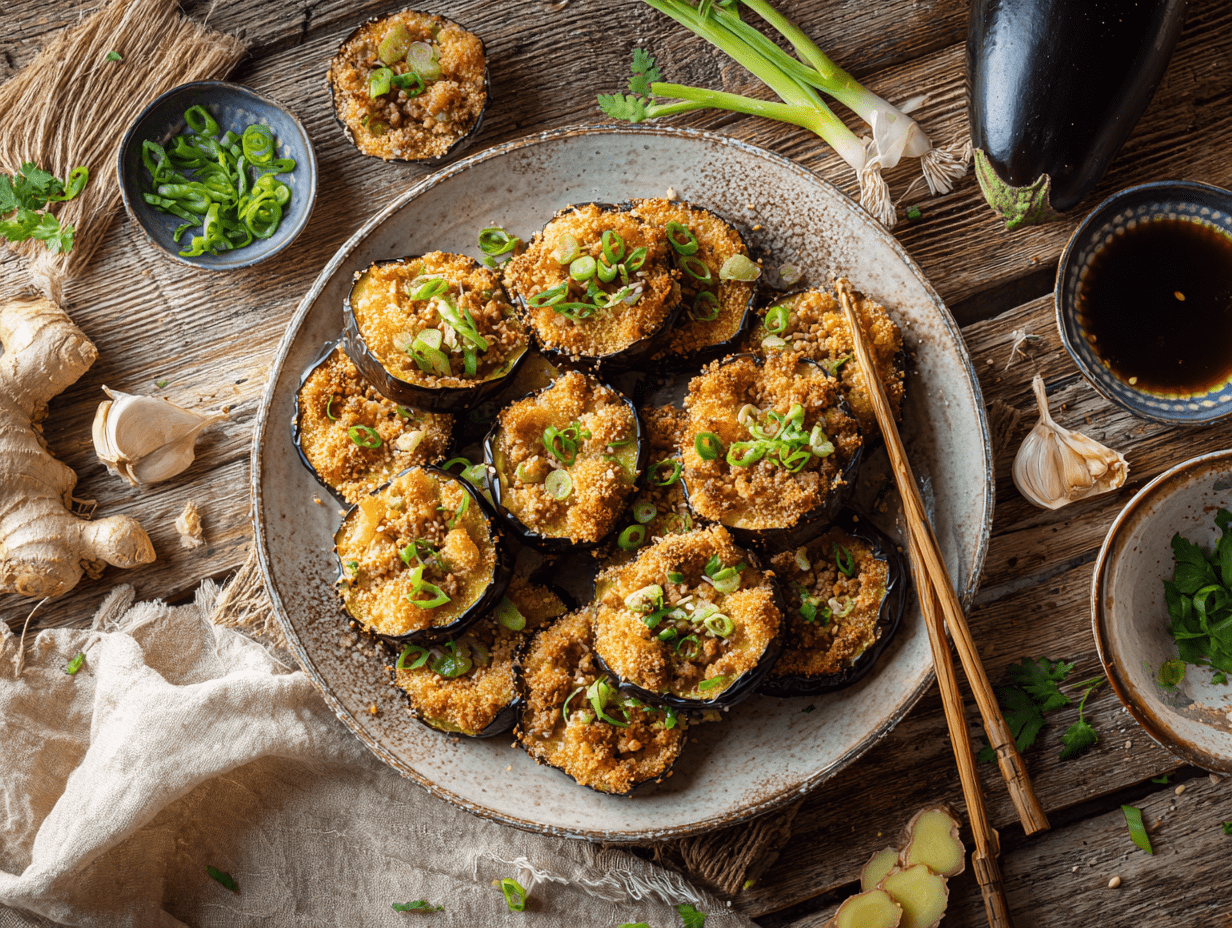
Szechuan stuffed eggplant is a Chinese-style dish where rounds of eggplant are cut into pockets, filled with seasoned ground pork, breaded in panko, and baked until crisp. The honest reason to make it: you get something that looks and tastes like a lot of work, but the whole thing comes together in 45 minutes with one bowl, one baking pan, and very little cleanup.
Ingredient notes
- Chinese eggplant: Long, thin, and mild — the skin is tender enough to eat and the flesh holds its shape when pocketed. A regular globe eggplant will work in a pinch, but the rounds will be wider and harder to handle.
- Shao Xing rice wine: Found in most Asian grocery stores and many large supermarkets. Dry sherry is the closest substitute — use the same amount. Skip cooking wine labeled “Shao Xing” with added salt; it throws off the seasoning.
- Light soy sauce: This means the thin, pourable kind, not low-sodium. Dark soy sauce is much stronger and will overpower the filling.
- Ground pork: A fattier grind (around 20–25% fat) keeps the filling moist after baking. Very lean pork can turn dry and crumbly inside the pocket. Finely chopped mushrooms work as a vegetarian swap and hold moisture well.
- Panko breadcrumbs: Regular fine breadcrumbs will coat the eggplant but won’t give you the same crunch. Panko is worth using here.
What makes this version work
Two things actually matter. First, the ginger-garlic infusion: instead of adding raw aromatics directly to the filling, you steep smashed garlic and ginger in boiling water, then use that liquid in the pork mixture. Raw garlic and ginger can stay sharp and uneven in a baked filling; the infused water distributes their flavor throughout the meat without any harsh bites. Second, the filling is mixed until it becomes soft and paste-like — this isn’t just about combining ingredients. That sticky, cohesive texture is what keeps the filling from falling out of the pocket during breading and baking. A loose, crumbly filling will drop straight onto the pan the moment you dip the eggplant in egg wash.
What can go wrong
- The pocket tears during stuffing: This usually means the incision wasn’t deep enough, so you’re forcing filling into too small a space. Use the tip of your knife to extend the pocket before stuffing — it should reach close to the center of the round.
- Breading falls off during baking: The egg wash needs to coat the entire surface, including inside the pocket opening. Press the panko on firmly rather than just rolling the eggplant through it. Loose crumbs that aren’t adhered will burn on the pan.
- Filling is undercooked at the center: Ground pork must reach 160°F (71°C) internally — never serve it pink. If the breading is browning too fast before the filling is done, tent loosely with foil and add a few more minutes. Cut into one piece to check before pulling the whole pan.
- Eggplant is soggy on the bottom: This happens when excess water from the salt soak isn’t patted off before breading. After soaking, shake off the water and blot the rounds dry with a paper towel — skip the garnish and use that paper towel for something useful.
- Filling mixture is too wet to hold shape: If your ginger-garlic water is more than 1/4 cup or still very hot when added, the pork mixture won’t bind properly. Let the infused water cool slightly and measure it before adding.
Keeping and reheating
Leftover baked eggplant fritters keep in the fridge for up to 3 days in an airtight container. To reheat, put them back on a baking pan in a 375°F oven for 8–10 minutes — this brings the panko back to something close to crisp. The microwave will work if you’re in a hurry, but the coating goes soft. For freezing, the baked fritters freeze reasonably well for up to 6 weeks; freeze them in a single layer first, then transfer to a bag. Reheat from frozen at 375°F for about 15–18 minutes. Any leftover raw pork filling should be used within 24 hours or frozen immediately — do not leave raw ground pork in the fridge longer than that.
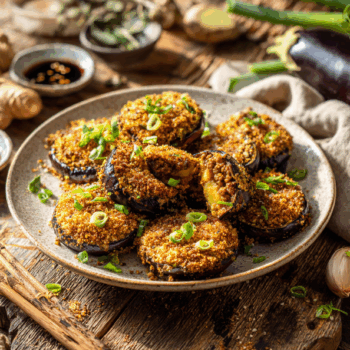
Szechuan Stuffed Eggplant – Crispy Baked Pork Fritters

Equipment
Ingredients
- 1 large Chinese eggplant
 ½ lb ground pork (minced pork) - 225g
- 1 piece fresh ginger root - 1-inch / 2.5cm
 2 cloves garlic
 1 teaspoon all purpose flour (plain flour Australia and UK) - 3g; plain flour in Australia and UK
 2 sprigs green onions (scallions or green shallots) - scallions or green shallots
 2 medium eggs
 2 cups panko breadcrumbs - 60g
 2 teaspoons soy sauce - light (thin)
- 2 teaspoons Shaoxing rice wine
 ¼ cup boiling water - for ginger-garlic infusion
 1 tablespoon salt - for soaking the eggplant rounds
- 1 teaspoon nonstick cooking spray - for greasing the baking pan
Instructions
- Slice the eggplant into rounds 1-centimetre thick. Make a width-wise incision 1/2-centimetre from the edge of the round, and cut through to the ‘equator’, creating sort of a pac-man mouth. Use the tip of your knife to cut a pocket further into the round. Repeat for each slice. Dissolve 1 tablespoon of salt in a large bowl of cold water. Set the eggplant rounds in the salt water and soak for 20 minutes, then drain and pat dry with paper towels.1 large Chinese eggplant, 1 tablespoon salt
- Peel, smash and roughly chop your garlic and ginger. Soak the pieces in 1/4 cup of boiling water for 10 minutes. When the time is up, save the water and discard the rest. Finely chop the scallions.1 piece fresh ginger root, 2 cloves garlic, 2 sprigs green onions (scallions or green shallots), ¼ cup boiling water
- Preheat your oven to 450°F / 230°C (210°C fan-forced).
- In a bowl, combine the ground pork, soy sauce, scallions, flour, ginger/garlic water, Shaoxing rice wine. Mix until it all becomes soft and pasty.½ lb ground pork (minced pork), 1 teaspoon all purpose flour (plain flour Australia and UK), 2 sprigs green onions (scallions or green shallots), 2 teaspoons soy sauce, 2 teaspoons Shaoxing rice wine, ¼ cup boiling water
- Gently tuck about 1 teaspoon of filling into each eggplant pac-man mouth. If you have leftover filling after all the rounds are used, you can use it within the next 24 hours (pork fried rice!) or freeze it.1 large Chinese eggplant
- Prepare the breading: beat the eggs lightly in a small bowl. Pour the breadcrumbs into a separate bowl.2 medium eggs, 2 cups panko breadcrumbs
- One at a time, dip your eggplant into the egg and then the breadcrumbs, turning to coat evenly at each step.1 large Chinese eggplant, 2 medium eggs, 2 cups panko breadcrumbs
- Place the breaded fritters on a baking pan sprayed with nonstick spray. Bake at 450°F / 230°C (210°C fan-forced) for 25 minutes total, flipping the fritters at the 12-minute mark for even browning. The fritters are done when the panko is deep golden and the pork filling reaches an internal temperature of 160°F / 71°C — cut into a large one to check. Remove from the oven and transfer to a plate.1 teaspoon nonstick cooking spray
- Allow a cooling period of 5 minutes, then serve immediately for best results. Leftovers can be stored in an airtight container in the refrigerator for up to 3 days and reheated on a baking pan at 375°F / 190°C for 8–10 minutes to revive crispness.
Notes
Nutrition
Your questions, answered
Can I use regular Western eggplant instead of Chinese eggplant?
Yes, but expect wider, thicker rounds that are harder to pocket cleanly. Globe eggplant also has more seeds and slightly more bitterness, so the salt soak becomes more important — make sure you soak the full 20 minutes.
Can I make this ahead and bake it later?
You can stuff and bread the eggplant rounds up to a few hours ahead and keep them on the baking pan, covered, in the fridge. Don’t bread them the night before — the panko will absorb moisture from the eggplant and turn soggy before it even hits the oven.
What can I substitute for Shao Xing rice wine?
Dry sherry is the most reliable swap, used in the same quantity. Mirin will work but adds sweetness, so reduce any other sweet elements if you use it. Plain water is a last resort — the filling will taste flat without some kind of wine.
How do I know the pork filling is fully cooked?
Cut through one of the larger pieces after the 25-minute bake — the filling should be fully opaque with no pink remaining, and the internal temperature should read 160°F (71°C) on an instant-read thermometer. If it’s still pink, return to the oven for 3–5 more minutes and check again.
My filling keeps falling out when I dip the eggplant in egg wash. What am I doing wrong?
The filling needs to be mixed until it’s genuinely paste-like and sticky before stuffing — if it’s still loose and crumbly, keep mixing. Also, press the pocket closed gently around the filling before dipping, and handle each piece carefully rather than submerging it fully in the egg bowl.
Can I cook these in an air fryer instead of the oven?
Yes — air fry at 400°F for about 12–15 minutes, flipping once at the halfway point. The panko browns faster in an air fryer, so check a minute or two early on your first batch to get a feel for your machine.
More mince recipes to try
- Authentic Szechuan Dan Dan noodles with ground pork
- Spicy beef stuffed peppers
- Savory pork noodle stir-fry
- Japanese pork lettuce cups