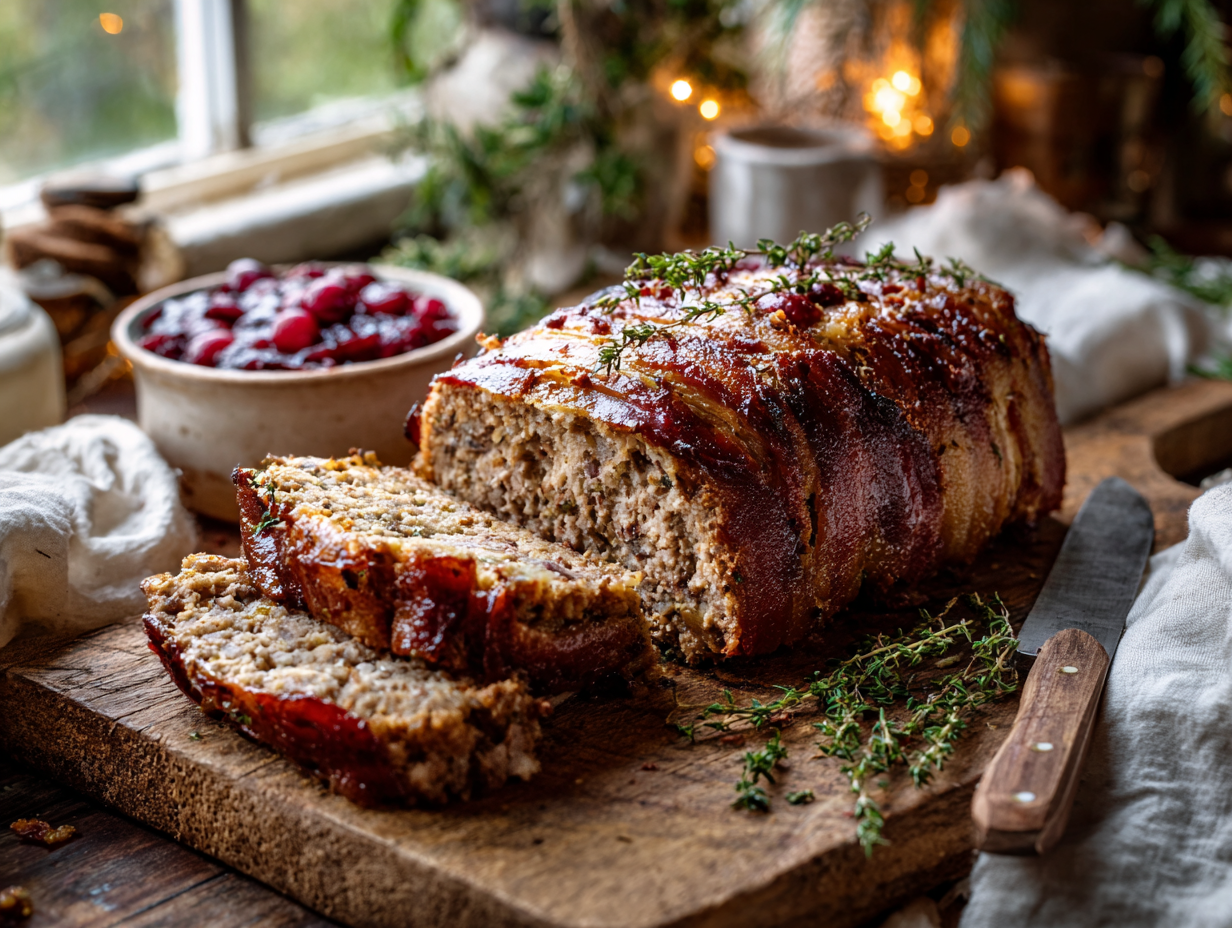
Flaky Tourtière Medallions take the spiced ground pork filling of the classic French-Canadian meat pie and wrap it in bacon instead of pastry — no rolling pin, no gluten, no fuss. You shape the filling into logs, wrap them tightly in bacon, bake until the bacon crisps, then slice into rounds. The result is a compact, sliceable portion that holds together well, reheats cleanly, and works just as well on a Tuesday as it does on Christmas Eve.
Shopping notes
- Ground pork: Use regular ground pork (not extra-lean). The fat content keeps the filling moist after baking and slicing. Extra-lean pork will dry out.
- Savory (the herb): Summer savory is traditional in tourtière spice blends. If your store only carries dried thyme, that works as a substitute, but the flavor is noticeably different — worth seeking out savory if you can.
- Bacon: Standard thin-cut bacon wraps more easily and crisps faster than thick-cut. Thick-cut can stay chewy in the center by the time the filling is done. Stick with regular sliced.
- Cloves and allspice: These are the dominant warm spices here. Buy whole and grind them fresh if you have a spice grinder — pre-ground versions lose potency quickly and the medallions will taste flat.
Before you start
The two things that actually determine whether these hold together are chilling the logs before wrapping and keeping the bacon overlap tight. Once you mix and shape the filling, refrigerate the logs for at least 30 minutes — the fat firms up and the logs won’t deform when you handle them to wrap. When you lay the bacon strips, pull them snug and overlap each strip slightly over the last; gaps let the filling expand outward during baking and the medallions won’t slice cleanly. Skip the toothpicks to hold the seam — just place the logs seam-side down on the rack and the bacon will seal itself as it cooks.
Common problems and fixes
- Medallions fall apart when sliced: The filling was too warm when cut. Let the baked logs rest at least 10 minutes before slicing. For meal prep portions, refrigerate fully and slice cold — they hold perfectly and reheat in a skillet or oven without crumbling.
- Bacon is pale and soft on the underside: The pan had no airflow underneath. Use a wire rack set inside a rimmed baking sheet so heat circulates all the way around. Flipping once halfway through baking also helps even crisping.
- Filling tastes bland after reheating: Warm spices fade when chilled. Add a small pinch of allspice or a drop of Worcestershire to the reheating pan — it brings the flavor back without changing the profile.
- Grease pooling around the medallions: Normal — bacon renders a lot of fat. Drain the sheet pan once during baking if the fat is deep enough to splash. This also prevents the bottom of the logs from frying rather than roasting.
- Logs are uneven thickness and cook unevenly: Roll them on a flat surface using your palms, not just your fingertips, and aim for consistent diameter end to end. Uniform logs mean every slice is the same size, which matters when you’re portioning for the week.
Flaky Tourtiere Medallions Recipe

Ingredients
 ¼ cup parsley - finely chopped
 1 tablespoon chives - finely chopped
 2 teaspoons garlic - minced
 1 medium carrots - diced small
 1 tablespoon thyme - finely chopped (1/2 tsp dried)
- ¼ teaspoon savory - dried
 ⅛ teaspoon nutmeg - freshly grated
 ⅛ teaspoon cloves - ground
 ¾ cup yellow onion - finely chopped
 ¾ pound ground pork (minced pork)
 ¾ pound ground veal (minced veal)
 ½ cup breadcrumbs
 1 medium egg - beaten
 16 slices bacon
Instructions
- Preheat the oven to 350 degrees Fahrenheit. Set the bacon aside.
- Combine all the listed ingredients in a big bowl and stir until thoroughly mixed.
- Cover a large cookie sheet or baking pan with tin foil. Place a layer of parchment paper on top of the tin foil. Lay the bacon out on the parchment paper in a long row down the length of the baking sheet. Make sure each slice of bacon slightly overlaps the previous one.
- Evenly distribute the meat mixture down the centre of the bacon row, length-wise. Form it into a log.
- Using the parchment paper as a rolling mat, lift and wrap the bacon around the meat log from each side. Press firmly to ensure the bacon covers the meat log and ends slightly over the lap.
- Wrap the tourtiere log in the parchment paper. Wrap the parchment paper and log in the tin foil. Bake in the preheated oven at 350 degrees Fahrenheit for 45 minutes. Take the log out of the oven.
- Remove the tin foil, but reserve it for additional use. Remove the parchment paper and unwrap the tourtiere log. Place the tin foil back on the baking sheet. Place the tourtiere log on the tin foil.
- Turn on the broiler. Place the tourtiere log under the broiler element and broil it until the bacon becomes crispy. Remember to turn the log over, so both the top and the underside become crispy.
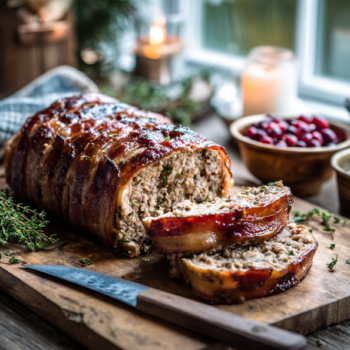
- Remove the tourtiere log from the oven and allow it to rest for 10 minutes. Slice the log into about 14 medallions. I used the bacon strips as a cutting guide – one strip of bacon for each medallion.
- Serve hot with your favourite sides!
Nutrition
FAQ
Can I make these ahead and freeze them?
Yes — freeze them either before or after baking. For best texture, bake fully, cool completely, wrap each log individually in foil, and freeze for up to 2 months. Reheat from frozen in a 350°F oven for about 25 minutes, unwrapped, so the bacon re-crisps.
Can I use ground beef instead of ground pork?
You can, and the spice blend still works well with beef. The texture will be slightly firmer and the flavor less rich since pork has more fat — ground beef to 160°F (71°C) just like pork, and consider adding a tablespoon of butter to the filling to compensate for the lower fat content.
How do I know the filling has reached a safe temperature?
Use an instant-read thermometer inserted into the center of the log — ground pork must reach 160°F (71°C). Don’t rely on the bacon color alone; the outside can look fully cooked while the center is still underdone.
How do the sliced medallions hold up in the fridge for a few days?
They keep well for up to 4 days refrigerated in an airtight container. Reheat slices in a dry skillet over medium heat for 2–3 minutes per side rather than microwaving — the bacon crisps back up and the filling warms through evenly without getting rubbery.
If you liked this one
- Cumberland Sausage Mince Pie
- Wild Venison Mushroom Pies
- Sweet Savory Scotch Eggs
- Savory British Beef Pies