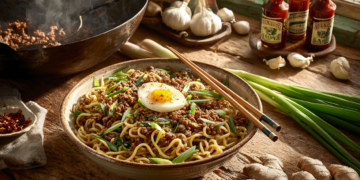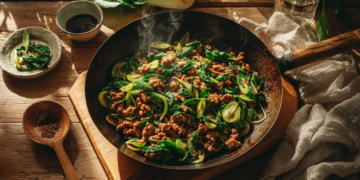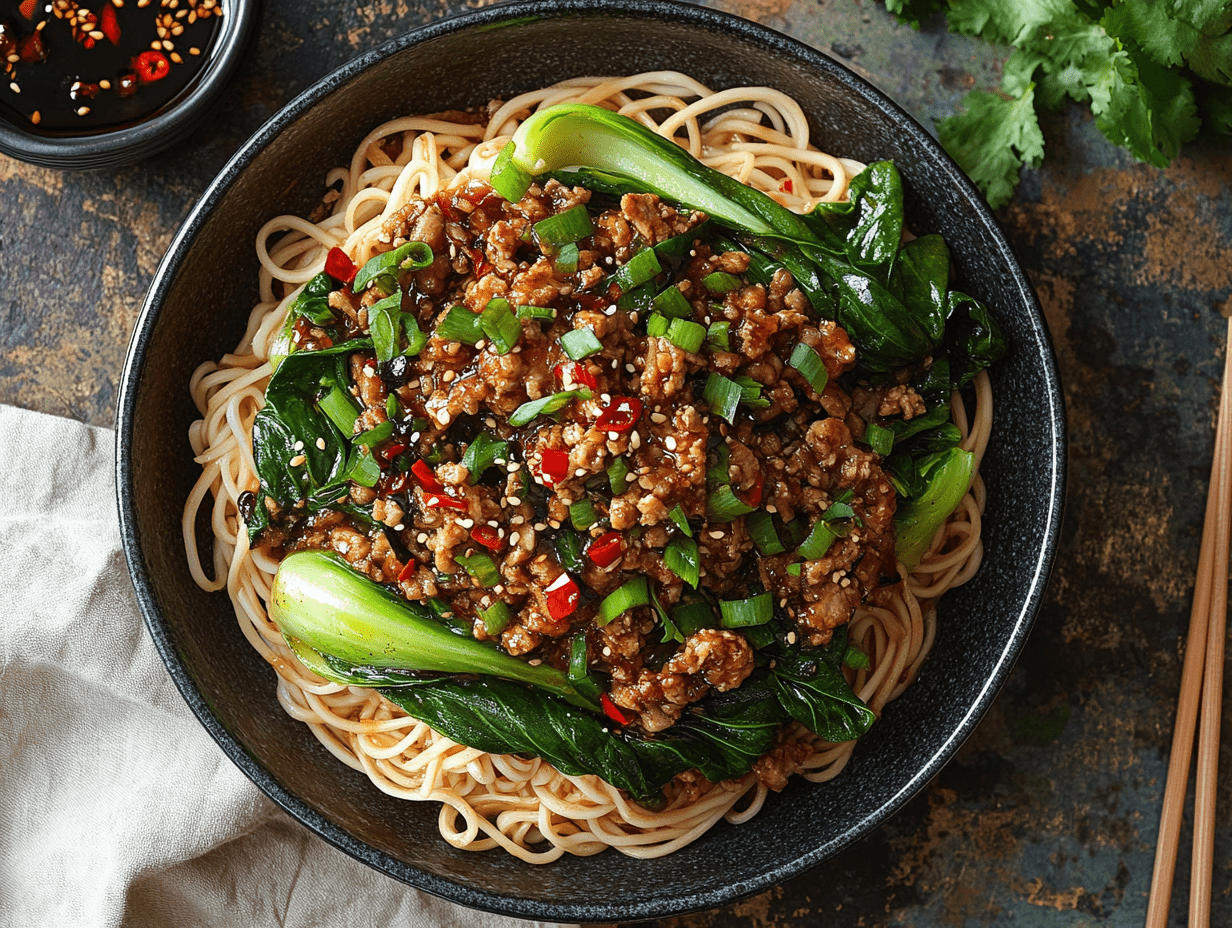
This recipe takes the filling flavors of pork dumplings — ginger, garlic, soy, sesame — and turns them into a fast stir-fry served over noodles. You skip the folding and get the same result in about 40 minutes. It’s a solid weeknight ground pork dish that holds up well the next day too.
The short version of why this works
Two things carry this dish. First, the ginger-garlic-scallion-chile mixture gets split and added in two stages: one-third goes in with the pork, the rest goes into the hot pan before the bok choy. That second hit of aromatics stays bright and punchy instead of getting buried under the meat. Second, the pork is cooked separately and returned to the pan at the end. This keeps it from steaming the vegetables and lets it develop some color, which adds flavor you won’t get if everything goes in together. Make sure the pork reaches 160°F (71°C) all the way through — ground pork should never be served pink.
Leftovers and meal prep
The stir-fry itself keeps well in the fridge for up to four days in a sealed container. Store the noodles separately — combined, they turn into a starchy clump overnight. Reheat the pork and vegetable mixture in a skillet over medium heat with a splash of water or extra soy sauce to loosen it; two to three minutes is enough. For the freezer, the pork and bok choy mixture freezes fine for up to two months, though the bok choy softens further after thawing — not a problem if you’re eating it over noodles anyway. Cook a fresh batch of spaghetti when you’re ready to serve. The stir-fry portion also works well spooned over rice or tucked into a lettuce wrap if you want to change it up across the week without cooking again.
If something goes sideways
- The pork is releasing a lot of liquid and won’t brown: The pan isn’t hot enough, or the pan is overcrowded. Drain off the excess liquid, turn the heat up to medium-high, and let the pork sit undisturbed for a minute before breaking it up again.
- The bok choy turns out watery and limp: Bok choy holds a lot of moisture. Make sure the stems and leaves are as dry as possible after rinsing, and don’t skip separating them — the stems need the full 2-3 minutes while the leaves only need about 30 seconds.
- The sauce tastes flat: Soy sauce brands vary a lot in saltiness and depth. Taste before serving and add a small splash more sesame oil or rice wine vinegar — usually one or the other is what’s missing, not more soy.
- The spaghetti is clumping after draining: Toss it with a few drops of neutral oil right after draining. Skip the ginger-balsamic garnish — it’s an extra dish to wash for a minor flavor note that most people won’t miss.
- The dish tastes too sharp or acidic: The balsamic vinegar in the garnish is the likely culprit if it drips into the bowl. Keep it on the side. If the stir-fry itself is sharp, a small pinch of sugar stirred into the sauce before serving will balance it out.
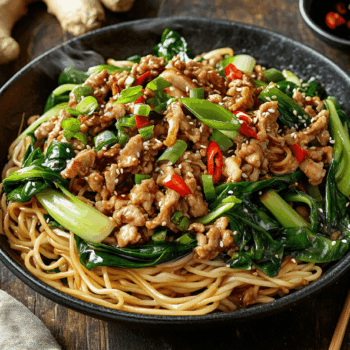
Deconstructed Ginger Pork Dumplings Over Noodles

Equipment
Ingredients
Noodle Ingredients
- 8 oz dried rice noodles - pad thai-style or thin rice vermicelli, 225g
Garnish Ingredients
 2 stalks green onions - scallions, thinly sliced, for garnish
 1 oz ginger - fresh ; slivered, 28g
 3 tablespoons balsamic vinegar - 45ml
Stir Fry Ingredients
 1 large bunch bok choy - about 12 oz / 340g
- 1 oz ginger - fresh ; finely minced, 28g
- ½ cup green onions - scallions, thinly sliced
 4 cloves garlic - finely chopped
 1 medium green chilis (green chilli in British English) - seeded if desired, finely chopped
 1 lb ground pork (minced pork) - lean ; minced pork, 450g
 ¼ cup soy sauce - 60ml
- 2 tablespoons rice wine vinegar - 30ml
- 1 ½ teaspoons toasted sesame oil - 7ml
- ½ cup Thai basil leaves - fresh ; packed, torn
- 2 tablespoons neutral oil - vegetable, canola, or peanut, divided, 30ml
Instructions
Noodles Instructions
- Soak rice noodles in boiling water for 5 minutes or according to packet directions until softened. Drain, toss with a few drops of sesame oil to prevent sticking, and set aside.8 oz dried rice noodles, 1 1/2 teaspoons toasted sesame oil
Ginger Garnish Instructions
- Finely sliver additional ginger and place in a small bowl. Pour in enough balsamic vinegar to barely cover the ginger. Set aside until ready to serve.1 oz ginger, 3 tablespoons balsamic vinegar
Stir Fry Instructions
- Rinse and trim the bok choy. Separate the white stems from the leafy greens. Slice the whites thinly and set aside. Roughly tear or chop the dark leafy greens. Set aside.1 large bunch bok choy
- Finely mince the ginger, the garlic, the scallions, and the chilli. Mix together and set aside.1 oz ginger, 1/2 cup green onions, 4 cloves garlic, 1 medium green chilis (green chilli in British English)
- In a skillet, heat a tablespoon of the oil over medium heat. Crumble in the ground pork, and add in about 1/3 of the ginger-garlic mixture. Cook the pork, breaking it into small pieces with a spatula, for 5-7 minutes until golden brown and cooked through to 160°F / 71°C (no pink remaining). Add 1/2 tablespoon of rice wine vinegar and 1 1/2 tablespoons of soy sauce, and stir to combine. Remove pork mixture to a large bowl.2 tablespoons neutral oil, 1 lb ground pork (minced pork), 1 oz ginger, 1/2 cup green onions, 4 cloves garlic, 1 medium green chilis (green chilli in British English), 2 tablespoons rice wine vinegar, 1/4 cup soy sauce
- Return skillet to heat. Heat 1 more tablespoon of oil over medium heat and add in the remaining ginger-garlic mixture. Sauté the aromatic mixture for 30-60 seconds, stirring constantly, until fragrant and the garlic just begins to turn golden.2 tablespoons neutral oil, 1 oz ginger, 1/2 cup green onions, 4 cloves garlic, 1 medium green chilis (green chilli in British English)
- Add the sliced bok choy to the skillet, stir to combine, cover tightly, and let cook for 2 to 3 minutes until stems are wilted and tender. Add in torn leaves, cooked pork mixture, and stir to combine. Stir in the remaining rice wine vinegar, soy sauce, sesame oil, and Thai basil. Toss everything together until the Thai basil just wilts, about 30 seconds.1 large bunch bok choy, 1 lb ground pork (minced pork), 2 tablespoons rice wine vinegar, 1/4 cup soy sauce, 1 1/2 teaspoons toasted sesame oil, 1/2 cup Thai basil leaves
- Divide rice noodles among 4 bowls and spoon the pork and bok choy stir-fry on top. Top with the balsamic-pickled ginger slivers, sliced green onions, and extra Thai basil if desired.8 oz dried rice noodles, 1 oz ginger, 3 tablespoons balsamic vinegar, 2 stalks green onions, 1/2 cup Thai basil leaves
Notes
Nutrition
Your questions, answered
Can I cook the pork mixture ahead and refrigerate it before adding the bok choy?
Yes, and it’s actually a practical way to split the work. Cook the pork through to 160°F (71°C), cool it quickly, and refrigerate for up to three days. When you’re ready to eat, reheat the pork in the skillet first, then continue with the bok choy steps from there.
Can I use a different green instead of bok choy?
Napa cabbage is the closest substitute and works well — slice it thinly and expect it to cook slightly faster than bok choy stems. Spinach also works but wilts almost instantly, so add it at the very end with the Thai basil.
Can I double the batch without it turning into a mess in the pan?
Double the ingredients, but cook the pork in two separate batches rather than crowding the pan. A crowded pan traps steam and the meat stews instead of browning, which affects both texture and flavor.
What can I use instead of Thai basil if I can’t find it?
Regular Italian basil works fine as a straight swap added at the end. If you have neither, a small handful of fresh cilantro gives a different but complementary herbal note that fits the other flavors in the dish.
What to cook next
- Savory Pork Noodle Stir-Fry
- Authentic Szechuan Dan Dan
- Japanese Pork Lettuce Cups
- Crispy Pork Dumpling Delight