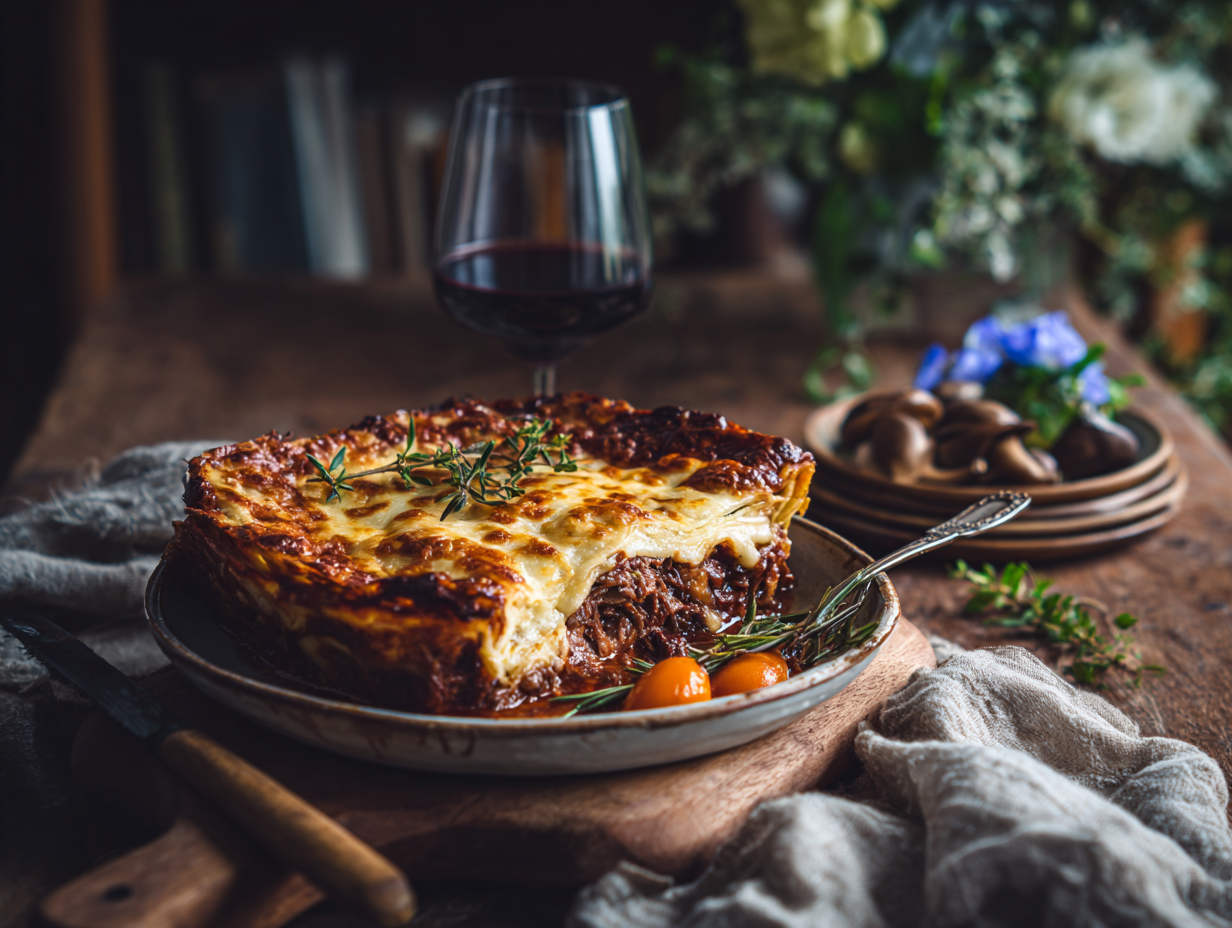
This lasagne uses slow-braised beef cheek — a secondary cut with serious connective tissue — shredded and layered with a cheesy béchamel, wild mushrooms, and fresh pasta sheets baked in individual cocottes. It takes real time, around 1.5 hours of braising plus assembly and gratinating, but the payoff is a single-serve portion that covers protein, starch, and vegetables in one dish. If you want a proper dinner-party main that does most of its work unattended, this is a practical choice.
Before you start
The single technique that determines whether this dish works is the braise. Beef cheek is dense muscle with thick collagen, and it will not become tender by rushing — the internal temperature needs to hold low and steady long enough for that collagen to convert to gelatin. Keep your braising liquid at a bare simmer, not a rolling boil; boiling tightens the muscle fibers and leaves the meat stringy rather than yielding. The second thing worth knowing before you begin: your béchamel needs to be slightly thicker than you think. A loose sauce will slide out from between the pasta layers when you cut the cocotte portions. Cook the roux long enough to lose the raw flour smell, then pull the sauce when it coats the back of a spoon firmly — it will loosen slightly in the oven anyway.
Mistakes to avoid
- Skipping the sear on the beef cheek. A deep brown crust on the meat before braising builds the fond that flavors the entire braise liquid. A pale, steamed-looking sear means a flat-tasting sauce. Pat the cheek dry and use high heat with a small amount of oil — don’t crowd the pan.
- Using the braising liquid as-is for the meat sauce. After 1.5 hours the liquid is thin and greasy. Skim the fat, then reduce it separately until it coats a spoon before folding it back into the shredded meat. This concentrates flavor and keeps the layers from going soggy.
- Cutting pasta sheets cold and stiff. If your fresh pasta has been resting in the fridge, it will crack when you cut the 2 cm × 10 cm strips. Let it come to room temperature for 10 minutes first, or blanch the sheets briefly and lay them flat on a damp towel before cutting.
- Overfilling the cocottes. It is tempting to pack in extra layers, but the béchamel expands slightly and the lid of cheese needs room to brown without spilling. Leave at least 1 cm of clearance at the top before gratinating. Skip the baby carrot garnish — not worth the extra pan and prep time when the dish is already complete protein and carb in the cocotte.
- Pulling the dish straight from the oven to the table. Beef cheek lasagne needs 5 minutes of rest after gratinating. The béchamel sets slightly and the layers hold together when you serve. Cut into it immediately and it collapses into a hot puddle.
Make-ahead notes
The braised beef cheek is actually better made a day ahead — refrigerating it overnight lets the fat solidify on top so you can lift it off cleanly, and the meat absorbs more of the reduced braising liquid as it sits. Store the shredded meat and reduced sauce together in an airtight container for up to 3 days in the fridge, or freeze for up to 2 months; thaw overnight in the fridge before assembling. The béchamel can be made up to 2 days ahead — press plastic wrap directly onto the surface to prevent a skin, refrigerate, and reheat gently on the stovetop with a splash of milk to loosen it back to the right consistency. Fully assembled, unbaked cocottes can be covered and refrigerated for up to 24 hours; add 5–8 extra minutes to the gratinating time if going in cold from the fridge. Reheat leftover baked portions covered with foil at 325°F (160°C) for 15–20 minutes, then uncover for the last 5 minutes to re-crisp the top.
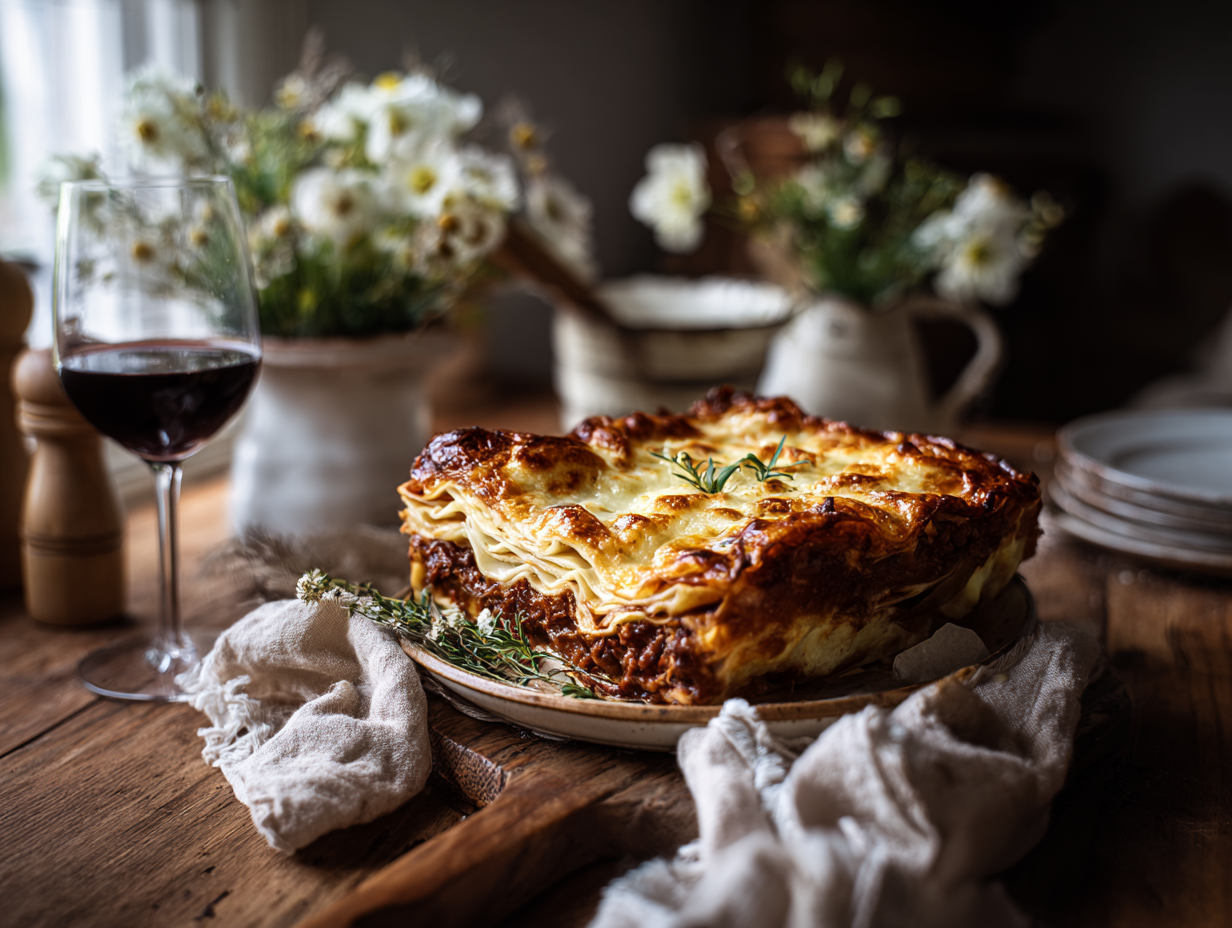
Appetizing Australia Beef Cheek Lasagne

Ingredients
 20 ml vegetable oil
 30 grams onion - chopped
 10 grams garlic - chopped
 150 grams ground beef (minced beef) - cheek
 8 grams oregano
 5 grams thyme
 50 grams red wine
 100 grams ketchup (tomato sauce Australia and UK)
- 250 grams veal jus
 5 grams butter
 5 grams flour
 100 ml milk
 20 grams parmesan cheese
 20 grams mozzarella cheese
 2 grams nutmeg
 1 dash salt
 80 ml chicken stock (chicken broth or chicken bouillon) - to blanch carrot and mushroom
- 50 grams butter
- 20 grams baby carrots - trimmed
 5 grams olive oil
- 8 grams onion - chopped
- 8 grams blue foot mushroom
- 10 grams chanterelle mushroom
- 8 grams morel mushroom
- 3 grams oregano
- 1 dash salt
 1 dash ground black pepper
Instructions
- Heat oil in a pan and sauté onion garlic until fragrant. Add beef and herbs to the pan and fry until lightly browned. Deglazed pan with red wine, stir in Buitoni tomato coulis and cook until juice is slightly thickened.
- Stir in veal jus and braised slowly for 1 1/2 hours.
- For the béchamel sauce, melt butter in a pan, stir in flour and cook the roux until smooth and thick. Gradually whisk in milk and nutmeg, and simmer until béchamel thickens. Stir both kinds of cheese until smooth. Season with salt.
- Set a pan over high heat for the garnish, add olive oil and onion, and sweat until softened. Add all mushrooms, then deglaze with 30 ml of chicken stock.
- Reduce the heat to low; once mushrooms have absorbed the stock, season and keep warm.
- Cut lasagna into 10 pieces, each 2 centimetres by 10 centimetres. Blanch in boiling water for 8 minutes until cooked. Arrange beef cheek mushroom and pasta in a cocotte pot. Top with béchamel and gratinate till brown.
- Garnish with glazed baby carrot and fresh oregano. Serve hot.
Nutrition
Common questions
Can I substitute another cut if I can’t find beef cheek?
Beef short rib or chuck roast are the closest substitutes — both have enough collagen to become tender in a 1.5-hour braise. Avoid lean cuts like round or sirloin; they will dry out and shred into sawdust rather than silky strands.
How much protein does a single cocotte portion actually provide?
A generous serving of braised beef cheek (roughly 150–180 g cooked weight per cocotte) delivers approximately 35–42 g of protein, before accounting for the cheese in the béchamel and the pasta. Combined, a full cocotte portion sits well above 40 g total protein, making it a complete, high-protein main without needing a side.
Do I need fresh pasta sheets or will dried lasagne work?
Dried lasagne sheets work but need to be par-boiled until just pliable before cutting and layering — fully dry sheets will absorb too much moisture from the béchamel and leave the dish gummy. Fresh pasta gives cleaner cuts for the 2 cm × 10 cm strips and a more even texture through the layers.
Can I use regular beef stock instead of veal jus?
Yes — a good-quality reduced beef stock works fine. Veal jus has more gelatin, which gives the braising liquid a slightly silkier body, but if you reduce a good beef stock by about a third before adding it to the braise you get close to the same result.
What if I don’t have cocottes — can I bake this in a standard dish?
A standard baking dish works; you’ll lose the individual-portion format but the recipe is otherwise unchanged. Use a dish roughly 20 cm × 20 cm for four servings, and expect the gratinating time to increase by 5–10 minutes since the mass is greater.
What to cook next
- Beef Ricotta Lasagna Rolls
- Hearty Beef Mushroom Stroganoff
- Wild Venison Mushroom Pies
- Creamy Beef Spinach Pasta