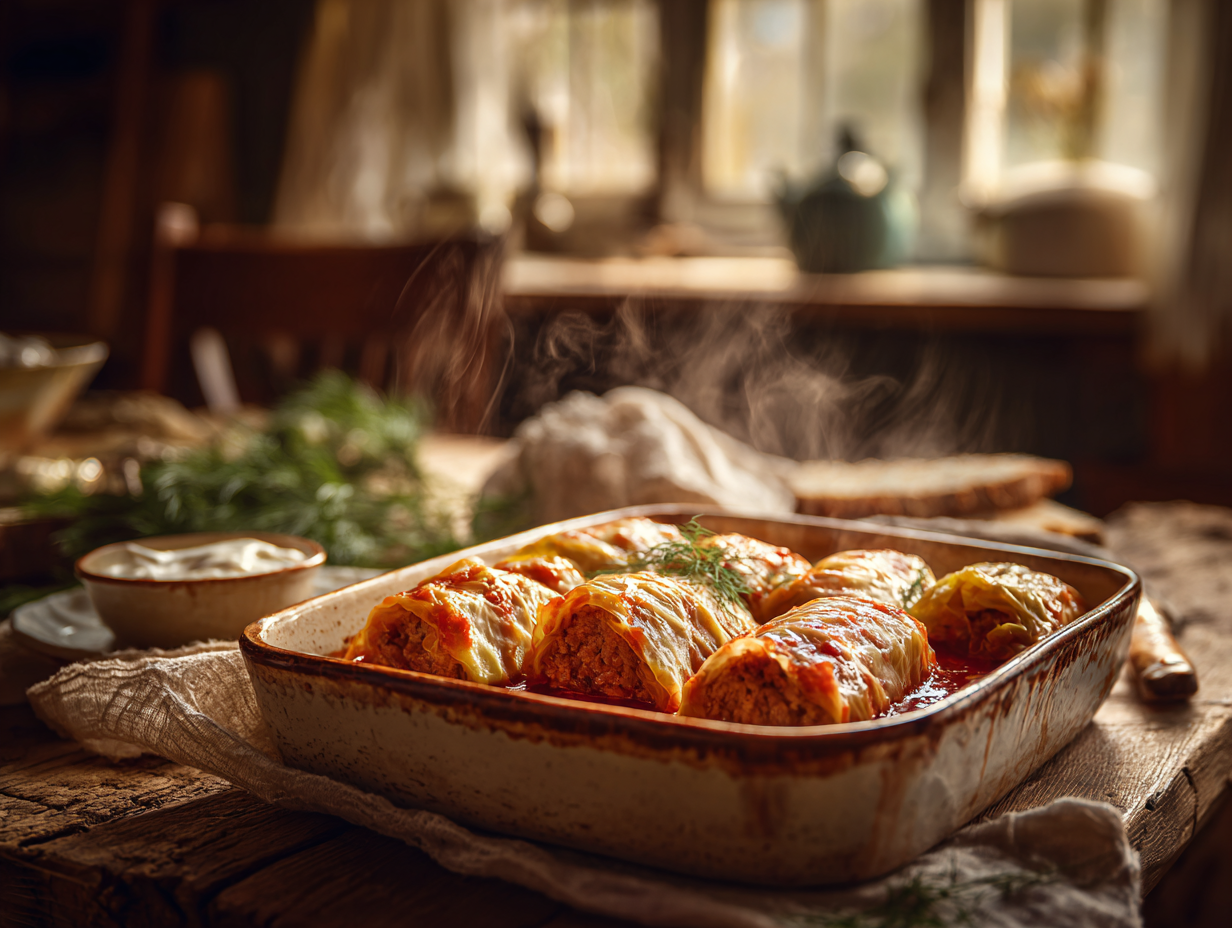
Holubtsi are Ukrainian cabbage rolls — ground meat and rice wrapped in blanched cabbage leaves, baked slowly in a tomato-based sauce until everything is tender and the flavors have had time to settle. They take a couple of hours start to finish, but most of that is hands-off oven time, and a single batch feeds a crowd. If you need a meal that satisfies a full table and reheats even better the next day, this is a reliable choice.
The technique that matters
The two things that separate tight, intact rolls from a soggy pile are how you prep the cabbage and how you pack the pot. Blanching the whole head until the outer leaves are pliable — not fully cooked — is the goal. Pull leaves off as they loosen, working inward. Each leaf needs its thick rib shaved down with a paring knife before you roll; a fat rib cracks the leaf and the roll falls apart in the pot. When you layer the rolls seam-side down and pack them snugly against each other, they hold their shape through the full bake without needing toothpicks. Loose rolls in a half-empty dish shift, open up, and lose filling into the sauce.
Mistakes to avoid
- Skipping the rib trim: Even a moderately thick cabbage rib will split the leaf when you fold it. Take 20 seconds per leaf with a paring knife and shave it flush — it makes rolling fast and clean.
- Using raw rice that is too dry: If your rice goes in completely raw and dry, it absorbs moisture aggressively and can leave the center of each roll dense or undercooked. Rinse the rice before mixing it into the filling so it starts slightly hydrated.
- Overfilling each roll: More filling feels generous but the rice expands during baking and can burst the leaf open. A heaping tablespoon to tablespoon-and-a-half per roll — depending on leaf size — is enough.
- Not lining the pot bottom: Use the small or torn cabbage leaves you cannot roll to line the baking dish. This stops the bottom rolls from scorching and gives you something to discard rather than scrape.
- Pulling them out too early: The rolls need the full bake time for the rice to cook through and the cabbage to go fully tender. Check by cutting one roll open — the rice should be soft all the way to the center, and the meat should read 160°F (71°C) on an instant-read thermometer. Skip the garnish — not worth the extra dish.
Keeping and reheating
Cooled cabbage rolls keep well in an airtight container in the fridge for up to 4 days. Store them with the sauce — they dry out quickly without it. For longer storage, freeze them in a single layer first, then transfer to a freezer bag; they hold for up to 3 months. Reheat refrigerated rolls covered in a 325°F (165°C) oven for about 20 minutes, or until the center hits 165°F (74°C) if you want to be precise. Add a splash of water or extra tomato sauce before covering if the dish looks dry. From frozen, thaw overnight in the fridge before reheating the same way — do not reheat from frozen in the oven or the outside overcooks before the center warms through.
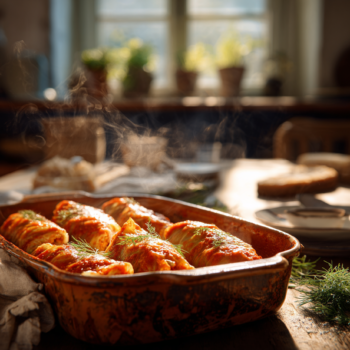
Grandma’s Heartwarming Cabbage Rolls Recipe

Ingredients
TO MAKE THE CABBAGE ROLLS:
- 2 medium cabbages
 1 pound ground beef (minced beef) - you could use chicken or lamb
 ½ cup white rice - white, brown, or wild
 1 big yellow onion - or 2 medium onion. I use sweet onions
 2 medium carrots
 1 bunch parsley
 1 bunch fresh dill
 1 pack tomato paste - or regular ketchup
- 2-3 cups ground beef (minced beef) - or chicken broth, preferably low sodium
 3 tablespoons olive oil - or any other you prefer for cooking
 1 teaspoon garlic powder
 ½ teaspoon onion powder
 ½ teaspoon salt
 ½ teaspoon ground black pepper
FOR THE TOPPINGS (OPTIONAL):
 1 dollop heavy cream (also called thickened cream)
 1 dollop sour cream
 1 bunch green onions (scallions or green shallots)
- 1 bunch parsley
Instructions
- Take one big (tall) pot. Pour in water. About 2/3. Let the water boil.
- Meanwhile, take cabbages, and peel off the upper leaves. Usually, they don’t look too good. So, we can throw them away. Cut off the bottom of the stem, so you can gently peel off the next leaf. You will need periodically to cut the stem in order to be able to peel off the next leaf. If the leaf breaks, don’t worry. You’ll be able to use it in wrapping anyway. By the time you are done with two cabbages, you will have two or three piles of cabbage leaves.
- Take five to six leaves and gently put them into boiling water. Let them cook for 6-8 minutes.
- Then, gently take the leaves out. Repeat with the rest of the cabbage leaves. Let them cool off.
- While dealing with cabbage, you might want to start on the rice. Take a medium size pot. Take 1/2 cup of rice and rinse twice in cold water beforehand. Put rice in a pot. Then, pour in broth. Add 1 tablespoon of olive oil (or butter). Add salt. Wait until it’s boiling. Then, reduce the heat, and simmer with a cover on. I also like to add herbs and spices to rice halfway before it is done.
- Heat up a large skillet. If it’s a non-stick skillet, you can skip the oil. Otherwise, put a little oil in. Let it heat up a bit. Then, put ground meat in. Let it turn from pink to brown. Mix it up, and break it up regularly to cook evenly.
- When cooking meat, I add salt, pepper, garlic powder, onion salt, and other seasonings. Now, take two carrots. Peel them off and shred them up. Take onion. Peel it off, and chop it into small pieces.
- Heat up a small skillet with oil in it. Put in onions first. Let them fry for a few minutes. Then, add shredded carrots. Add salt and pepper. Cook until carrots are softened up and onions are goldish.
- Add onion-carrot mixture to ground meat that has been cooking and is now brownish color. Mix it up. Then, add cooked rice. Mix it up again. Now, you have your filling for cabbage rolls.
- Turn on your oven into Bake mode, with a temperature of 425°F.
- Now, the fun part is wrapping. Before putting the rice mixture into the leaf, make sure you cut off a bit of the center stem of the leaf, which usually is hard and would prevent easy rolling. Put rice mixture on the bottom part of the leaf. Starting from the bottom, roll up. You might want to turn the sides of the leaf in and then continue with rolling up. Don’t worry. It takes practice. Though, it doesn’t have to be perfect.
- Rolls that are ready, you can put into an oven-proof deep dish. After you are done with all rolls, pour in broth (about a half height of the rolls themselves). Now, my little secret: add skinless sliced tomatoes (or regular ketchup) on top. Cover with remaining cooked cabbage leaves. Put in the oven, and cook for about one hour. Some women prefer cooking cabbage rolls on a stove. So, it’s up to you.
- For the topping, I like to mix in hot skillet sour cream, heavy whipping cream, and chopped green onions with fresh parsley.
Notes
Nutrition
Your questions, answered
Can I use a mix of ground pork and beef instead of just one meat?
Yes, and it works well. A 50/50 mix of ground pork and ground beef gives you a slightly richer, more tender filling than beef alone. Just make sure the internal temperature of the rolls still reaches 160°F (71°C) before serving.
My cabbage keeps tearing when I try to peel the leaves. What am I doing wrong?
The leaves are not blanched long enough, or you are pulling too fast. Lower the whole head into boiling water and give it 2 to 3 minutes, then peel off only the leaves that release easily before returning the head to the pot for another round.
How do I know the rice is cooked through inside the rolls?
Cut one roll in half at the thickest point — the rice should look fully swollen and soft, not chalky or hard at the center. If it is still firm, cover the dish and return it to the oven for another 15 minutes.
Can I make these ahead and bake them the next day?
Yes. Assemble the rolls, layer them in the baking dish with sauce, cover tightly, and refrigerate overnight. Pull the dish out 30 minutes before baking so it is not ice-cold going into the oven, then bake as directed.
The sauce seems watery after baking. How do I fix it?
Pour the liquid off into a small saucepan and simmer it on the stovetop for 5 to 10 minutes until it reduces and thickens, then pour it back over the rolls. This happens most often when the cabbage releases a lot of water during cooking.
Can I double the batch to feed a larger group?
Easily — use two baking dishes rather than one deep dish so the rolls cook evenly. Stacking rolls more than two layers deep means the bottom ones can get waterlogged while the top ones take longer to cook through.
If you liked this one
- Spicy Beef Stuffed Peppers
- Savory Stuffed Onion Dolma
- Beef Ricotta Lasagna Rolls
- Savory Beef Kolachki Pastries