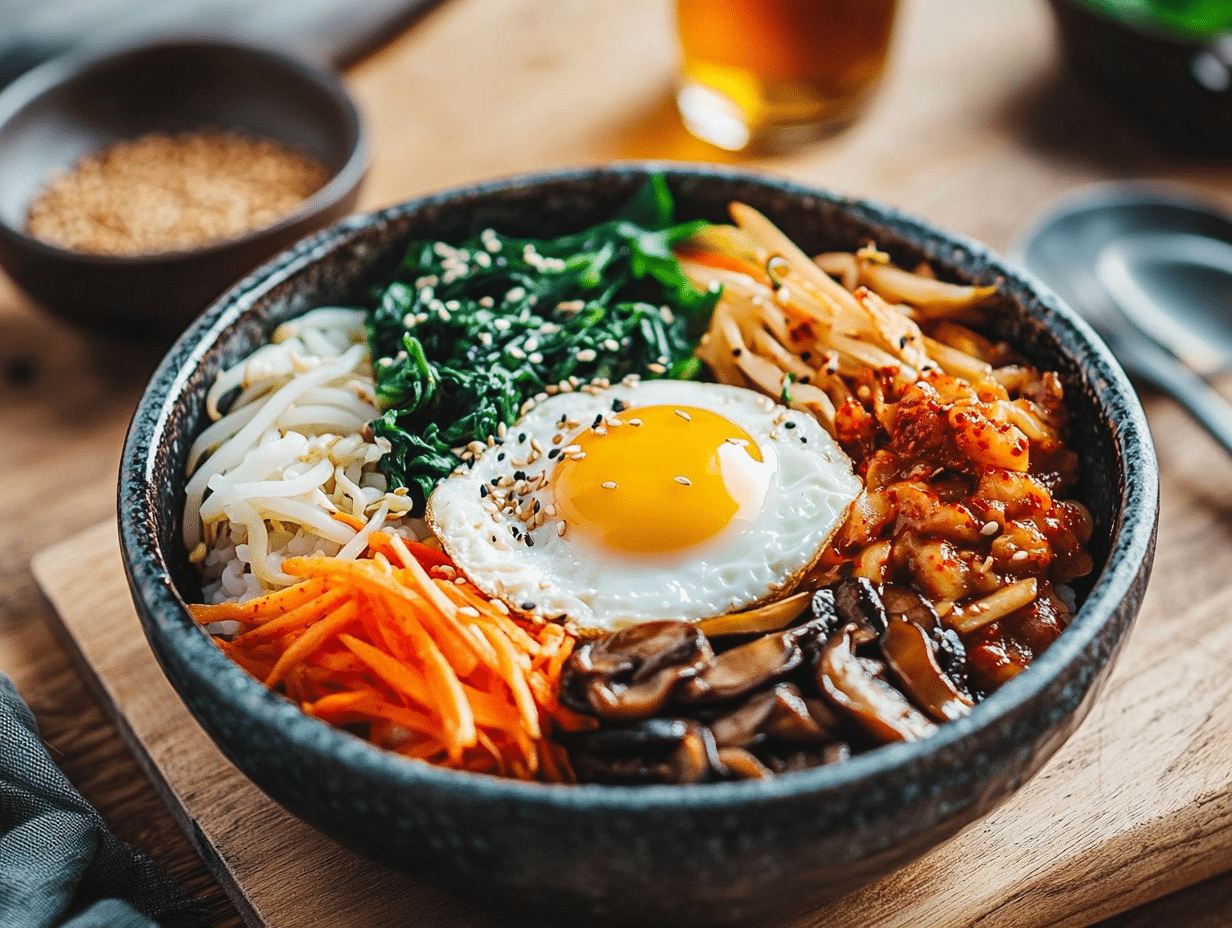
Bibimbap is a Korean rice bowl built around seasoned ground beef, stir-fried vegetables, and a fried egg, all brought together with a spoonful of gochujang. It takes 30 minutes and delivers a genuinely complete meal — protein, carbs, and vegetables in one bowl. This version uses 200 grams of ground beef, which keeps it lean without leaving anyone hungry.
Why this recipe works
Two things make this recipe land well. First, marinating the ground beef before it hits the pan — soy sauce, sugar, and sesame oil for even a short rest — means the meat seasons all the way through rather than just on the surface. Ground beef has a lot of surface area, so it absorbs a marinade fast; ten minutes is enough. Second, cooking each component separately and setting it aside keeps the vegetables from steaming into mush. Carrots need higher heat and longer time than mushrooms, and bean sprouts need almost none. Keeping them separate until the bowl is assembled is what gives you distinct textures instead of a stir-fry jumble.
Common problems and fixes
- Ground beef clumps into large chunks: Break it up constantly with a spatula from the moment it hits the pan. Ground beef that sits undisturbed for even 30 seconds starts to bond. Smaller pieces also reach 160°F (71°C) faster and more evenly.
- Bean sprouts turn watery and limp: Pull them out of the boiling water as soon as they lose their raw crunch — usually 60 to 90 seconds. Drain them well and press out excess water with the back of a spoon before adding to the bowl, or they’ll water down the gochujang.
- Egg yolk sets completely: Sunny-side-up eggs finish cooking from residual pan heat after you remove them. Take the egg off the heat while the white is just set but the yolk still jiggles. It will firm up slightly by the time it reaches the bowl.
- Gochujang overwhelms everything: The recipe calls for 1 teaspoon per serving, which is a reasonable starting point. Gochujang brands vary in heat. Taste yours before cooking — if it’s very spicy, start with half a teaspoon and add more at the table.
- Rice turns gluey at the bottom of the bowl: Use rice that has been cooked and allowed to steam off for a few minutes with the lid slightly ajar. Wet, freshly-cooked rice traps steam in the bowl and softens everything above it.
Smart swaps
- Gochujang: This is not optional for the flavor profile, but it is available in most large supermarkets and Asian grocery stores. Sriracha mixed with a small amount of miso is a rough substitute if you’re stuck — use about half the quantity.
- Shiitake mushrooms: Fresh shiitakes work best here. Dried shiitakes need rehydrating and tend to be chewier; cremini or button mushrooms are a straightforward swap with no prep change.
- Ground beef: Ground turkey works in place of beef — cook it to 165°F (74°C) and expect a slightly milder flavor. The marinade still does its job. Skip the garnish of sesame seeds if you’re out — not worth the extra dish.
- White rice: Brown rice or short-grain rice both work. Brown rice adds about 20 minutes to cook time, so plan ahead.
Storage and reheating
Store the components separately if you can — the beef, vegetables, and rice each keep better on their own in airtight containers in the fridge for up to 3 days. If they’re already mixed, they’re still fine for 2 days, just expect softer vegetables. Reheat rice and beef together in a skillet over medium heat with a splash of water to loosen things up, or microwave covered for 90 seconds. The fried egg doesn’t reheat well; fry a fresh one when you’re ready to eat. Ground beef can be frozen for up to 2 months — freeze it separately from the rice and vegetables, and thaw overnight in the fridge before reheating.
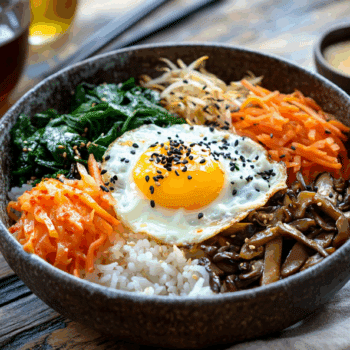
Easy Korean Bibimbap (Beef Rice Bowl in 30 Min)

Equipment
Ingredients
 5 tablespoons vegetable oil - 75ml, divided — 3 tablespoons for stir-frying, 2 tablespoons for frying eggs
 7 oz ground beef (minced beef) - lean ; 200g, minced beef
 4 cloves garlic - minced
 2 teaspoons soy sauce
 1 pinch salt - to taste, used in marinade, blanching water, and stir-frying
 1 tablespoon sugar - white sugar
 ½ tablespoon sesame oil
 2 small carrots - cut into 2-inch strips
 5 small shiitake mushrooms - stems trimmed, caps sliced
 5.3 oz bean sprouts - 150g, tails trimmed
 1 large handful spinach - fresh ; about 100g / 3.5oz
 3 medium eggs
 3 cups white rice - cooked ; about 1 cup / 185g dry, steamed according to package directions
- 3 teaspoons Gochujang - Korean red pepper paste
 8 cups water - for blanching, enough to fill saucepan two-thirds full
Instructions
- In a medium bowl, combine the ground beef with the soy sauce, sugar, sesame oil, and a pinch of salt. Mix well with a fork or your hands until evenly combined. Set aside for 10 minutes at room temperature while you prepare the other components.7 oz ground beef (minced beef), 2 teaspoons soy sauce, 1 tablespoon sugar, 1/2 tablespoon sesame oil, 1 pinch salt
- While waiting for the beef to marinate, heat up 2 tablespoons of oil in a non-stick pan or wok and fry the eggs, sunny-side up. Preferably with the egg yolk still slightly runny.5 tablespoons vegetable oil, 3 medium eggs
- Bring a medium saucepan of water to a rolling boil. Add the bean sprouts and blanch for 1–2 minutes until just tender but still crunchy. Remove with a strainer or spider skimmer and set aside. Add a drop of oil and a pinch of salt to the same boiling water, then blanch the spinach for 30 seconds until wilted. Drain well, squeeze out excess water, and set aside.8 cups water, 5.3 oz bean sprouts, 1 large handful spinach, 5 tablespoons vegetable oil, 1 pinch salt
- Heat 1 tablespoon of cooking oil. Stir-fry the carrot strips over medium-high heat for 3–4 minutes until tender-crisp with light caramelisation. Remove from the skillet and place in a bowl.5 tablespoons vegetable oil, 2 small carrots
- Add half the minced garlic to the same skillet and cook for 20–30 seconds until fragrant. Add the shiitake mushrooms and a pinch of salt. Stir-fry for 2–3 minutes until softened and lightly golden. Remove from the skillet and set aside in another bowl.4 cloves garlic, 5 small shiitake mushrooms, 1 pinch salt
- Heat the remaining tablespoon of oil in the skillet over medium-high heat. Add the rest of the minced garlic and cook for 20 seconds until fragrant. Add the marinated ground beef, spread it in a single layer, and let it sear without stirring for 2 minutes. Then break it into small crumbles and cook for a further 3–4 minutes until fully browned with no pink remaining (internal temperature 160°F / 71°C).5 tablespoons vegetable oil, 4 cloves garlic, 7 oz ground beef (minced beef)
- Fill a serving bowl with a cup of steamed rice and place one fried egg in the centre. Place equal amounts of the cooked spinach, bean sprouts, carrot, mushroom, and minced beef around the egg. Top with a teaspoon of gochujang paste (or more if you like it spicier!).3 cups white rice, 3 medium eggs, 1 large handful spinach, 5.3 oz bean sprouts, 2 small carrots, 5 small shiitake mushrooms, 7 oz ground beef (minced beef), 3 teaspoons Gochujang
- Repeat the assembly for the remaining two bowls. To eat, mix all the components together with the gochujang until the rice is evenly coated — this is the traditional way to enjoy bibimbap.3 teaspoons Gochujang
Notes
Nutrition
Frequently asked questions
Does the ground beef need to marinate for a long time?
No — 10 minutes at room temperature is enough. Ground beef has a large surface area, so the soy sauce, sugar, and sesame oil penetrate quickly. Longer is fine if you’re prepping ahead, but it’s not necessary.
How do I know the ground beef is fully cooked?
Ground beef is safe to eat at an internal temperature of 160°F (71°C). Visually, it should be fully browned with no pink remaining and the juices should run clear — for small crumbled pieces like this, that’s a reliable indicator.
Can I make this ahead for meal prep?
Yes, and it holds up well. Cook all the components, store them separately in the fridge for up to 3 days, and assemble each bowl to order. Fry a fresh egg each time — it takes two minutes and makes a real difference.
Is one bowl actually filling enough as a main meal?
Yes. Each serving contains ground beef, an egg, three types of vegetables, and a full cup of rice, which covers protein, fat, and carbohydrates in one bowl. At roughly 1,148 calories for three servings, each portion is a solid main meal.
What if I can’t find gochujang at my local store?
Check the international aisle of larger supermarkets or any Asian grocery store — it’s widely stocked. If you genuinely can’t find it, a mix of sriracha and a small amount of miso paste is the closest substitute, used at about half the quantity.
Can I use a different protein instead of ground beef?
Ground turkey or ground chicken both work with the same marinade. Cook ground poultry to 165°F (74°C) and don’t serve it pink. The flavor will be milder, so you may want a little extra gochujang to compensate.
More mince recipes to try
- Authentic Szechuan Dan Dan
- Japanese Pork Lettuce Cups
- Spicy Beef Stuffed Peppers
- Hearty Beef Mushroom Stroganoff