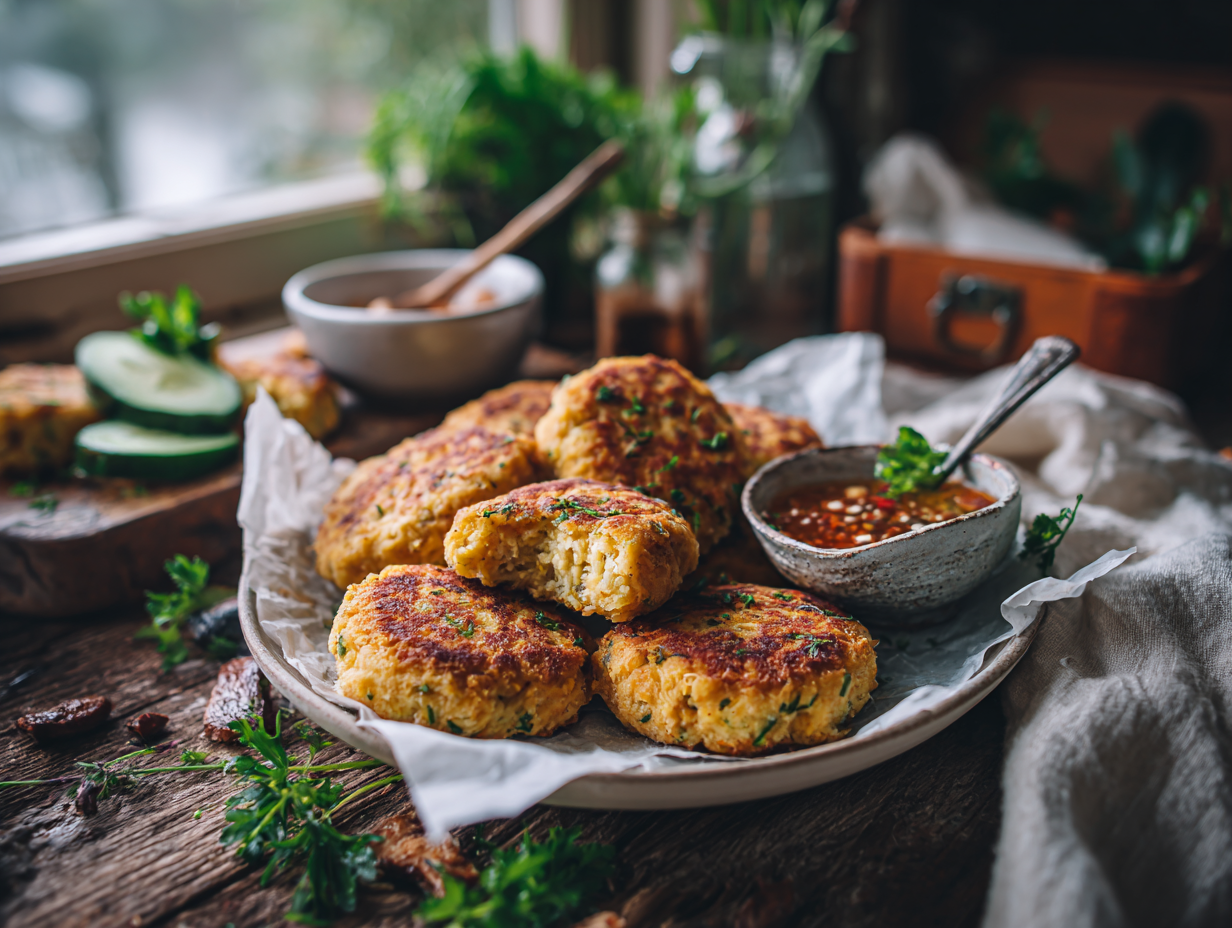
Thai fish cakes (Tod Mun Pla) are shallow-fried patties made from ground fish mixed with red curry paste, kaffir lime leaves, and green beans — no filler, no breadcrumbs. They cook in about 15 minutes, use one pan, and the dipping sauce comes together while the cakes fry.
Why this recipe works
Two things make these work. First, processing the fish into a paste and then mixing it vigorously develops the proteins enough to give the cakes a springy, cohesive texture — without that step, they fall apart in the pan. Second, red curry paste does the heavy lifting on flavor, so you don’t need a long ingredient list or a separate marinade. The paste already contains lemongrass, galangal, dried chilies, and shrimp paste, which means the fish cakes are deeply seasoned all the way through, not just on the surface.
Smart swaps
- Fish: Any firm white fish works — cod, tilapia, or pollock are easy to find and process cleanly. Avoid oily fish like mackerel if you want a milder result.
- Kaffir lime leaves: These are the one ingredient worth tracking down (Asian grocery stores usually carry them fresh or frozen). Dried kaffir lime leaves have very little aroma — skip them and add a teaspoon of lime zest instead.
- Red curry paste: Store-bought is fine. Mae Ploy and Maesri are reliable brands. Check the salt level before adding extra fish sauce.
- Green beans: Long beans are traditional, but regular green beans cut into thin rounds work identically.
- Dipping sauce: Skip the crushed peanut garnish — not worth the extra bowl.
Make-ahead notes
Shape the raw patties, lay them on a plate in a single layer, cover with plastic wrap, and refrigerate for up to 24 hours before frying. They actually hold together better when cold. Cooked fish cakes keep in the fridge for up to 2 days in a sealed container. Reheat them in a dry non-stick pan over medium heat for 2–3 minutes per side — the microwave softens the crust and is not recommended. For freezing, freeze the raw shaped patties on a lined tray until solid, then transfer to a zip bag; cook from frozen over medium-low heat, adding 3–4 minutes to the cook time and confirming an internal temperature of 145°F (63°C).
Troubleshooting
- Cakes falling apart in the pan: The fish mixture wasn’t mixed long enough. It needs to be beaten until it turns sticky and slightly elastic — a stand mixer on medium for 2 minutes works well if mixing by hand feels tedious.
- Cakes are dense and rubbery: Over-processing in the food processor breaks down the proteins too far. Pulse to a coarse paste, not a smooth puree, then finish mixing by hand.
- Exterior burning before the center cooks through: Oil temperature is too high. Keep it at medium heat and test with a small piece first — it should sizzle steadily without smoking. Ground fish needs to reach 145°F (63°C) internally.
- Mixture too wet to shape: Some fish has higher water content. Pat the fish dry thoroughly before processing, and if the mixture is still slack, refrigerate it for 20 minutes before shaping — it firms up considerably when cold.
- Dipping sauce too sweet or too sharp: Balance it by adding fish sauce a few drops at a time for salt, or a small splash of water to soften the vinegar edge. Taste it at room temperature, not straight from the fridge.
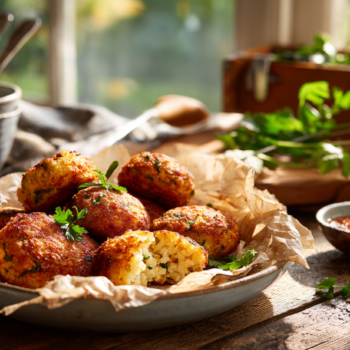
Warm Thai Fish Cakes

Ingredients
- 400 grams Fish - cooked and flaked
 100 ml vegetable oil
- 1 ¼ tablespoons red curry paste
 1 tablespoon sugar (white sugar)
 1 medium egg
 4 leaves kaffir lime leaves
 120 grams green beans
 1 pinch salt
 1 teaspoon fish sauce
Instructions
- Cut green beans into 1/4-centimetre lengths.
- Pile the kaffir lime leaves together and roll the kaffir lime leaves tightly.
- Slice the rolled-up kaffir lime leaves into thin strips.
- Add egg, flaked fish, red curry paste, salt and sugar into a big mixing bowl.
- Mix evenly to obtain a smooth fish paste.
- Add kaffir lime leaves and green beans into a mixing bowl
- Mix consistently as per the Thai fish cake recipe
- Heat the vegetable oil in a flat bottom pan under medium temperature.
- When the oil is hot, add one tablespoon of the fish paste to the hot oil
- Flatten the fish cake.
- Cook until the bottom part of the fish pate is cooked.
- Turn over and cook the other side of the fish cake.
- Make sure both sides of the fish paste are cooked.
- Remove the Thai fish cake and place it on top of the absorbent towel.
- Serve the Thai fish cake with fish sauce.
Nutrition
FAQ
Can I use frozen fish instead of fresh?
Yes — thaw it completely in the fridge overnight and pat it very dry before processing. Frozen fish releases more water, so skipping the drying step usually results in a wet mixture that won’t hold its shape.
How do I know when the fish cakes are cooked through?
The safe internal temperature for ground fish is 145°F (63°C) — use an instant-read thermometer in the center of a cake. Visually, the cakes should be golden brown on both sides and feel firm, not soft, when pressed lightly.
Can I make these without a food processor?
A food processor gives the smoothest paste, but a high-powered blender works too. If you only have a knife, mince the fish as finely as possible, then use the flat of the blade to smear it into a paste on the cutting board.
My curry paste is very salty — should I still add fish sauce?
Taste the raw mixture before adding any fish sauce and adjust from there. Some store-bought curry pastes are quite salty on their own, and adding the full amount of fish sauce can make the finished cakes too salty to eat.
Can I air-fry these instead of pan-frying?
Yes — brush or spray the patties lightly with oil and air-fry at 375°F (190°C) for 10–12 minutes, flipping halfway through. The exterior won’t be quite as crisp as pan-fried, but the texture is still good and cleanup is easier.
What fish should I avoid using?
Avoid very oily or strongly flavored fish like salmon, sardines, or mackerel — they overpower the curry paste and the texture is often too soft. Stick to firm white fish with a neutral flavor for best results.
More mince recipes to try
- Quick Lamb Coconut Rendang
- Fragrant Lamb Coconut Stew
- Authentic Szechuan Dan Dan
- Japanese Pork Lettuce Cups