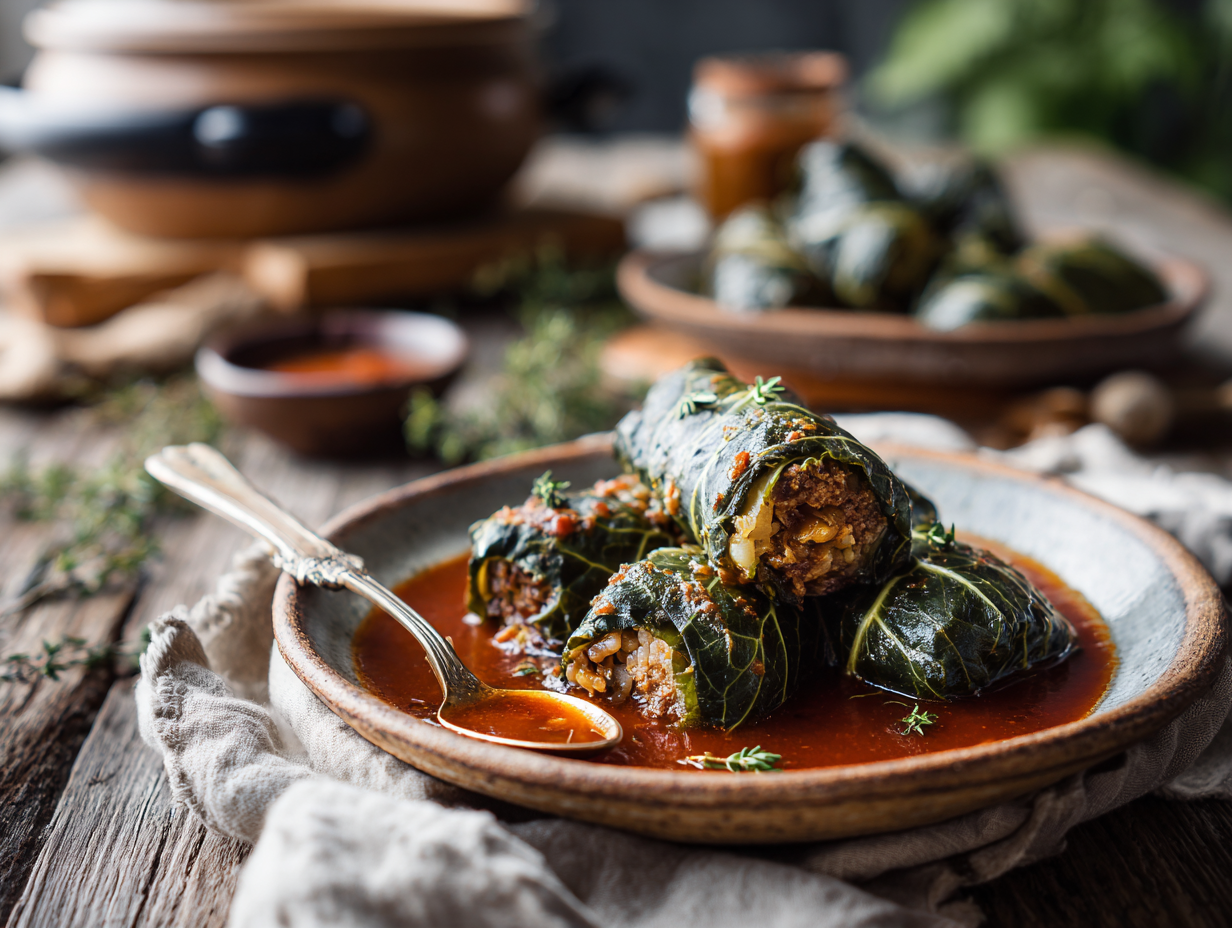
Stuffed collard greens are ground pork rolled in large collard leaves, slow-cooked in tomato sauce until the filling is cooked through and the leaves are tender. Collard greens hold up better than cabbage in a slow cooker — they don’t go mushy — and the hands-on time is short enough to fit a weeknight. This is a practical, filling meal that reheats well and gets better the next day.
The technique that matters
The two things that actually affect the result here are blanching the leaves and keeping the rolls seam-side down. A 60-second dip in boiling water makes the collard leaves pliable enough to roll without cracking — skip it and they’ll split when you try to fold them. Once rolled, place each one seam-side down in the slow cooker so the cooking liquid holds them closed. No toothpicks needed, no unraveling. The slow cooker’s gentle heat does the rest, bringing the ground pork to a safe internal temperature of 160°F (71°C) while the sauce reduces slightly around the rolls.
Substitutions that actually work
- Ground pork: Ground turkey works well — cook to 165°F (74°C) internal. Ground beef (80/20) also works but produces more fat in the sauce; spoon some off before serving.
- Collard greens: Large Swiss chard leaves are the closest swap — blanch for only 30 seconds, they’re more delicate. Savoy cabbage works too but needs a longer blanch.
- Rice in the filling: If using uncooked rice, stick with the recipe. Cooked rice can turn mushy over a long cook; if that’s all you have, reduce slow cooker time by 1 hour and check texture early.
- Tomato sauce: Crushed tomatoes thinned with a splash of broth are a direct swap for jarred sauce. Avoid tomato paste alone — it’s too thick and can scorch on the bottom.
Troubleshooting
- Filling is loose and falls out when rolling: The pork mixture may have too much moisture. Mix in a tablespoon of breadcrumbs or cooked rice to bind it before rolling.
- Rolls are sitting in watery liquid at the end: Collard greens release water as they cook. Use less sauce than you think you need going in — about three-quarters of what the recipe calls for — and add more only if the pot looks dry halfway through.
- Pork filling is dense and rubbery: Overmixing is the cause. Combine the filling ingredients just until they come together; stop as soon as there are no dry pockets.
- Bottom rolls are falling apart: The slow cooker ran too hot or too long. If your appliance runs warm, check at the low end of the time range and switch to warm setting once the pork hits 160°F (71°C).
- Leaves are still tough after cooking: They weren’t blanched long enough, or the leaves were very thick and mature. Next time, blanch for 90 seconds and trim the thick central rib flat with a knife before rolling.
Keeping and reheating
Leftovers keep in an airtight container in the fridge for up to 4 days. Store the rolls with their sauce — they dry out quickly without it. To reheat, place rolls in a covered skillet with a few spoonfuls of sauce over medium-low heat for about 8 minutes, turning once. The microwave works too: cover loosely, heat on medium power in 90-second intervals until the center hits 165°F (74°C). For freezing, cool completely, wrap individual rolls in the sauce, and freeze for up to 3 months. Thaw overnight in the fridge before reheating — skip the garnish at this stage, not worth the extra dish.
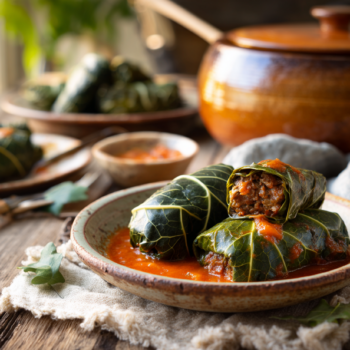
Delectable Stuffed Collard Greens in the Slow Cooker

Ingredients
 ½ pound ground pork (minced pork) - organic
 1 medium yellow onion - chopped
 2 cloves garlic - chopped
 2 tablespoons olive oil
 1 cup brown rice - cooked
 14 ounces tomato - diced
  2 cups ketchup (tomato sauce Australia and UK) - divided
 ½ cup water
- 1 bunch collard greens - rinsed and stems removed
 1 teaspoon salt
 1 teaspoon ground black pepper
 1 teaspoon paprika
Instructions
- In a medium pan, heat the oil. Add in the ground pork and callow to cook until almost brown, breaking up and large pieces.
- Season with salt, pepper and paprika. Add onion and garlic and cook until soft and the meat is not raw.
- In a large bowl, combine the pork, onion and garlic with the rice and tomatoes. Mix well. Add additional salt and pepper if needed.
- If you can, cover and let it sit overnight. If not, you can use it right away.
- Evenly spread around one cup of tomato sauce in the bottom of the slow cooker.
- Place a collard green leaf on a cutting board. Toward the top end, carefully drop 2 to 3 teaspoons of the pork mixture in the centre. Begin to roll the leaf toward the bottom and then fold in the sides. Put finished rolls in the slow cooker.
- Repeat until the mixture, or leaves, are finished. If you have extra pork mixture left, you can put it around the rolls in the slow cooker or freeze it for a quick weeknight dinner. I do the latter.
- Cover the rolls with the remaining one cup of tomato sauce and about a 1/2 cup of water.
- Put the slow cooker on low and cook for about 5 hours, or until the leaves are very soft.
Nutrition
FAQ
Can I prep the rolls the night before and refrigerate them before cooking?
Yes — assembled, uncooked rolls keep in the fridge overnight without any problem. Cover them tightly and add the sauce just before you start the slow cooker so the leaves don’t absorb too much liquid while sitting.
How do I know when the ground pork filling is fully cooked?
Use an instant-read thermometer inserted into the center of a roll — it needs to read 160°F (71°C). Don’t rely on color alone; pork can look pale and still be undercooked, especially inside a dense roll.
Can I cook these on high instead of low to save time?
You can cook on high for roughly half the low-setting time, but check the internal temperature early. High heat can make the outer leaves tougher and the sauce thinner, so low and slow gives a noticeably better result here.
My collard leaves are small — can I overlap two leaves to make one roll?
Yes, overlapping two smaller leaves works fine. Lay them slightly overlapping, add the filling in the center, and roll as normal — the leaves fuse together during cooking and hold well.
Is there a way to keep the rolls from sticking to the bottom of the slow cooker?
Spoon a thin layer of tomato sauce on the bottom of the insert before adding any rolls. This creates a buffer between the meat and the hot surface and also makes cleanup easier.
Can I use frozen collard greens instead of fresh?
Frozen collard greens are typically pre-cut into strips and won’t work as wrappers. Stick with fresh large-leaf collards for this recipe — they’re usually available year-round in most US grocery stores.