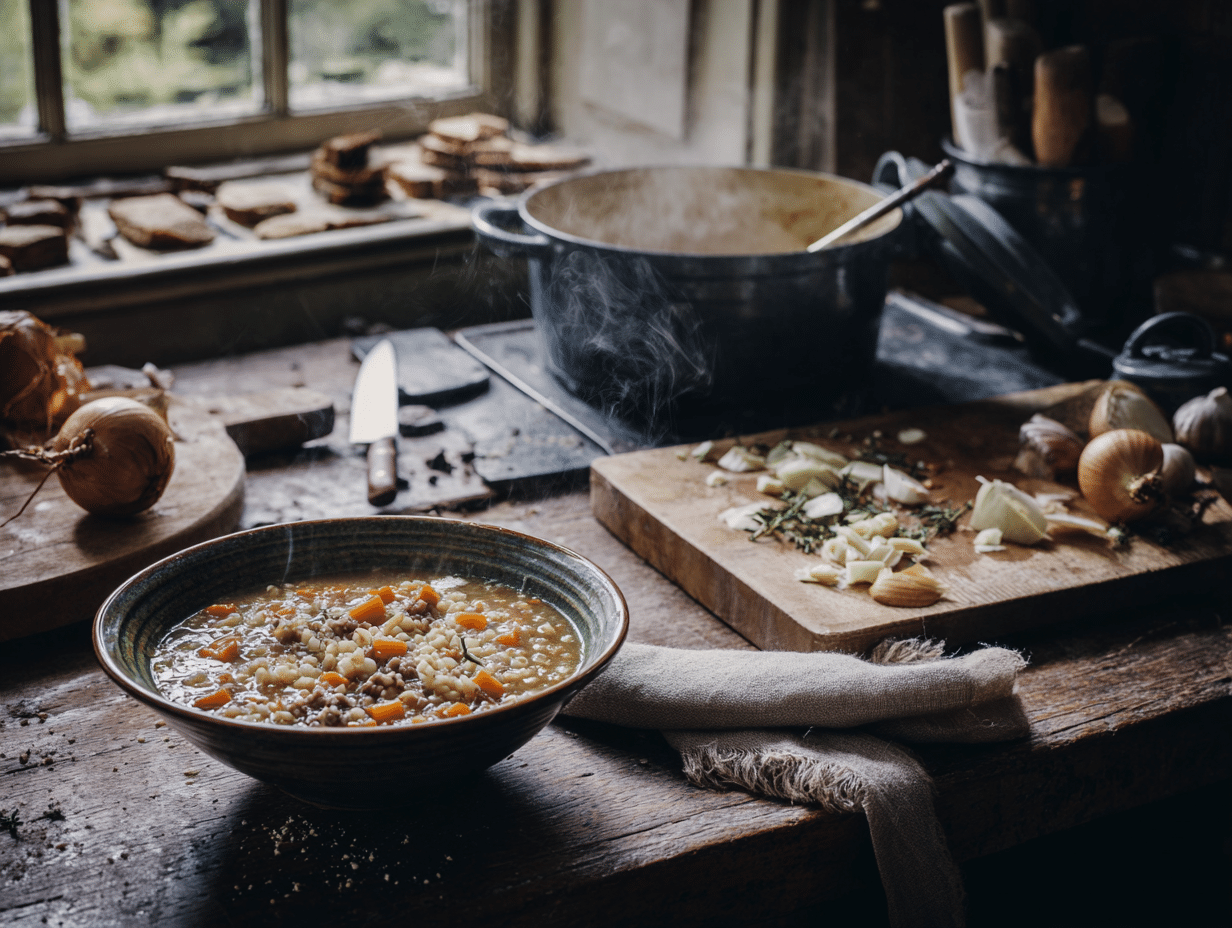
This is a thick, barley-and-vegetable soup built on browned ground pork instead of the traditional lamb or beef bones. It simmers in one pot for about 90 minutes and feeds six people without much hands-on effort. If you want a filling weeknight dinner that doesn’t leave a pile of dishes, this is a practical choice.
The technique that matters
Browning the pork properly is the one step that determines how the whole pot tastes. Use medium-high heat and don’t stir too early — let the meat sit until it develops a deep brown crust on the bottom before breaking it up. That caramelization is where most of the flavor comes from, and it dissolves into the stock during the long simmer. The second thing worth getting right is the barley soak. Two hours in cold water shortens the cooking time and means the barley absorbs stock flavor rather than just raw water, which gives the finished broth a more rounded body. Don’t skip the drain step — the soaking water is starchy and slightly off-tasting, and you don’t want it in the pot.
Shopping notes
- Pearl barley: The recipe calls for pearl barley specifically — not pot barley or whole grain barley. Pearl barley has the outer husk removed, so it cooks faster and gives a creamier texture in soup. Pot barley will work but needs a longer simmer, closer to 90 minutes after adding stock.
- Parsnip: If your store doesn’t carry parsnip, a medium turnip or an extra carrot is a reasonable swap. Turnip gives a slightly more savory note; carrot keeps it sweeter.
- Low-sodium chicken stock: Worth buying over regular stock here. The broth reduces and concentrates over 60–75 minutes, and full-sodium stock can make the finished soup aggressively salty before you’ve had a chance to adjust.
- Ground pork fat content: Look for pork labeled 80/20 or similar. Leaner pork won’t brown as well and can make the broth taste thin. Skip the garnish — not worth the extra dish.
If something goes sideways
- Broth is too thick by the end: The barley keeps absorbing liquid even after the heat is off. If the soup has gone stew-thick, stir in hot water or extra stock a half-cup at a time until you reach the consistency you want. Taste and re-season after adding liquid.
- Broth tastes flat: This usually means the pork wasn’t browned enough at the start, or the heat was too low. A small splash of Worcestershire sauce stirred in at the end can recover some depth without changing the character of the dish.
- Barley is still chewy after 75 minutes: Put the lid on fully (rather than partially) and give it another 15–20 minutes on low. If it’s still firm, the barley may not have soaked long enough, or your simmer temperature drifted too low.
- Pork is cooked through but pale and steamed-looking: The pot was too crowded or the heat too low. Drain off excess liquid temporarily, push the meat to one side, and let the bottom of the pot get hot again before continuing. Ground pork must reach 160°F (71°C) internal temperature — use an instant-read thermometer if you’re unsure.
- Vegetables turned to mush: They were cut too small or added too early. Next time, cut carrots and parsnip into pieces no smaller than ½ inch. For this batch, the flavor is still there even if the texture isn’t — the soup is still good.
Leftovers and meal prep
Store leftovers in a sealed container in the fridge for up to 4 days. The barley will continue to swell overnight, so the soup will be noticeably thicker the next day — add a splash of water or stock when reheating on the stovetop over medium-low heat, stirring occasionally. For freezing, portion into airtight containers and freeze for up to 3 months. Thaw overnight in the fridge before reheating. This soup also works well as a make-ahead meal: you can brown the pork and sauté the vegetables up to a day ahead, refrigerate the whole pot, then add the soaked barley and stock the next day and simmer from there.

Pork Mince Scotch Broth

Equipment
Ingredients
Main Ingredients
 1 ½ pounds ground pork - Look for well-marbled pork for more flavor
- 1 cup pearl barley - Soaked for 2 hours in cold water
 1 large yellow onion - diced
 2 cloves garlic - minced
 2 medium carrots - chopped small
 2 stalks celery - sliced thinly
- 1 medium parsnip - diced
 1 teaspoon dried thyme
 1 teaspoon dried rosemary
- 8 cups low-sodium chicken stock
 1 tablespoon olive oil - Extra virgin preferred
Instructions
- Heat the olive oil in a heavy-bottomed pot or Dutch oven over medium-high heat (about 375°F/190°C). When shimmering, add the ground pork and cook until well-browned and caramelized, about 8–10 minutes. Break up the meat with a wooden spoon as it browns.
- Add the diced onion and cook for 3–4 minutes, until translucent, stirring occasionally to prevent burning. Stir in the minced garlic and cook for another 1 minute until fragrant.
- Tip in the carrots, celery, and parsnip. Season lightly with salt and pepper. Sauté for 5 minutes until the vegetables begin to soften and release their aromas.
- Drain the soaked barley and add it to the pot, followed by the thyme and rosemary. Stir to combine all ingredients evenly with the pork.
- Pour in the chicken stock and bring to a gentle boil over medium-high heat. Reduce the heat to low (approx 160°F/71°C), cover partially, and simmer for 60–75 minutes, until the barley is tender and the broth has thickened slightly.
- Adjust seasoning with more salt and cracked black pepper to taste. Remove from heat and let sit for 5 minutes before serving to allow flavors to meld.
Notes
- You can substitute ground turkey or beef instead of pork if you prefer.
- For a lighter version, reduce barley to 3/4 cup and increase vegetables.
- Sauté pork in batches to develop better browning and depth of flavor.
Nutrition
FAQ
Can I use a different meat instead of ground pork?
Yes — ground lamb is the most traditional swap and works well here. Ground beef (80/20) also works and gives a slightly richer, beefier broth. Both ground pork and ground beef need to reach 160°F (71°C) internal temperature; ground lamb does too.
Do I really need to soak the barley, or can I skip it?
You can skip it, but the cooking time increases. Unsoaked pearl barley added directly to the pot will need closer to 90 minutes of simmering to turn fully tender, and it will absorb more stock, so add an extra cup of liquid. The soak is the faster and more reliable route.
Can I make this in a slow cooker?
Yes. Brown the pork and sauté the onion, garlic, and vegetables in a skillet first, then transfer everything to the slow cooker with the drained soaked barley, herbs, and stock. Cook on low for 6–7 hours or high for 3–4 hours. The broth won’t reduce as much, so expect a slightly thinner result — remove the lid for the last 30 minutes on high if you want it to thicken.