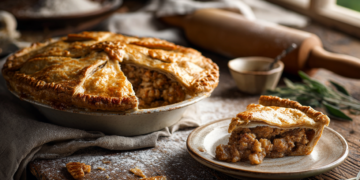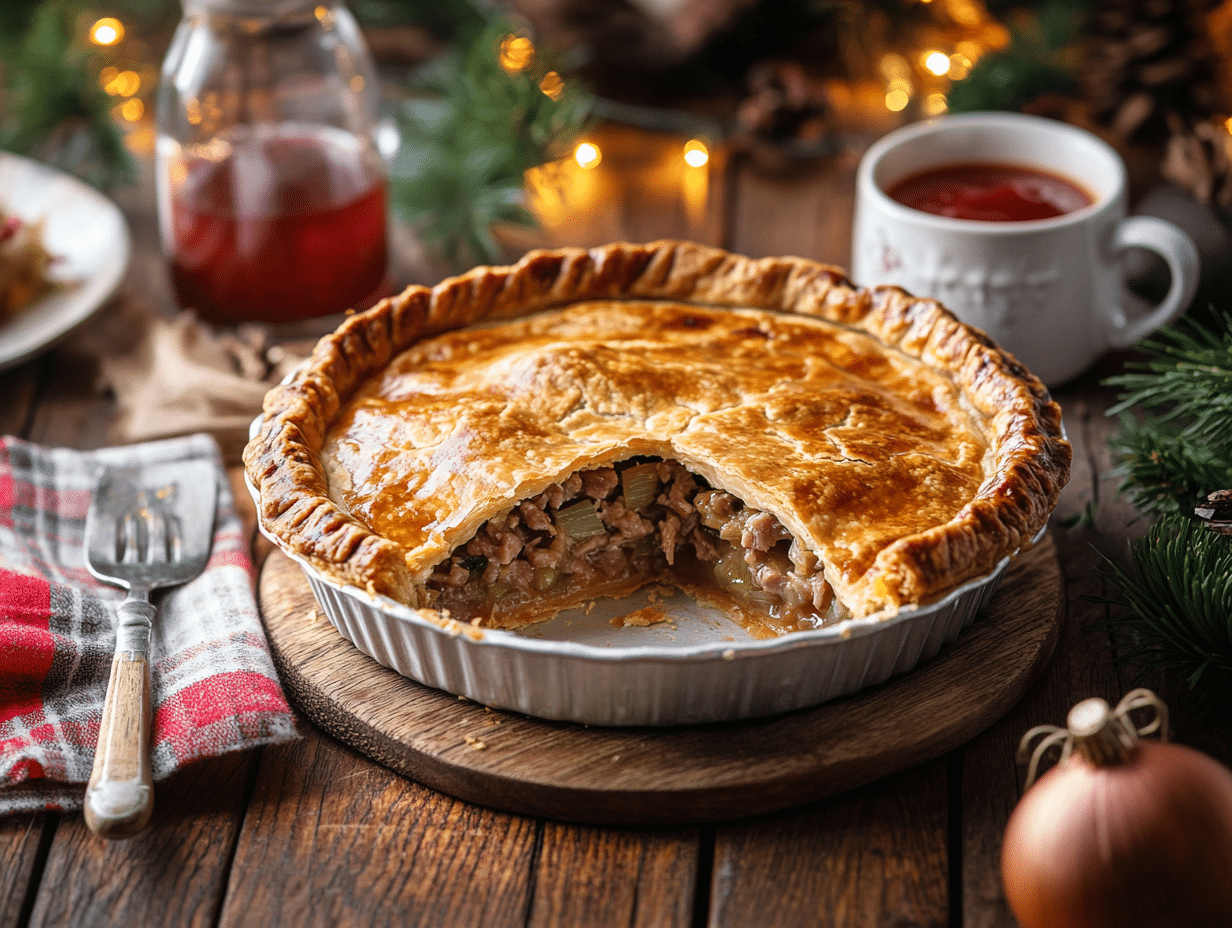
Tourtière is a French-Canadian ground pork pie seasoned simply with onion, leek, and garlic, then baked low and slow inside a double crust. It is a proper main course — one slice delivers around 670 calories and a solid hit of protein from two pounds of pork shared across six servings. If you want a filling, no-fuss winter dinner that comes together the day before you need it, this is a practical choice.
The technique that matters
The freeze-before-bake step is the one thing that separates this recipe from a standard meat pie. When you freeze the assembled pie overnight and then bake it from frozen at a low 275°F, the crust has time to set before the filling pushes moisture outward, which keeps the bottom crust from going soggy and lets the filling stay juicy rather than drying out over three hours. The other technique worth getting right is how you cook the filling in the Dutch oven: you want the liquid to reduce enough that the filling holds together when you cut the pie, but not so much that it becomes dry. Pull it off the heat when the mixture is moist but not pooling. The internal temperature of the finished pie should reach 160°F (71°C) at the center — use an instant-read thermometer pushed through one of the fork vents to confirm the pork is fully cooked before you serve it.
Troubleshooting
- Bottom crust is raw or doughy after baking: This usually means the pie went into the oven before it was fully frozen solid. Give it a full 24 hours in the freezer, not just a few hours. A fully frozen pie needs the entire low-and-slow bake to cook through properly, which is what gives the bottom crust time to crisp.
- Filling is watery when you slice the pie: The filling was not reduced enough before assembly. Next time, cook it an extra 5 minutes uncovered after the meat is no longer pink, until most of the liquid has evaporated and the mixture looks glossy rather than soupy.
- Crust splits or cracks badly on top: Fork vents that are too shallow or too few let steam build up and force its own exit. Make the fork marks deeper and add a couple more — five or six vents across the top is not too many for a pie this size.
- Pie is still cold in the center after 3 hours: Oven temperature varies. If your thermometer reads below 160°F (71°C) at the center, cover the crust loosely with foil to prevent over-browning and continue baking in 20-minute increments until it hits temperature. Do not serve ground pork undercooked.
- Leek adds too much moisture: Leeks hold a lot of water. If you are using a particularly large stalk, slice it and squeeze it briefly in a clean towel before adding it to the Dutch oven — skip the garnish step of rinsing it right before it goes in, since extra surface water adds up.
Leftovers and meal prep
Baked tourtière keeps in the fridge for up to 4 days, wrapped tightly or stored in an airtight container. Reheat individual slices in a 325°F oven for 15–20 minutes rather than the microwave — the microwave softens the crust and you lose the texture that makes the pie worth eating. If you want to freeze a baked pie, wrap it well and freeze for up to 2 months; thaw overnight in the fridge before reheating. For meal prep, the unbaked assembled pie can stay in the freezer for up to 3 months before baking day, which makes it a genuinely useful make-ahead option for the holidays. A green salad or steamed vegetables on the side rounds out the meal without much extra effort — each slice already covers protein and carbohydrates, so you do not need a heavy side dish.
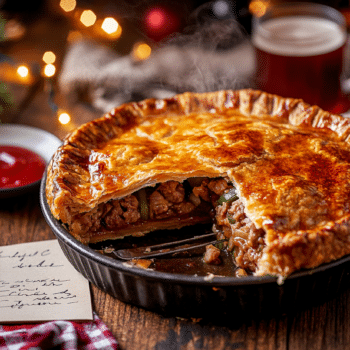
Grandma’s Tourtière: Classic French-Canadian Meat Pie

Equipment
Ingredients
 1 large white onion - about 300g / 10.5oz, diced
 1 large leek - about 200g, white and light green parts only, halved lengthwise, rinsed, and thinly sliced
 3 cloves garlic - thinly sliced
 2 pounds ground pork (minced pork) - medium ground, about 900g
 1 ¼ cups water - 300ml
- 2 store-bought 9-inch (23cm) pie crusts - or homemade double-crust pie dough
 1–2 teaspoons salt - to taste
 1–2 teaspoons ground black pepper - to taste
Instructions
- In a Dutch oven over medium heat, combine the ground pork, diced onion, sliced leek, sliced garlic, and water. Break the pork apart with a wooden spoon as it cooks. Thinly slicing the garlic rather than pressing it distributes the flavour more evenly throughout the filling.1 large white onion, 1 large leek, 3 cloves garlic, 2 pounds ground pork (minced pork), 1 1/4 cups water
- Cook over medium heat for 10–15 minutes, stirring occasionally and breaking up the pork, until the meat is no longer pink and the onion and leek are softened. The liquid should be mostly reduced — the filling should be moist but not pooling.
- Season with salt and pepper to taste, starting with 1 teaspoon of each and adjusting as needed. Let the filling cool slightly before assembling the pie.1–2 teaspoons salt, 1–2 teaspoons ground black pepper
- Spoon the filling into one of the pie crusts set in a 9-inch (23cm) pie plate, spreading it evenly in a level layer. Include some of the cooking liquid to keep the filling moist, but do not add so much that it pools around the edges.2 store-bought 9-inch (23cm) pie crusts
- Place the second pie crust over the filling. Press and crimp the edges together to seal. Cut 4–5 small slits in the top crust with a fork or knife to allow steam to escape. Cover the pie tightly with plastic wrap or aluminium foil and freeze overnight (or for up to 3 months).2 store-bought 9-inch (23cm) pie crusts
- When ready to bake, preheat your oven to 275°F / 135°C (140°C fan-forced). Place the frozen pie on a rimmed baking sheet and bake for approximately 3 hours. The pie is done when the crust is golden brown, juices are bubbling through the vents, and an instant-read thermometer inserted through a vent reads 160°F / 71°C at the centre.
- Remove from the oven and let the pie rest for 15–20 minutes before slicing. This allows the filling to set so slices hold together. Serve with ketchup on the side.
Notes
Nutrition
Your questions, answered
Can I use a mix of ground pork and ground beef instead of all pork?
Yes, a 50/50 mix of ground pork and ground beef works well and is a common variation. Both meats need to reach 160°F (71°C) at the center, so the food safety requirement stays the same — just check with a thermometer before serving.
Do I have to freeze the pie before baking, or can I bake it fresh?
You can bake it fresh, but the result will be different. Without freezing, the filling releases moisture faster than the crust can handle it, which often leads to a soggy bottom and a drier filling — the freeze step genuinely does affect the final texture, not just the flavor.
What should I serve with tourtière to make it a complete meal?
A simple green salad or roasted vegetables is all you need. Each slice has roughly 670 calories and a substantial amount of protein from the pork, so the pie itself is the main event — a light side keeps the meal balanced without adding much work.
Can I make this recipe with store-bought pie crust?
Yes, the recipe is written for pre-made crusts and they work fine here. The long, low bake at 275°F is forgiving enough that store-bought crust holds up well, especially after freezing, so there is no practical reason to make pastry from scratch unless you want to.
How do I know the pie is fully cooked through after 3 hours at 275°F?
Use an instant-read thermometer inserted through one of the fork vents in the top crust — the center of the filling needs to read 160°F (71°C) before you serve it. Crust color alone is not a reliable indicator because the low oven temperature means the crust can look done while the center is still below safe temperature.
Try these next
- Cumberland Sausage Mince Pie
- Wild Venison Mushroom Pies
- Savory Pork Apple Pasties
- Savory British Beef Pies