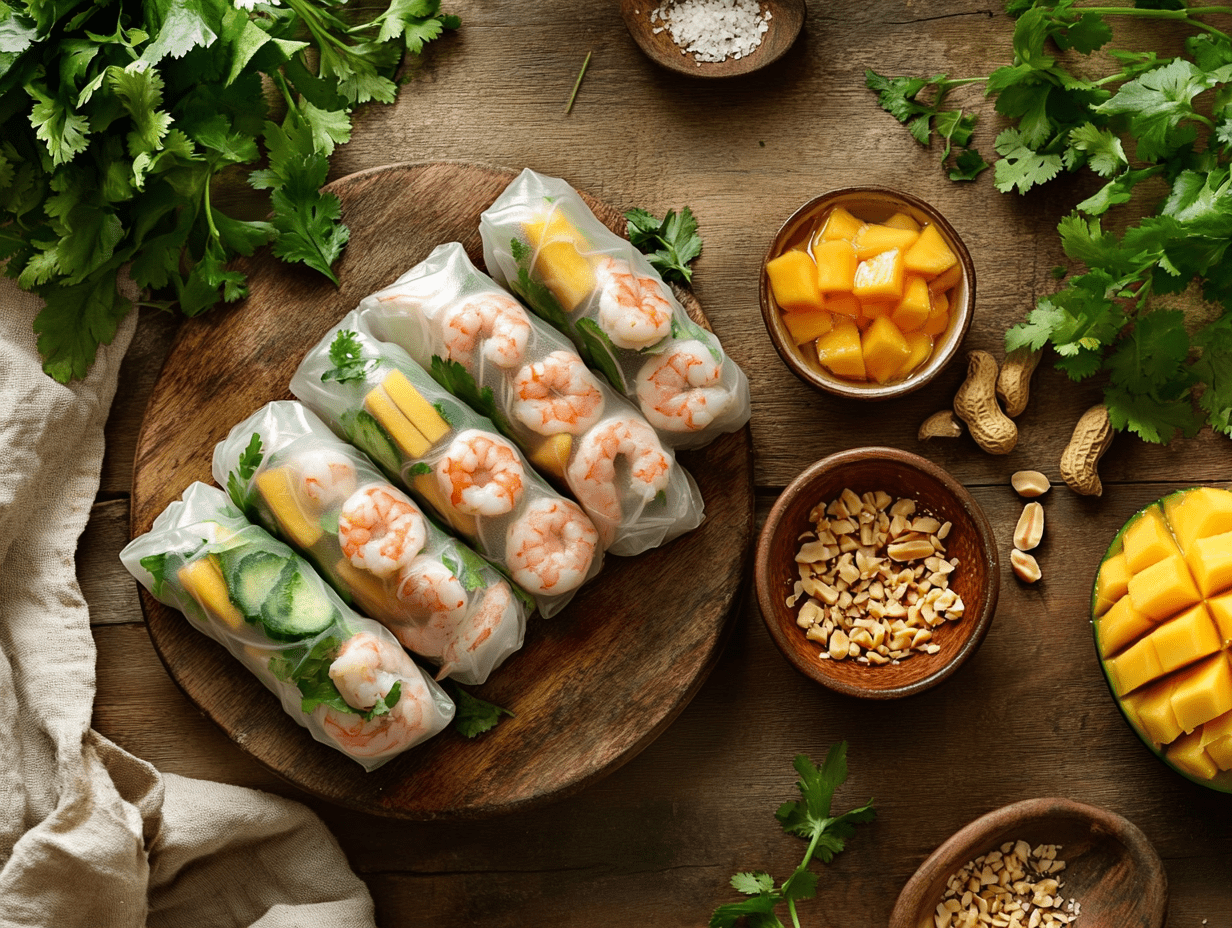
These are fresh, no-fry Vietnamese spring rolls filled with ground pork, shrimp, rice vermicelli, and herbs, all wrapped in rice paper and served with a hoisin-peanut dipping sauce. Total time is 35 minutes, and the result is a light, filling meal that works as a starter or a main. The honest reason to make them: once you get the rolling motion down, they come together fast and the peanut sauce alone is worth the effort.
Smart swaps
- Rice paper (bánh tráng): Found in most Asian grocery stores and many supermarkets in the international aisle. If you can only find smaller rounds, just use two sheets slightly overlapped.
- Ground pork: Ground chicken works here — just cook it to an internal temperature of 165°F (74°C) instead of 160°F (71°C). Ground turkey is also fine.
- Pork broth for the sauce: Use the broth left from simmering the pork — the recipe tells you to save it, and it genuinely improves the sauce over store-bought stock.
- Mango: Marked optional in the recipe and it is. Skip it if mangoes aren’t ripe or in season — an underripe mango adds nothing.
- Bird’s eye chili: A pinch of red pepper flakes stirred into the sauce works as a substitute if you can’t find fresh chilies.
Before you start
The one technique that makes or breaks this recipe is how you handle the rice paper. Dip it in warm — not hot — water for about 3 to 5 seconds only. It should still feel slightly stiff when you lay it on your surface; it will continue to soften as you add the filling. If you soak it until fully pliable in the water, it will tear when you roll. Work on a smooth, lightly damp glass or wooden board rather than a dry plate — the paper sticks less and you get a cleaner roll. Have all your fillings prepped and within arm’s reach before you dip a single sheet, because once the paper is wet, you need to move.
Mistakes to avoid
- Overfilling the roll: It’s tempting to pile everything in, but too much filling makes the rice paper split. A small, tight bundle rolls better than a generous heap.
- Not draining the vermicelli well enough: Wet noodles make the rice paper soggy and the roll falls apart quickly. Shake the colander and let them sit for a few minutes before using.
- Skipping the butterfly cut on the shrimp: The recipe calls for this so the shrimp lies flat against the rice paper, which is what gives the roll its clean, visible shrimp layer. Rushing past this step means uneven rolls that are harder to eat.
- Making the rolls too far ahead: Rice paper dries out and sticks to itself within 30 to 40 minutes at room temperature. If you’re not eating immediately, cover the finished rolls with a lightly damp paper towel and plastic wrap.
- Adding peanuts to the sauce too early: Stir the ground peanuts in at the end, off the heat. Cooking them in the sauce makes them lose their texture and the sauce turns gluey.
Storage and reheating
Finished rolls are best eaten the day they’re made. If you need to store them, wrap each roll individually in plastic wrap and refrigerate for up to 24 hours — beyond that the rice paper becomes rubbery. The peanut sauce keeps well in a sealed container in the fridge for up to 4 days; stir in a splash of warm water to loosen it before serving. These rolls are not suitable for freezing — the rice paper breaks down completely on thawing. The cooked ground pork on its own can be frozen for up to 2 months and thawed overnight in the fridge, which is a useful shortcut if you want to prep ahead.
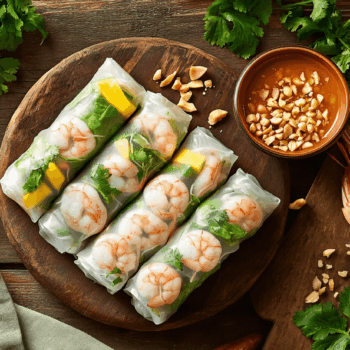
Fresh Vietnamese Spring Rolls with Peanut Sauce

Equipment
Ingredients
Roll Ingredients
- 10 sheets rice paper - about 22cm / 8.5-inch rounds
 10.6 oz ground pork - minced pork
 1 teaspoon salt
 15 medium shrimp - about 200g / 7oz, peeled and deveined
- 1 tablespoon neutral oil - vegetable or canola, for sautéing shrimp
 3 cloves garlic - minced, for sautéing shrimp
- 7.05 oz rice vermicelli
 1 small cucumber - sliced
- 1 bunch lettuce
 ¼ cup cilantro (coriander) - fresh ; coriander, leaves and tender stems, about 10g
- ¼ cup mint leaves - fresh ; about 5g
 2 stalks spring onions - scallions, cut into 2- to 3-inch strips
- 1 medium mango - sliced, optional
Peanut Sauce Ingredients
- 1 tablespoon neutral oil - vegetable or canola
- 1 clove garlic - minced, for sauce
 5 tablespoons hoisin sauce
- 5 tablespoons pork broth - reserved from boiling the pork
- 3 tablespoons peanut butter
 ½ tablespoon sugar
- 1 medium bird’s eye chilli - thinly sliced, optional
- ¼ cup roasted peanuts - roughly chopped, for garnish, about 35g
Instructions
Rolls Instructions
- Bring a medium saucepan of water to a boil. Add the ground pork and 1 teaspoon salt, breaking the meat apart with a spoon. Reduce heat and simmer for 8–10 minutes until the pork is cooked through (no pink remaining, internal temperature 160°F / 71°C). Remove the pork with a slotted spoon and set aside. Reserve the broth — you will use 5 tablespoons for the sauce.10.6 oz ground pork, 1 teaspoon salt
- Heat 1 tablespoon neutral oil in a small skillet over medium-high heat. Add 3 cloves of minced garlic and sauté for 30 seconds until fragrant. Add the shrimp and cook for 2–3 minutes per side until pink and opaque. Remove from heat and let cool.1 tablespoon neutral oil, 3 cloves garlic, 15 medium shrimp
- Once cooled, peel and devein the shrimp if not already done. Butterfly-cut each shrimp by slicing along the back without cutting all the way through, then press gently to flatten. This creates a larger, more attractive piece for the roll.15 medium shrimp
- Cook your rice vermicelli according to package instructions and drain in a colander.7.05 oz rice vermicelli
- Wash the lettuce, cilantro, spring onions and mint leaves.1 bunch lettuce, 1/4 cup cilantro (coriander), 2 stalks spring onions, 1/4 cup mint leaves
- Slice the cucumber and mango.1 small cucumber, 1 medium mango
- Prepare a large shallow dish of warm water. This is where you will dip the rice paper.
- Dip one sheet of rice paper into the warm water for 3–5 seconds, turning once to wet both sides evenly. It should still feel slightly stiff — it will continue to soften. Lay it flat on a smooth, lightly damp glass or wooden cutting board.10 sheets rice paper
- On the lower third of the rice paper, layer a few lettuce leaves, a small bundle of vermicelli, a portion of pork, herbs, cucumber slices, and mango if using. Leave about 2.5cm (1 inch) clear on each side.1 bunch lettuce, 7.05 oz rice vermicelli, 10.6 oz ground pork, 1/4 cup cilantro (coriander), 1/4 cup mint leaves, 2 stalks spring onions, 1 small cucumber, 1 medium mango
- Fold the bottom edge of the rice paper up and over the filling, tucking it tightly. Fold both sides inward. Place 2–3 shrimp halves, cut-side down, in a line on the rice paper just above the roll. Continue rolling upward — the shrimp will press against the wrapper and show through the translucent paper. Repeat with remaining wrappers and filling.10 sheets rice paper, 15 medium shrimp
Sauce Instructions
- Heat 1 tablespoon neutral oil in a small saucepan over medium heat. Add the minced garlic and sauté for 30 seconds until fragrant — do not let it brown.1 tablespoon neutral oil, 1 clove garlic
- Add the hoisin sauce and 5 tablespoons of reserved pork broth. Stir to combine, then add the peanut butter and sugar. Whisk until smooth.5 tablespoons hoisin sauce, 5 tablespoons pork broth, 3 tablespoons peanut butter, 1/2 tablespoon sugar
- Reduce heat to low and simmer for 2–3 minutes, stirring frequently, until the sauce coats the back of a spoon. Transfer to a dipping bowl and top with sliced bird’s eye chilli and chopped peanuts.1 medium bird’s eye chilli, 1/4 cup roasted peanuts
Notes
Nutrition
Frequently asked questions
How do I know when the ground pork is fully cooked?
Ground pork is safe to eat when it reaches an internal temperature of 160°F (71°C) — use a meat thermometer to check. Visually, it should be completely grey-brown throughout with no pink remaining, and the juices should run clear.
Can I assemble the rolls in advance for a party?
You can assemble them up to an hour ahead if you keep them covered with a damp paper towel and plastic wrap. Beyond that, the rice paper dries out and sticks, so for a party it’s easier to prep all the fillings in advance and roll them to order.
My rice paper keeps tearing — what am I doing wrong?
The most common cause is soaking the paper too long so it becomes fragile before you even start rolling. Dip for 3 to 5 seconds only and let it finish softening on the board. Overfilling is the second most common cause — keep the filling bundle smaller than you think you need.
Can I use pre-cooked shrimp from the store?
Yes, pre-cooked shrimp works fine and cuts your prep time. Just peel, devein, and butterfly-cut them before assembling — you’re skipping the sauté step, not the prep.
If you liked this one
- Savory Pork Noodle Stir-Fry
- Japanese Pork Lettuce Cups
- Authentic Szechuan Dan Dan
- Crispy Pork Dumpling Delight