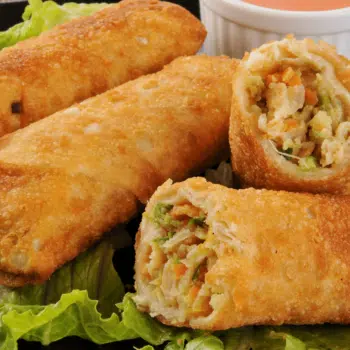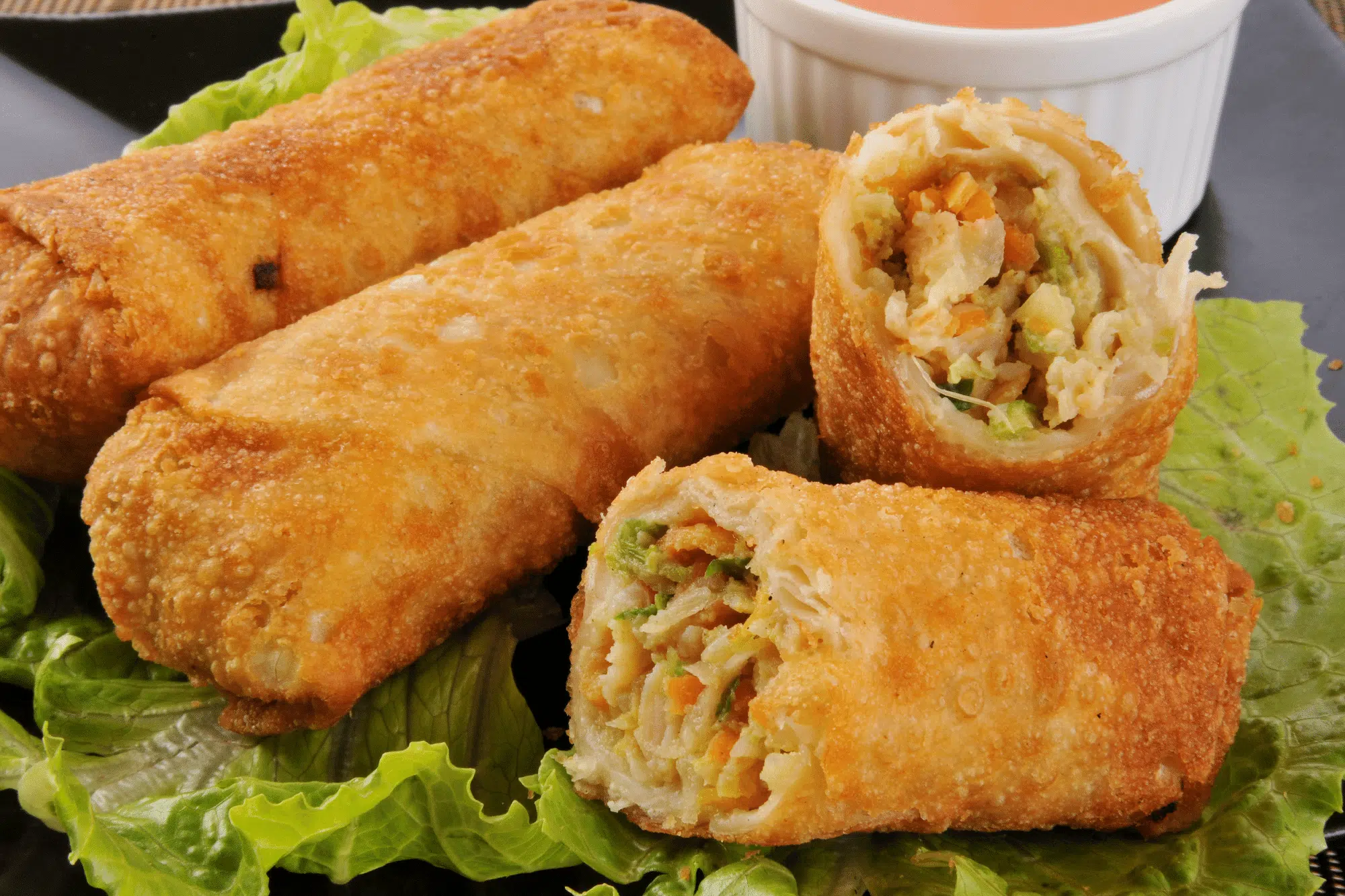
These egg rolls use ground pork packed with shiitake mushrooms, taro, glass noodles, and carrot — a filling that holds together well and delivers real protein alongside the vegetables. Deep-frying in wheat wrappers gives you the thick, crunchy shell that distinguishes these from lighter spring rolls. If you want a snack that actually satisfies rather than just crunches, this is the one to make.
About the ingredients
- Taro root: Not always easy to find — check Asian grocery stores. It adds a mild, nutty flavor and stays firm through frying. If you can’t find it, substitute with an equal amount of extra carrot or diced water chestnuts for similar texture without going mushy.
- Glass noodles (mung bean vermicelli): Sold dried in most Asian supermarkets. Soak them in warm water until pliable, then chop before mixing into the filling — long strands make rolling difficult and the filling uneven.
- Dried shiitake mushrooms: Rehydrate in cold water for 30 minutes rather than hot; cold soaking pulls out more flavor. Squeeze them thoroughly before chopping — they hold a surprising amount of liquid.
- Fish sauce: This is doing the heavy lifting on umami. Don’t substitute soy sauce one-for-one; soy sauce is saltier and thinner. If you must swap, use two-thirds the amount of soy sauce.
- Egg white as sealer: The extra egg white brushed on the wrapper edge is what keeps the roll closed during frying. Don’t skip it — water alone won’t hold under hot oil.
The technique that matters
The single most important step is getting the filling genuinely dry before you roll. After cooking the pork to a safe internal temperature of 160°F (71°C) and mixing in the vegetables and noodles, spread the filling on a sheet pan or wide plate and let it cool completely — at least 15 minutes. Steam trapped inside a warm filling will soften the wrapper from the inside out, and no amount of hot oil will fix that once it starts. When you roll, pull the wrapper snug around the filling on the first fold before tucking the sides; a loose first roll creates air pockets that bubble and burst in the oil. Fry in batches small enough that the oil temperature doesn’t drop noticeably — a crowded pan is the second most common reason egg rolls come out pale and greasy instead of golden and crisp.
Common problems and fixes
- Wrapper splits open during frying: Usually caused by overfilling or a weak seal. Use no more than 2 tablespoons of filling per roll, and make sure the egg white is applied right before you seal — it dries out quickly and loses its grip.
- Filling tastes bland after frying: Season the raw filling slightly more aggressively than you think you need to. Frying mutes salt and fish sauce flavors. Taste the cooked filling before rolling and adjust.
- Greasy exterior that doesn’t crisp: The oil wasn’t hot enough when the rolls went in. Use a thermometer — you want 350°F (175°C). If you don’t have one, drop a small piece of wrapper in; it should sizzle immediately and float to the surface.
- Filling slides to one end: The noodles weren’t chopped short enough, or the filling wasn’t packed tightly on the first roll. Chop noodles to roughly 1-inch lengths and press the filling into a compact log shape before wrapping.
- Rolls stick together in the freezer: Freeze them uncovered on a baking sheet until solid — about 2 hours — before transferring to a bag. Skip this step and you’ll end up with a frozen brick. That said, skip the dipping sauce garnish when serving from frozen; it’s not worth the extra dish when the rolls are already the main event.
Keeping and reheating
Cooked egg rolls keep in the refrigerator for up to 3 days in an airtight container. To reheat, use an oven or air fryer at 375°F (190°C) for 8 to 10 minutes — microwaving turns the wrapper soft and chewy, which defeats the point. Uncooked, assembled rolls freeze well for up to 2 months; fry them straight from frozen at 325°F (163°C) for about 12 to 14 minutes, slightly lower temperature than fresh so the filling heats through before the wrapper over-browns. Label your freezer bag with the date — after 2 months the wrapper texture starts to suffer even if the filling is still safe.

Easy Egg Rolls Recipe
Ingredients
3 medium carrots
2 pounds ground pork (minced pork)
1 medium onion
1 cup shiitake mushrooms- ⅓ cup glass noodles
2 medium eggs
1 tablespoon green onions (scallions or green shallots)- 1 big taro root
1 pinch salt
1 pinch ground black pepper
1 tablespoon fish sauce- 1 tablespoon chicken seasoning
- 40 small egg roll wrappers
Instructions
- Put the Shiitake mushroom in lukewarm water to get it to soften up. You only need to use half of the bag or less. It all depends on how many you want to make. After the mushroom gets softened, chop it up but not too fine.
- Put the glass noodle in lukewarm water as well. Cut the noodle into small pieces as well.
- You will need to thinly chop all your root ingredients, such as carrot and big taro root. The big taro root is tough to find, and sometimes it doesn’t even that fresh. Don’t worry and get more carrots instead if you can’t find them.
- You may get a mandolin slicer to slice the root all nice and even.
- Chop onion and green onion in fine pieces. You don’t want to bite in your egg roll and taste a chunk of onion.
- Put all your chopped onion, green onion, carrot, giant taro, Shiitake mushroom and glass noodle in a big bowl with ground pork or turkey. The bigger the bowl, the better you can mix all the ingredients up.
- Put in 1 whole egg and 1 egg yolk in the mixture. Don’t throw away the egg white. You will need it to seal the egg roll wrap.
- Season the mixture with salt, pepper, Knorr Chicken seasoning and fish sauce (a lot of fish sauce). I don’t measure how much seasoning to put in because different people have different taste buds. Just season it like how you usually cook your food. If you want to check it, you can get a small scoop and microwave it to see if it is not over seasoning.
- Time to get down and dirty. Mix everything up. I usually wear gloves and mix everything up for literally 5 minutes. Cover the egg rolls and store in the fridge for 2 hours.
- After 2 hours, time to wrap the egg roll. There is instruction on how to wrap your egg roll in every egg roll wrap. Fry the egg roll in medium heat, so the wrap doesn’t get burnt. Put the leftover egg rolls that are not cooked in a freezer. Just take it out and fry it up whenever you want an egg roll.
Nutrition
Your questions, answered
Can I use ground chicken or turkey instead of ground pork?
Yes, both work well in this filling. Cook ground chicken or turkey to an internal temperature of 165°F (74°C) — higher than pork — and make sure no pink remains before mixing with the other filling ingredients.
How do I keep the egg rolls crispy if I’m making them ahead for a party?
Fry them, then hold on a wire rack in a 250°F (120°C) oven for up to 30 minutes. Placing them on a plate or paper towel traps steam underneath and softens the wrapper faster than anything else.
My egg roll wrappers keep tearing when I try to roll them — what’s wrong?
They’re probably too cold and stiff straight from the refrigerator. Let the wrappers sit at room temperature for 10 to 15 minutes before use, and keep the stack covered with a slightly damp towel while you work so they don’t dry out.
Is there enough protein in these egg rolls to serve as a main meal?
With ground pork as the base and glass noodles adding bulk, two to three egg rolls per person makes a reasonable main when paired with a simple side like steamed rice or a cucumber salad. The filling ratio in this recipe is generous compared to takeout versions, so the protein content per roll is meaningful.
Can I bake these instead of deep-frying?
You can, but the result is noticeably different — the wrapper stays chewier and doesn’t blister into the same crunch. If you bake, brush generously with a neutral oil and use 425°F (220°C) for 20 to 22 minutes, flipping once halfway through.
What to cook next
- Crispy Pork Dumpling Delight
- Savory Pork Noodle Stir-Fry
- Japanese Pork Lettuce Cups
- Authentic Szechuan Dan Dan