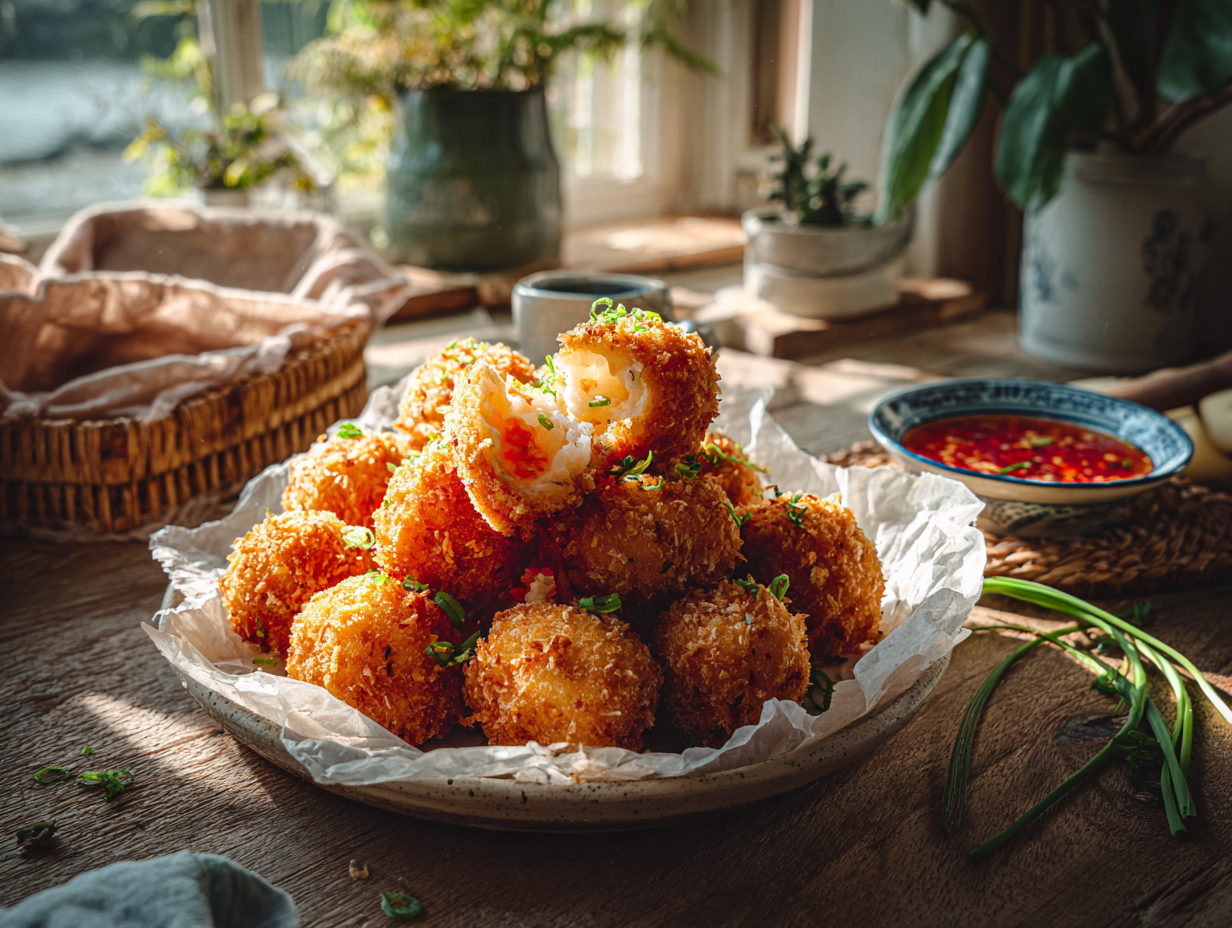
Crunchy shrimp balls are deep-fried rounds of minced shrimp and ground chicken coated in panko breadcrumbs — the kind of appetizer that disappears fast at any table. The filling is springy and savory, the crust genuinely shatters when you bite in, and the whole batch comes together in under an hour. If you want a high-protein finger food that pulls real weight at a meal, this is a practical choice.
The technique that matters
Two things decide whether these turn out right. First, how you handle the shrimp mixture: combine the minced shrimp and ground chicken until just incorporated — overworking it tightens the proteins and produces a rubbery, dense ball instead of a springy one. Stop mixing the moment everything looks uniform. Second, oil temperature. If the oil is too cool, the panko soaks up fat before it can crisp, and you get greasy, pale balls; too hot and the crust browns before the interior reaches the safe target of 145°F (63°C) for seafood. A steady 350°F (175°C) gives the coating time to turn golden while the center cooks through completely. Use a thermometer — guessing by color alone is unreliable with a panko crust.
Shopping notes
- Shrimp: Small or medium peeled raw shrimp work well here and are usually cheaper per pound than large shrimp. Frozen is fine — thaw fully and pat very dry before mincing, or excess moisture will loosen the mixture and make shaping difficult.
- Ground chicken: Ground chicken thigh has more fat than breast and keeps the interior juicier. Either works, but thigh is the better call if you have a choice.
- Panko: Standard Japanese-style panko from any supermarket is what you want. Regular fine breadcrumbs will produce a denser, less crunchy crust — skip the garnish of extra herbs pressed into the coating too, not worth the extra dish.
- Neutral oil: You need enough oil to submerge the balls — at least 2 to 3 inches in the pot. Vegetable, canola, or sunflower oil all work. Avoid olive oil; its smoke point is too low for this temperature.
Storage and reheating
Cooked shrimp balls keep in an airtight container in the fridge for up to 3 days. For freezing, arrange them in a single layer on a baking sheet, freeze until solid (about 2 hours), then transfer to a freezer bag — they’ll keep for up to 2 months. Reheat from fridge in an oven or air fryer at 375°F (190°C) for 8 to 10 minutes; microwaving works in a pinch but turns the crust soft. From frozen, add 5 to 7 minutes to that time and check that the center hits 145°F (63°C) again before serving. Uncooked shaped balls can be refrigerated on a tray for up to 24 hours before frying, which makes them a good make-ahead option for a party.
Common problems and fixes
- Balls fall apart in the oil: The mixture is too wet. This usually means the shrimp weren’t dried thoroughly before mincing. Next time, press the shrimp between paper towels. A short chill — 20 minutes in the fridge after shaping — also helps them hold together.
- Panko coating slides off: The surface of the ball needs to be slightly tacky for the crumbs to stick. Lightly wetting your hands when rolling, or pressing the panko on firmly rather than just rolling the ball through it, fixes this.
- Interior still raw when crust is already dark: The balls are too large, or the oil is too hot. Aim for consistent golf-ball size and keep oil at 350°F (175°C). Fry in small batches — crowding drops the oil temperature and throws off cooking time.
- Filling tastes bland after frying: Seasoning needs to be slightly more assertive in raw seafood mixtures than you’d expect, because frying mutes salt. Fry one test ball first, taste it, and adjust the remaining mixture before shaping the rest.
- Greasy texture on the finished balls: Oil was below temperature when the balls went in. Let the oil recover fully between batches — at least 60 to 90 seconds — before adding the next round.
Crunchy Shrimp Balls Recipe

Ingredients
 ½ kilogram shrimp (prawn) - finely minced
 ¼ cup milk
 ¼ kilogram ground pork (minced pork)
 ¼ cup green onions (scallions or green shallots) - finely minced
 1 dash salt
 1 dash ground black pepper
 1 medium egg
 2 tablespoons all purpose flour (plain flour Australia and UK)
 1 cup Panko breadcrumbs
 ⅓ cup vegetable oil
Instructions
- Put shrimp in a bowl and add milk. Let it sit for about 5 to 10 minutes to remove any fishy smell. Drain. Mince it. Add the ground pork or chicken, finely chopped red onion and minced green onion leaves.
- Season with salt and pepper. Add beaten egg and enough flour to make it paste-ey. Chill in the refrigerator for 30 minutes.
- Shape into 1 1/2-inch balls and roll in Japanese bread crumbs.
- In a pot, pour oil until about 3 inches deep and put on medium heat. You’ll know it’s hot enough when you put a tiny drop of water, and it begins to splatter. Put 4-5 balls at a time. I put the cover on for about 3 minutes and swirled the pot to move the balls around to ensure uniform cooking and golden colour. Remove the cover and let it cook for another 3 minutes.
- Drain and put on paper towels to remove excess oil. Serve with sweet chilli sauce. Don’t forget the yang chow rice!
- I put the balls in a bowl of Japanese bread crumbs (panko) and roll them about.
Nutrition
FAQ
Can I make these without a deep fryer?
Yes — a heavy-bottomed pot or Dutch oven on the stovetop works just as well. You need enough oil to fully submerge the balls (2 to 3 inches), a reliable thermometer to hold the temperature at 350°F (175°C), and a slotted spoon or spider strainer to retrieve them safely.
Can I use all shrimp and skip the ground chicken?
You can, but the balls will be firmer and slightly denser without the chicken to soften the texture. If you go all-shrimp, avoid over-processing — pulse rather than blend to keep some texture in the mince, and make sure the internal temperature still reaches 145°F (63°C).
What do I serve with these to make a full meal?
Steamed jasmine rice and a simple cucumber or cabbage slaw alongside the dipping sauce turns this into a complete plate with solid protein, carbs, and vegetables. Fried rice works equally well and can be made while the shrimp balls drain — both options use minimal extra effort.
How do I know the shrimp balls are cooked through without cutting them all open?
An instant-read thermometer inserted into the center of one ball should read at least 145°F (63°C) for the seafood to be safe. If you don’t have a thermometer, cut one ball from the first batch in half — the interior should be opaque throughout with no translucent or grey patches.
If you liked this one
- Crispy Pork Dumpling Delight
- Chicken Macadamia Sausage Rolls
- Colombian Chicken Cheese Empanadas
- Japanese Pork Lettuce Cups