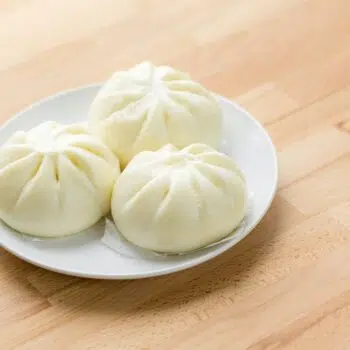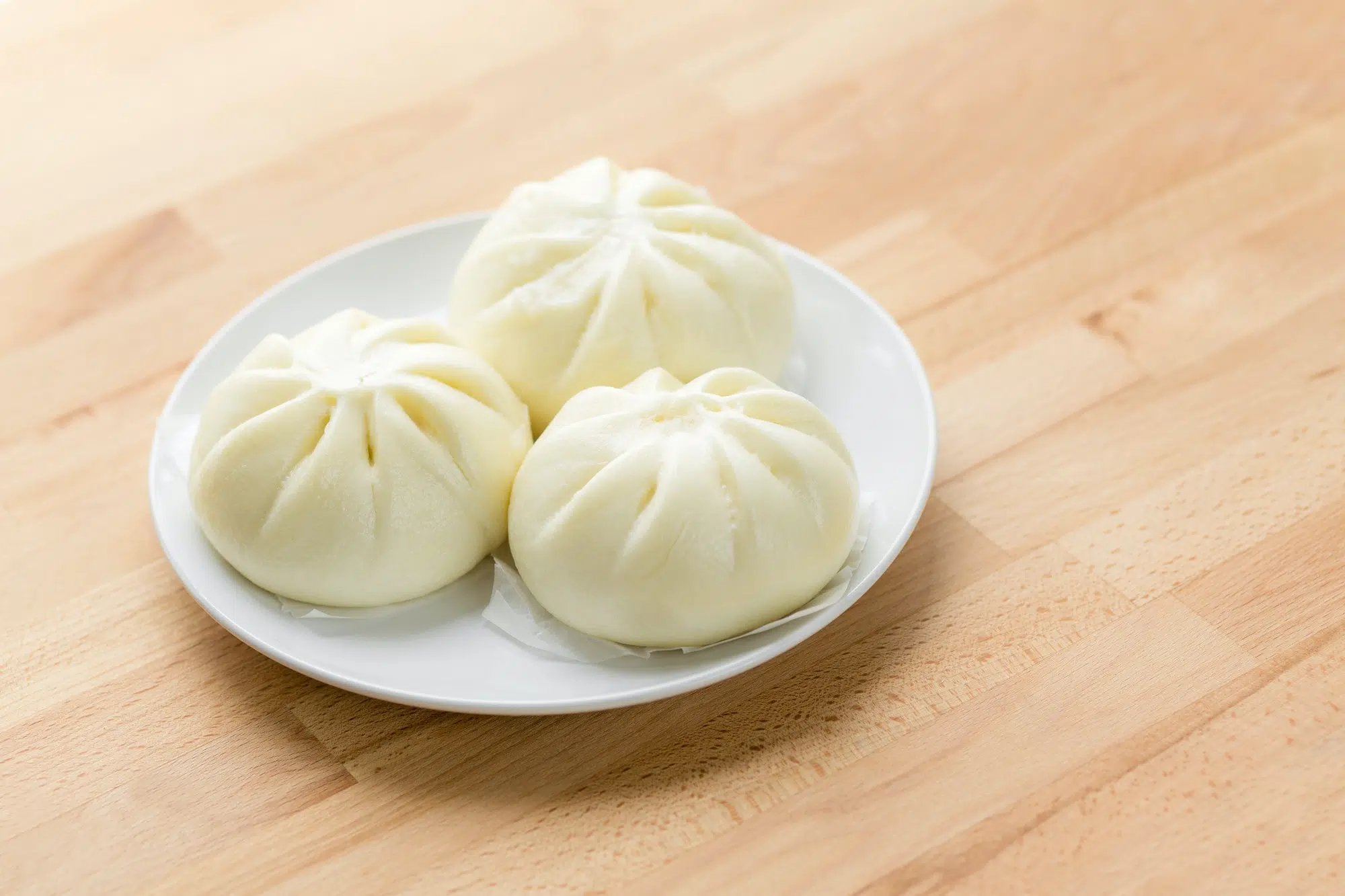
Siopao is a Filipino steamed bun filled with seasoned ground meat — soft, slightly chewy dough wrapped around a saucy beef filling. The recipe takes about 45 minutes of active work plus an hour of hands-off rising time, and it makes 9–10 buns that work equally well as a snack, lunch, or a freezer stash for busy days. The honest reason to make these at home: they’re cheaper than takeout, and the dough is more forgiving than it looks.
Before you start
Two things determine whether this recipe works. First, the yeast proof: when you combine the yeast, sugar, and warm water, the mixture should turn foamy within 5 minutes. If it stays flat and cloudy, the yeast is dead — stop and get a fresh packet, because no amount of kneading will fix a failed proof. Water temperature matters here; aim for warm to the touch but not hot (roughly 100–110°F / 38–43°C). Second, drain the cooked beef thoroughly before adding the sauces. Ground beef releases a significant amount of fat and liquid as it cooks, and if you skip draining, the filling will be watery and will soak through the dough during steaming, making the buns collapse or tear when you pick them up. A quick tip on internal temperature: ground beef is safe to eat at 160°F (71°C) — a meat thermometer takes the guesswork out of knowing when the filling is fully cooked.
What can go wrong
- Buns stick to the steamer basket: Even with parchment squares under each bun, a bamboo or metal steamer can grab the dough if the squares are too small. Cut them at least 3×3 inches so the bun sits fully on the paper, not overlapping onto bare metal or bamboo.
- Dough doesn’t rise: Beyond dead yeast, a cold kitchen is the usual culprit. If your kitchen is below 70°F, the dough will rise very slowly or barely at all. Put the covered bowl in an unheated oven with just the oven light on — that small amount of warmth is usually enough.
- Buns open up during steaming: The seal wasn’t tight enough. After pinching and twisting, press the seam firmly with your fingers and place the bun seam-side down on the parchment. Steaming seam-side up is the most common reason they split open.
- Filling is too wet to scoop neatly: If the beef mixture looks soupy after adding the sauces, return it to medium heat for 2–3 minutes, stirring constantly, until the liquid reduces and the filling holds its shape on a spoon. Skip the extra sauce at this stage — not worth a soggy bun.
- Buns come out dense instead of fluffy: Over-kneading after the rise is the likely cause. Once the dough has doubled and you’ve punched it down, handle it as little as possible. Work quickly when shaping the portions into balls.
Make-ahead notes
The filling can be made up to 2 days ahead and stored in a sealed container in the fridge — it actually thickens up nicely overnight, which makes it easier to portion. Fully assembled, unsteamed buns can be refrigerated for up to 8 hours before steaming; add 2–3 minutes to the steaming time if going straight from cold. Already-steamed buns keep in the fridge for 3 days in an airtight container. To reheat, steam them again for 5–6 minutes rather than microwaving — the microwave makes the dough rubbery and the outside gummy. For longer storage, freeze steamed buns individually on a tray until solid, then transfer to a zip-lock bag; they keep well for up to 2 months. Steam from frozen for 10–12 minutes.

Easy Filipino Steamed Bun (Siopao)
Ingredients
FOR THE FILLING:
2 ½ pounds ground beef (minced beef) - (or your preference of meat)
⅓ cup Hoisin sauce
½ cup BBQ sauce (barbecue sauce)
1-2 pieces bay leaf (bay leaves)
FOR THE DOUGH:
2 ½ cup all purpose flour (plain flour Australia and UK)
3 tablespoons vegetable oil - or shortening
½ tablespoon baking powder
¼ cup sugar (white sugar)
1 teaspoon vegetable oil
1 cup water - warm- 1 pouch active dry yeast
1 tablespoon sugar (white sugar)
Instructions
INSTRUCTIONS FOR THE FILLING:
- Place the ground beef in a skillet, cooking it on its own juice. Add bay leaves. Let it brown lightly or until cooked. Remove from heat. Drain excess oil that came out, then back to the stove on medium heat.
- Add the Hoisin sauce and barbecue sauce. Mix them well. Remove from heat and so with the bay leaves. Set aside.
INSTRUCTIONS FOR THE DOUGH:
- In a small-sized bowl, mix the yeast and 1 tablespoon of sugar in 1 cup of warm water and let stand for 5 minutes.
- Using a medium or large-sized mixing bowl, combine flour, baking powder, and 1/4 cup sugar. Mix well, add 3 tablespoons of shortening or vegetable oil, then add the water combined with yeast from earlier. Mix well with a large spoon or spatula until you form a dough. (You can mix them manually or use a hand mixer machine or a stand mixer)
- Knead the dough on a lightly floured surface for about 5 minutes or until it turns smooth enough. Turn into a ball and coat with oil. Place in a large bowl and cover with a clean kitchen towel or plastic wrap and leave for an hour in a warm area of your kitchen to rise until it doubles in size. Cut 10 small squares of parchment paper to lay the sealed Siopao when you steam it later.
- Back to your lightly-floured surface. Punch the dough to take out air and roll it into a log. Divide the log into 10 equal portions and turn them into a ball. For larger buns, divide it into 8 equal portions. You can just eyeball it or weigh it for more uniform size.
- Using the rolling pin, take a ball and flatten it into a 5-inch circle. Scoop a tablespoon or two of your filling in the middle of the circle and gather the ends from one side towards the middle, keeping the folds in the middle as you go until you reach the other end. Hold those ends firmly together, then pinch and twist to seal. Do the same with the rest of the balls. Let stand for 10-15 minutes.
- Lay the sealed Siopao in a steamer about an inch apart and with a small square parchment paper underneath each. Steam for 15-20 minutes. Let it cool and enjoy!
Nutrition
FAQ
Can I use ground pork or chicken instead of ground beef?
Yes — ground pork works especially well and is traditional in many siopao recipes. If you use ground chicken or turkey, cook it to an internal temperature of 165°F (74°C) and make sure there is no pink remaining before you drain and add the sauces.
Do I need a bamboo steamer, or will any steamer work?
Any steamer setup works — a metal steamer insert, a large pot with a rack, or even a colander set over a pot of boiling water with a lid on top. The key is that the lid fits tightly enough to trap steam, and that the buns aren’t sitting in water.
My dough feels sticky after kneading. Should I keep adding flour?
Add flour only a small pinch at a time, and stop as soon as the dough stops sticking to your hands. Siopao dough is meant to be slightly tacky — adding too much flour makes the finished buns tough and dense rather than soft.
How do I know when the buns are fully steamed?
The buns are done when they look matte and slightly puffed, and the dough springs back when you press it lightly with a finger. At 15–20 minutes over a steady boil, the filling will have been hot long enough to be safe, but the dough texture is your best visual cue.
Why does condensation drip off the lid onto my buns?
This is a common issue with metal lids — the water droplets make wet patches on the dough. Wrap the lid in a clean kitchen towel before putting it on the steamer; the towel absorbs the condensation before it can drip.
The buns turned slightly grey or yellowish after steaming. Is that normal?
A slight off-white or pale yellow tint is normal and comes from the oil and yeast in the dough — it doesn’t affect flavor or safety. If you want brighter white buns, some cooks substitute a small amount of the all-purpose flour with cake flour, which has less protein and produces a paler result.
If you liked this one
- Golden Colombian Beef Empanadas
- Crispy Pork Dumpling Delight
- Savory Beef Carrot Turnovers
- Savory Lamb Dumpling Delights