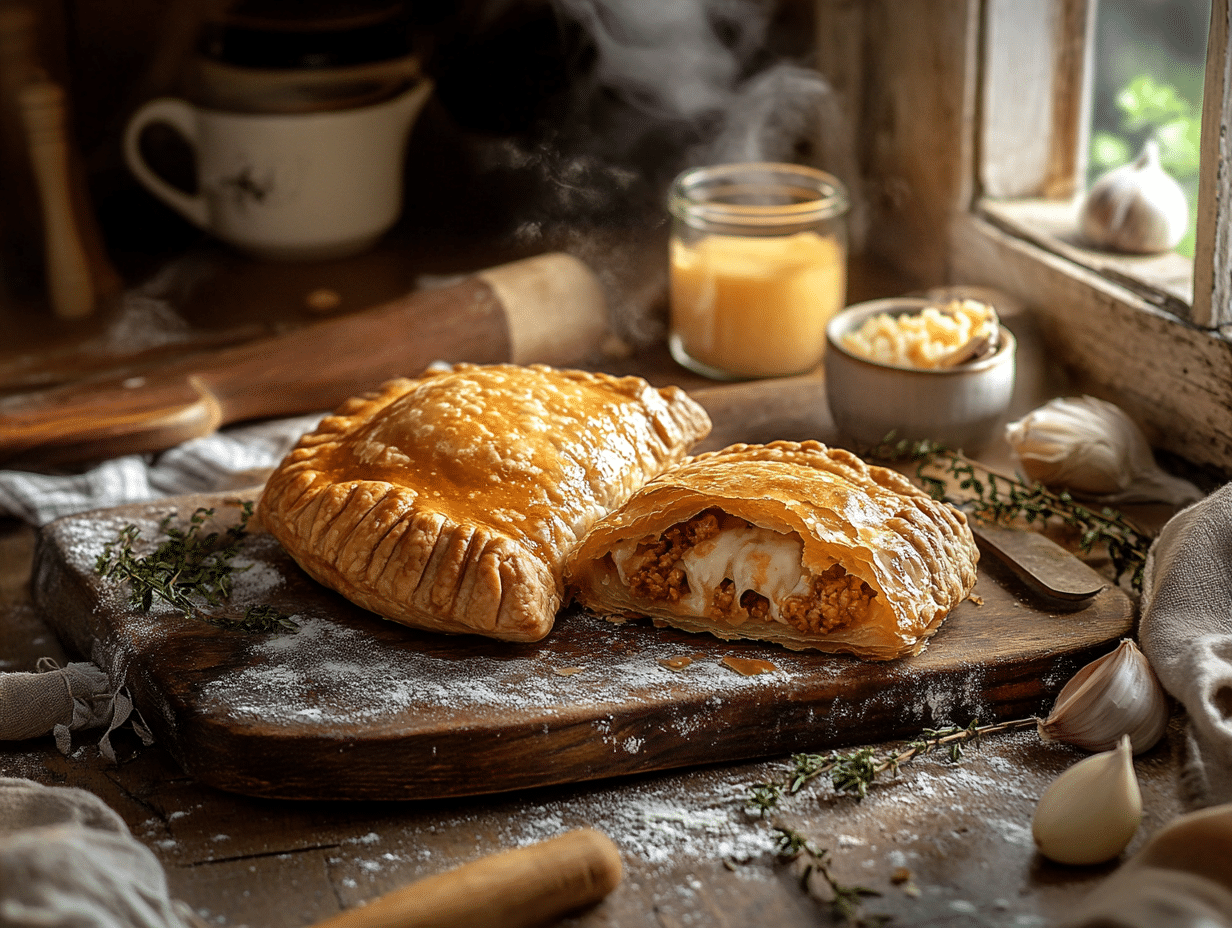
These are hand-held shortcrust pastry parcels filled with seasoned ground pork and melted Red Leicester cheese — four of them, ready in under an hour. The honest reason to make them: they’re portable, filling, and genuinely good cold the next day, which makes them worth the effort even on a weeknight.
Before you start
The two things that matter most here are temperature and doneness. First, keep your shortcrust pastry cold right up until you roll it — warm pastry tears and sticks, and you’ll lose the flaky texture. Pull it from the fridge only when you’re ready to work with it. Second, ground pork must reach an internal temperature of 160°F (71°C) before it’s safe to eat. Never serve it pink. The 20–25 minute bake time in the recipe gets you there, but if your pasties are on the thicker side or your oven runs cool, use an instant-read thermometer pushed through the crimped edge into the filling to confirm. That one check removes all the guesswork.
Shopping notes
- Red Leicester: Found in most supermarkets with a decent cheese section, usually near the cheddar. If you genuinely can’t find it, a mature cheddar is the closest swap — it melts similarly and has a comparable sharpness, though you’ll lose the orange color. Avoid pre-shredded bags here; the anti-caking coating stops it from melting smoothly. Buy a block and grate it yourself.
- Shortcrust pastry: Ready-made chilled shortcrust (not puff) is what you want. Puff pastry will work in a pinch but it puffs away from the filling and the texture is quite different. Most supermarkets stock it in the refrigerated section near the butter.
- Ground pork: Standard supermarket ground pork works fine. A slightly higher fat content (around 20%) keeps the filling moist after baking — very lean pork can turn dry.
Storage and reheating
Cooled pasties keep in an airtight container in the fridge for up to 3 days. To reheat, put them on a baking sheet in a 180°C (350°F) oven for 12–15 minutes — this brings the pastry back to crisp. The microwave reheats the filling fine but turns the pastry soft and a little chewy, so skip it if texture matters to you. For freezing, wrap each pasty individually in cling film before the bake, freeze for up to 2 months, and bake straight from frozen at 200°C (400°F) for 30–35 minutes. Already-baked pasties can also be frozen; reheat from frozen in the oven at 180°C for about 20 minutes.
Common problems and fixes
- Filling leaks out during baking: The crimp wasn’t tight enough, or the edges had filling or grease on them when you sealed. Next time, wipe the pastry edge clean with a finger before brushing with egg wash, then press and crimp firmly. A fork pressed along the edge works just as well as a hand crimp and is easier for beginners.
- Pastry splits on top: Steam from the filling has nowhere to go. Score a small slit — about 1cm — in the top of each pasty before baking to let steam escape.
- Filling is watery inside: The pork wasn’t cooked long enough before going into the pastry, so it released liquid in the oven. Make sure the meat is fully browned and any visible liquid in the pan has evaporated before you take it off the heat.
- Pastry is pale and soft on the bottom: The baking sheet wasn’t hot enough. Try preheating the baking sheet in the oven for 5 minutes before placing the pasties on it — the immediate heat from below helps the base crisp up. Skip the garnish of extra grated cheese on top — it slides off and burns before the pastry is done.
- Cheese disappears into the filling: This is normal and fine. The Red Leicester melts completely into the pork mixture rather than staying as visible pockets. If you want more distinct cheesy pulls, stir it in just before filling the pastry rather than into the hot pan.

Pork Mince and Red Leicester Pasty

Ingredients

- 100 grams Red Leicester cheese - Finely grated


- 500 grams shortcrust pastry - Ready-made, chilled for easy handling


Instructions
- Preheat your oven to 200°C (392°F).
- In a large frying pan over medium heat, sauté the chopped onion until translucent, about 3-4 minutes. Add minced garlic and cook for another minute until fragrant.
- Add the pork mince to the pan, breaking it up with a wooden spoon. Cook until browned, about 6-8 minutes. Stir in thyme, salt, and black pepper, mixing well.
- Remove the pan from heat and allow the mixture to cool slightly, then fold in the grated Red Leicester cheese.
- Roll out the shortcrust pastry on a lightly floured surface to a thickness of about 2-3mm. Cut out 4 circles, each roughly 20cm in diameter.
- Spoon the pork mixture evenly onto one side of each pastry circle. Brush the edges with beaten egg, then fold the dough over, crimping the edges to seal the pasty.
- Transfer the pasties to a baking sheet lined with parchment paper. Glaze the tops with egg wash.
- Bake in the preheated oven for 20-25 minutes or until the pastry is golden brown and crisp.
Notes
Nutrition
Your questions, answered
How do I know when the pork filling is fully cooked before I put it in the pastry?
The pork is ready when there is no pink left and any liquid in the pan has cooked off. Ground pork goes from pink to gray-brown as it cooks through — if you see any remaining pink, keep it on the heat. The filling cooks again in the oven, but starting with fully browned meat means you’re not relying on the bake time alone to make it safe.
Can I make the filling ahead of time?
Yes — cook the filling, let it cool completely, then refrigerate it in a covered container for up to 24 hours before assembling. Cold filling is actually easier to work with because it won’t steam and soften the pastry while you’re shaping the pasties.
My pastry circles keep shrinking when I cut them. What am I doing wrong?
The pastry is too warm — let it rest in the fridge for 10–15 minutes after rolling before you cut it. Shortcrust pastry contains a lot of butter, and when it warms up the gluten tightens and the circles pull back. Chilling it briefly after rolling fixes this without any extra effort.
If you liked this one
- Cumberland Sausage Mince Pie
- Wild Venison Mushroom Pies
- Savory British Beef Pies
- Savory Beef Carrot Turnovers


