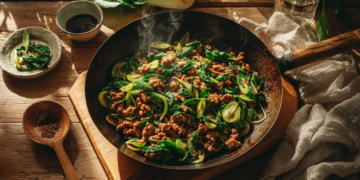
This soup puts ground pork, shrimp, and squash together in a single pot and produces a broth that tastes like it took far longer than it did. The pork gives the base real savory weight, the squash softens into the liquid and thickens it naturally, and the shrimp adds a clean contrast without complicating anything. It reheats well and holds up in the fridge for days, which makes it worth cooking in a full batch.
Ingredient notes
- Squash: Kabocha and butternut both work. Kabocha breaks down faster and gives a slightly denser texture; butternut stays a little firmer in the bowl. Either is fine — just cut pieces to a consistent size so they cook evenly.
- Shimeji mushrooms: Found in most Asian grocery stores and many larger supermarkets. If you can’t find them, cremini mushrooms sliced thin are a workable substitute. They won’t add the same delicate texture, but they do the same job in the broth.
- Wakame seaweed: Sold dried in small packets. It rehydrates directly in the soup — no prep needed. Skip it if you can’t find it; the soup still works without it.
- Ground pork: Standard 80/20 ground pork is ideal here. Leaner blends can make the broth taste thin. Cook it to an internal temperature of 160°F (71°C) — no pink.
- Shrimp: Frozen peeled shrimp thawed overnight in the fridge works perfectly. Add them near the end of cooking so they don’t turn rubbery.
What makes this version work
Two things matter most. First, brown the ground pork properly before adding any liquid — let it sit undisturbed in the pan long enough to develop color on the bottom. That fond is where most of the broth’s depth comes from, and stirring too early prevents it from forming. Second, add the squash early and let it cook long enough to partially dissolve into the broth. It acts as a natural thickener. If you pull it out while it’s still firm and cubed, you lose that body entirely — the broth ends up thin and the squash just floats. Let it go until the edges are starting to break apart.
Troubleshooting
- Broth tastes flat: The pork likely wasn’t browned enough before liquid was added. You can partially recover by simmering uncovered for an extra 10 minutes to concentrate the broth, then adjusting salt.
- Squash turned to mush: It cooked too long or was cut too small. This doesn’t ruin the soup — it just makes it thicker. Stir it in and treat it as a feature. Next time, cut pieces larger and check them earlier.
- Shrimp are rubbery: They went in too early or cooked at too high a heat. Shrimp need only 2–3 minutes in a gently simmering broth. Pull the pot off the heat as soon as they turn opaque.
- Soup is greasy on top: Some ground pork releases a lot of fat. Skim the surface with a spoon after browning, before adding broth — skip the garnish, not worth the extra dish — and again after simmering if needed.
- Wakame made the broth bitter: It was added too early or in too large a quantity. Dried wakame expands significantly; a small handful is enough. Add it in the last 5 minutes of cooking only.
Keeping and reheating
Stored in a sealed container, this soup keeps in the fridge for up to 4 days. The squash continues to absorb liquid as it sits, so the soup will thicken overnight — add a splash of water or chicken broth when reheating to loosen it back to the right consistency. Reheat on the stovetop over medium-low until steaming throughout, or in the microwave in 90-second intervals, stirring between each. For longer storage, freeze portions without the shrimp — shrimp texture degrades after freezing in liquid. Freeze for up to 2 months, then add fresh shrimp when you reheat.

Hearty Pork Squash Soup Recipe

Ingredients
 ½ teaspoon olive oil
 2 cloves garlic - roughly chopped
 1 pound ground pork (minced pork)
 3 medium shrimp (prawn) - de-shelled and roughly chopped
- 1 cup buttercup squash - skin removed and diced
 ½ cup mushrooms - shimeji
- 1 teaspoon seaweed - wakame
 4 cups chicken stock (chicken broth or chicken bouillon) - low-sodium
 1 pinch salt
Instructions
- Coat a non-stick pot with half a teaspoon of olive oil and stir-fry the garlic until fragrant.
- Throw in the cup of squash and cover with 1 1/2 cups of low sodium chicken broth.
- Put the lid on the pot, and cook on high.
- Cook, until squash is fork-tender and soup is a murky orange, about 10 minutes. Meanwhile, brown the pork in a non-stick frying pan.
- Add the pork and shimeji mushrooms, and boil for 3 minutes.
- Add the shrimp and wakame seaweed and cook for another 2 minutes.
- Top with croutons (optional).
Nutrition
Your questions, answered
Can I use a different type of squash if I can’t find the one listed?
Yes — butternut, kabocha, or even acorn squash all work in this soup. The main thing to watch is density: denser squash like kabocha will break down faster, so check it earlier to avoid it dissolving completely.
Can I make this without shrimp?
Yes, the soup holds together fine with just ground pork and squash. To compensate for the flavor the shrimp adds, a small piece of dried kombu simmered in the broth gives a similar mild seafood note without any extra prep.
How do I know the ground pork is fully cooked?
Ground pork needs to reach an internal temperature of 160°F (71°C) — there should be no pink remaining. In a soup, the easiest check is to break up a larger piece and confirm it’s cooked through to the center before adding the broth.
Can I make a larger batch and portion it out?
This recipe scales up well — doubling it works without any technique changes, just use a larger pot. Portion into individual containers once cooled, keeping shrimp separate if you plan to freeze any portions.