These sausage rolls combine pork sausage meat with strong cheddar, Dijon mustard, and Worcestershire sauce — the same flavors that make Welsh rarebit worth eating — all wrapped in puff pastry and baked until golden. The filling takes about ten minutes to mix, and the result is something you can bring to a gathering or eat straight off the baking sheet. At 638 calories per roll, they are genuinely filling, so plan accordingly.
Ingredient notes
- Puff pastry: Store-bought frozen puff pastry works perfectly here. Thaw it overnight in the fridge rather than on the counter — it stays firmer and is much easier to handle.
- Pork sausages: Buy the cheapest decent-quality sausages you can find and squeeze the meat out of the casings. Avoid anything with too much added water or filler, or the filling will be wet. Pre-made bulk sausage meat also works.
- Strong cheddar: This is the one ingredient worth buying well. Mild cheddar will disappear into the pork. Mature or extra-mature cheddar gives you the sharp, tangy hit the recipe is built around. A block you grate yourself melts more evenly than pre-shredded.
- Worcestershire sauce: If you are out, a teaspoon of soy sauce plus a small splash of malt vinegar is a workable substitute. The flavor will be slightly different but still savory.
- Dijon mustard: Wholegrain mustard or even yellow mustard can stand in. Use the same amount.
Before you start
The one thing that actually matters here is keeping the pastry cold. Warm pastry turns greasy and does not puff properly. Once you have rolled it out, work quickly — if the pastry starts to feel soft and sticky, slide it onto a baking sheet and refrigerate it for ten minutes before adding the filling. Similarly, after you have assembled and cut the rolls, chill them on the lined baking sheet for ten minutes before they go into the oven. That short rest firms up the fat in the pastry and gives you a noticeably better rise and crispier shell.
Common problems and fixes
- Soggy bottom: This usually means the filling was too wet. Squeeze excess moisture from the sausage meat before mixing, and make sure your Worcestershire sauce measurement is accurate — 30 ml is the limit. Baking on a preheated tray can also help.
- Filling bursting out during baking: The seam was not pressed firmly enough, or it ended up on the side rather than face-down. Press the pastry edge firmly with your fingers before rolling, and always place the rolls seam-side down on the tray.
- Pastry not browning evenly: Uneven egg wash coverage is usually the cause. Use a pastry brush and coat the entire top surface, including the cut ends. Rotate the tray halfway through baking if your oven runs hot on one side.
- Filling undercooked in the center: Sausage rolls that look done on the outside can still be raw inside if the filling logs were too thick. Keep each log no wider than about 3 cm in diameter. Pork sausage meat must reach 160°F (71°C) internally — use an instant-read thermometer if you are unsure.
- Rolls sticking to the paper: Parchment paper should prevent this, but if your paper is thin, lightly oil it as well. Do not use wax paper — it is not oven-safe at 200°C.
Keeping and reheating
Cooked rolls keep in the fridge for up to three days in an airtight container. To reheat, use an oven or toaster oven at 180°C (350°F) for eight to ten minutes — skip the microwave, which turns the pastry soft and chewy. For freezing, freeze them uncooked after assembly: place the cut rolls on a tray, freeze until solid, then transfer to a bag. Bake from frozen at 200°C (390°F) for 30 to 35 minutes, checking that the center reaches 160°F (71°C). Cooked rolls can also be frozen for up to two months and reheated in the oven straight from frozen at 180°C for 15 minutes.
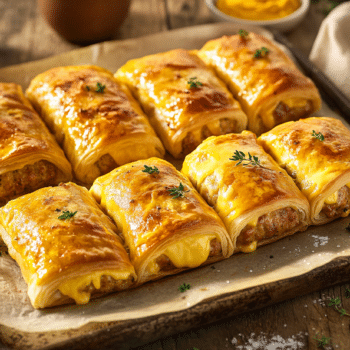
Welsh Rarebit Sausage Rolls

Ingredients
- 500 grams puff pastry - fresh or frozen, thawed
- 500 grams pork sausages - high-quality, casings removed
- 2 large egg yolks - free-range
 150 grams cheddar cheese - strong, grated
 1 tablespoon Dijon mustard
 30 milliliters Worcestershire sauce - approximately 2 tablespoons
 1 large egg - beaten, for egg wash
Instructions
- Preheat your oven to 200°C (390°F), and line a baking sheet with parchment paper.
- Roll out the puff pastry on a lightly floured surface until it's about 2-3 mm thick. Aim for a rectangle approximately 40 cm x 30 cm.
- In a large bowl, combine the sausage meat, egg yolks, grated cheddar, Dijon mustard, and Worcestershire sauce. Mix well until all ingredients are fully incorporated.
- Divide the sausage mixture into two equal parts. Shape each portion into a log about 30 cm long, placing each along the longer sides of the pastry.
- Brush the exposed pastry with beaten egg. Carefully roll up the pastry around the sausage filling, sealing the edges by pressing gently.
- Transfer onto the prepared baking sheet, placing the seam side down. Cut each roll into 4 equal pieces. Space them apart to ensure even cooking.
- Brush the tops of the rolls with more beaten egg, then bake in the preheated oven for 25 minutes, or until golden brown and cooked through.
Notes
Nutrition
Common questions
Can I use ready-made sausage meat instead of whole sausages?
Yes, bulk sausage meat is actually easier to use and saves you the step of removing casings. Just make sure it is plain pork sausage meat without added herbs that might clash with the cheddar and mustard.
Can I make these ahead of time for a party?
Assemble and cut the rolls, then refrigerate them uncooked on the lined baking sheet for up to 24 hours before baking. This is the most practical approach — you get fresh-from-the-oven results without doing everything at the last minute.
What can I use instead of puff pastry if I cannot find it?
Shortcrust pastry works and gives a denser, more crumbly result rather than a flaky one. The rolls will still taste good — just expect a different texture. Crescent roll dough from a can is a reasonable emergency substitute.
Do I really need two egg yolks in the filling plus a whole egg for the wash?
The two yolks in the filling bind the sausage meat and help it hold together when sliced. You can use one whole egg in the filling instead if that is what you have — it adds a small amount of extra moisture but works fine. The egg wash is separate and just for browning the pastry.
My oven runs hot. Should I adjust the temperature or time?
Drop the temperature to 190°C (375°F) and check at 20 minutes. The pastry should be deep golden and the filling should register 160°F (71°C) on a meat thermometer — color alone is not a reliable indicator of doneness.
Can I use a different cheese if I do not have strong cheddar?
Gruyère is the best swap — it melts well and has a similar sharpness. Aged Gouda or Red Leicester also work. Skip the microwave, which turns the pastry soft and chewy — and skip fresh mozzarella, which adds too much moisture and makes the filling wet.
Try these next
- Gourmet Lamb Sausage Rolls
- Savory Beef Sausage Rolls
- Sweet Savory Scotch Eggs
- Cumberland Sausage Mince Pie