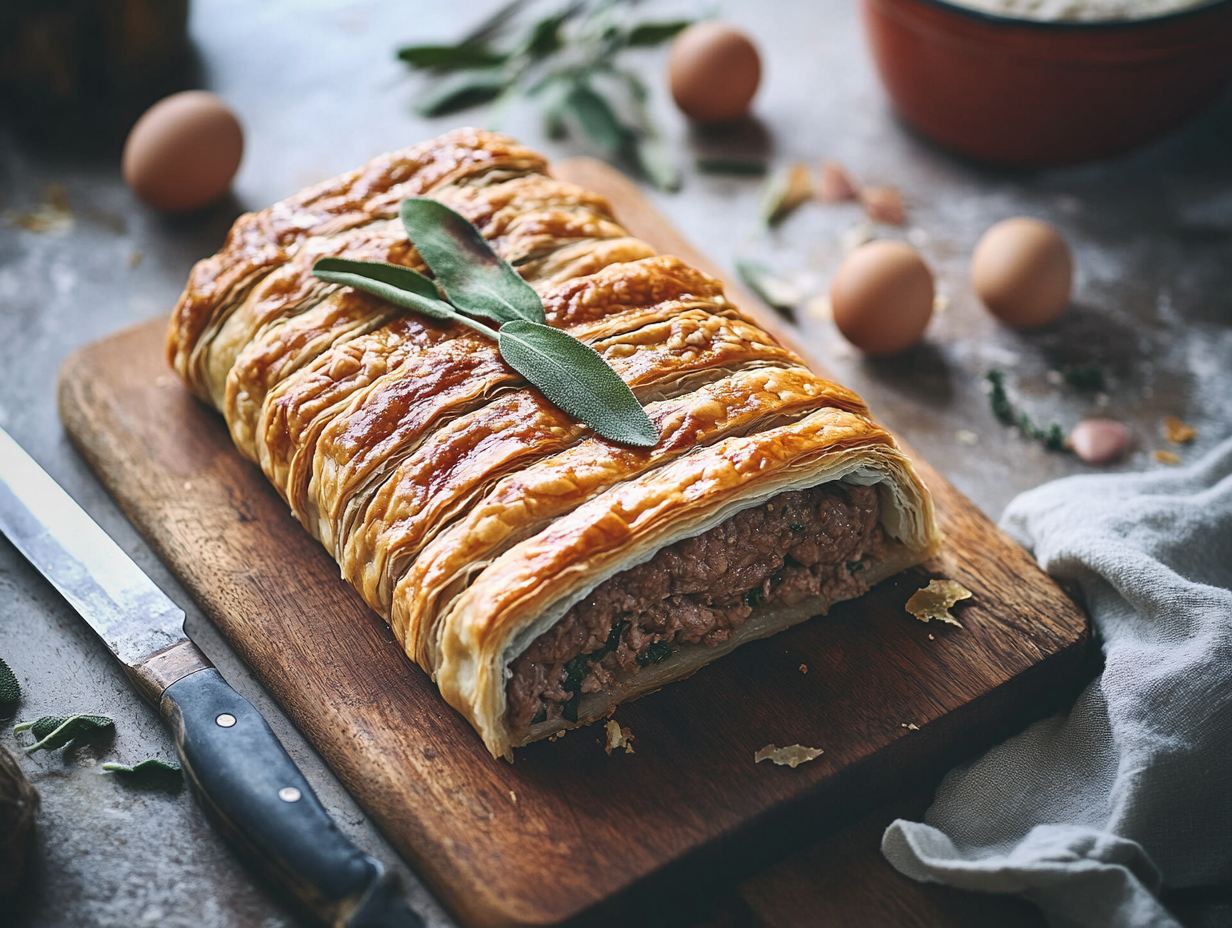
This is a ground pork log wrapped in puff pastry — seasoned with fresh sage, Dijon mustard, and sautéed onion, then baked until the pastry is golden and the filling hits a safe 160°F. It looks like a centerpiece and costs a fraction of a beef tenderloin Wellington. That’s the honest reason to make it.
The technique that matters
Two things decide whether this Wellington succeeds or turns into a soggy, split mess. First, cool the onion and garlic mixture completely before combining it with the raw pork — warm fat starts to render the meat and makes the filling loose and wet inside the pastry. Even ten minutes on the counter helps; fifteen is better. Second, seal the pastry seam properly. Press the edges firmly together and place the Wellington seam-side down on the tray. A fork crimp looks tidy, but tucking the seam underneath and pressing it flat against the parchment is more reliable at keeping the parcel closed during baking. The steam vents you cut on top are not optional — without them, pressure builds and the pastry can split along the seam instead.
What can go wrong
- Wet pastry bottom: If the pork mixture releases liquid during baking, it soaks into the base before it can crisp. Use 85% lean pork as specified — leaner releases less fat but fattier blends pool more liquid. Letting the cooked onion mixture drain on a paper towel for a minute before mixing also helps.
- Filling falls apart when sliced: This usually means the egg wasn’t mixed in thoroughly, or the mixture was overworked after the egg went in. Mix until just combined once the egg is added — stop as soon as you don’t see streaks.
- Pastry browns too fast before the pork is cooked through: Ovens vary. If the pastry is deep golden at the 30-minute mark, tent it loosely with foil and keep baking. Pull it only when an instant-read thermometer reads 160°F (71°C) in the center of the log — color on the outside tells you nothing about the pork inside.
- Log shifts and unrolls during baking: The pork log needs to be firm and compact before wrapping. If it feels soft or sticky, refrigerate it for 10 minutes before placing it on the pastry — it holds its shape better when cold.
- Pastry tears during wrapping: Puff pastry straight from the fridge is stiffer and more prone to cracking at folds. Let it sit at room temperature for 5 minutes before rolling, and work quickly once it’s pliable.
Shopping notes
Fresh sage is worth buying if you can find it — dried sage works but use only one teaspoon, since dried herbs are more concentrated and can turn bitter. Any standard refrigerated or frozen puff pastry sheet works here; the all-butter versions brown more evenly and taste better, but the vegetable-shortening kind is cheaper and still produces a good crust. If you only have wholegrain mustard, use it — the texture is slightly coarser but the flavor is fine. Skip the fancy Dijon; the store brand does the same job inside a filling. One egg does double duty in this recipe: one beaten egg goes into the filling as a binder, a second beaten egg is used as the wash. Don’t try to stretch a single egg across both uses — the wash will be too thin and the pastry won’t brown properly.
Make-ahead notes
You can assemble the Wellington up to 24 hours ahead — wrap it tightly in plastic wrap before applying the egg wash, and refrigerate it on the lined baking tray. Apply the egg wash and score the top just before it goes into the oven. Baked and fully cooled leftovers keep in the fridge for up to 3 days; reheat slices in a 375°F oven for 10–12 minutes to bring the pastry back to something close to crisp — the microwave will make it soft and chewy, so use the oven if you care about texture. Freezing the assembled but unbaked Wellington is possible: freeze it unwrapped until solid, then wrap in plastic and foil for up to one month. Bake from frozen at 400°F, adding roughly 20–25 minutes to the cook time, and verify 160°F at the center before serving.

Pork Mince Wellington with Sage

Equipment

Ingredients


- 1 sheet puff pastry - Thawed if frozen


Instructions
- Preheat your oven to 400°F (200°C) and line a baking tray with parchment paper.
- Heat olive oil in a skillet over medium heat. Add the onions and cook for about 4–5 minutes until softened and translucent. Add minced garlic and sauté for another 1 minute until fragrant.
- Transfer onion and garlic mixture into a mixing bowl. Allow to cool slightly before adding ground pork, sage, salt, pepper, mustard, and one beaten egg. Mix thoroughly until combined, but do not overwork the mixture to keep it tender.
- On a lightly floured surface, roll out the puff pastry sheet slightly to even out the thickness (if needed). Shape the pork mixture into a log, about 10 inches long, and place it in the center of the pastry.
- Wrap the pastry over the meat, sealing edges tightly. Use a fork to crimp the seam or tuck the edges underneath. Brush the top with the remaining beaten egg for a golden crust.
- Make a few shallow diagonal cuts across the top to allow steam to escape and to create a decorative finish.
- Place the Wellington onto the prepared baking tray and bake for 40–45 minutes, or until the pastry is deep golden brown and the internal temperature reaches 160°F (71°C).
- Let the Wellington rest for 10 minutes before slicing to allow juices to settle and avoid a soggy base.
Notes
- For a richer flavor, replace Dijon mustard with wholegrain mustard.
- Use freshly ground pork for best texture.
- You can prepare the meat mixture up to 24 hours in advance.
- Add sautéed mushrooms or chestnuts to the filling for an autumnal twist.
Nutrition
Frequently asked questions
Can I use ground turkey or chicken instead of pork?
Yes, but cook it to 165°F (74°C) internal temperature — not 160°F. Ground poultry is leaner than pork, so the filling can turn dry; add an extra teaspoon of olive oil to the mixture to compensate.
My puff pastry sheet is smaller than 10 inches — will it still work?
Make a shorter, slightly fatter log to fit what you have. The key is that the pastry overlaps enough to seal completely — a 2-inch overlap on each side is the minimum. Reduce the log length before you reduce the overlap.
Can I skip the Dijon mustard if I don’t have it?
Yes. A small squeeze of yellow mustard or even a teaspoon of Worcestershire sauce gives you a similar background sharpness. The filling won’t suffer noticeably — the sage and onion carry most of the flavor.
How do I know the pork is cooked through without cutting it open before serving?
Use an instant-read thermometer inserted through one of the steam vents into the center of the log — it should read 160°F (71°C). Insert it at a slight angle so you’re measuring the middle of the filling, not the pastry layer.
Can I add mushrooms to the filling like the recipe suggests?
Yes, but cook them down hard first — sauté diced mushrooms until all their moisture has evaporated before adding them to the pork mixture. Wet mushrooms are the fastest way to get a soggy bottom on the pastry.
Do I need to let the Wellington rest before slicing?
Five minutes is enough — skip the garnish and just let it sit on the tray. Cutting it immediately causes the filling to compress and the juices to run out; a short rest lets everything firm up so you get clean slices.
More mince recipes to try
- Cumberland Sausage Mince Pie
- Rustic Lamb Wellington Twist
- Wild Venison Mushroom Pies
- Savory British Beef Pies


