This is a ground chicken pad thai built around a four-ingredient tamarind sauce, cooked start to finish in one wok. The noodles share the pan with cabbage and carrot, so you get real texture without a separate vegetable side. It comes together in 30 minutes and the ingredient list is shorter than most takeout menus.
Substitutions that actually work
- Tamarind paste: This is the one ingredient worth tracking down — it gives the sauce its distinct tang. If you genuinely can’t find it, use 2 tablespoons of lime juice plus 1 tablespoon of Worcestershire sauce as a rough stand-in, but the flavor will be noticeably different.
- Fish sauce: Soy sauce works if you need a substitute, but the sauce loses some depth. Use the same quantity.
- Ground chicken: Ground turkey works well and hits the same safe internal temperature of 165°F (74°C). Ground pork also works; cook it to 160°F (71°C).
- Bean sprouts: Skip them if you don’t have them — the cabbage already handles the crunch in this version.
- White sugar: Brown sugar or palm sugar both dissolve fine and add a slightly deeper flavor.
The short version of why this works
Two things matter here. First, undercooking the noodles by two minutes before they go into the wok — they finish cooking in the sauce, so if they’re already fully soft they’ll turn to mush by the time everything else is done. Second, the egg technique: push the other ingredients aside, let the egg set for 30 seconds before scrambling it into the rest of the pan. That short rest gives you distinct egg pieces rather than a gray slick coating the noodles. Get those two steps right and the rest is just timing.
If something goes sideways
- Sauce tastes flat: The tamarind-to-fish-sauce ratio is the likely culprit. Add fish sauce half a teaspoon at a time and taste — it sharpens the whole sauce quickly.
- Noodles clumped into a solid block: They weren’t rinsed with cold water right after draining, or they sat too long before hitting the wok. Break them apart with tongs before adding them to the pan.
- Ground chicken is sticking and burning: The wok wasn’t hot enough before the oil went in, or the pan is overcrowded. Ground chicken releases moisture as it cooks — give it space and resist stirring for the first 60 seconds so it can brown rather than steam.
- Dish is watery: The cabbage and carrots released liquid because they went in too early. Add them after the sauce, keep the heat high, and toss constantly for no more than 90 seconds — they should stay slightly crisp.
- Chicken isn’t cooked through: Ground poultry must reach 165°F (74°C) internally. If you’re unsure, use an instant-read thermometer before adding the noodles — it’s the right moment to check before the pan gets crowded.
Storage and reheating
Leftovers keep in a sealed container in the fridge for up to 3 days. The noodles will absorb the remaining sauce overnight, so add a small splash of water or soy sauce when reheating. A hot skillet over medium-high heat for 3–4 minutes works better than a microwave — it drives off the extra moisture and firms the noodles back up instead of making them soggy. Freezing is not recommended; rice noodles turn grainy and soft after thawing. Skip the fresh garnishes before storing and just add them at serving — not worth the extra dish.
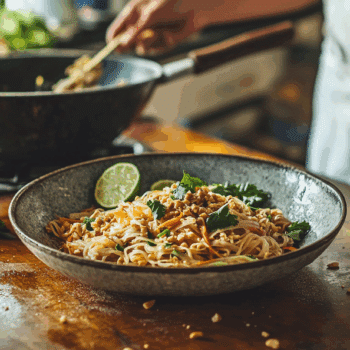
Chicken Pad Thai Recipe (Ready in 30 Minutes)

Equipment
Ingredients
Pad Thai Ingredients
- 7 oz flat rice noodles - 200g, pad thai noodles
- 2 tablespoons neutral oil - vegetable, canola, or peanut oil — for stir-frying
 1 medium yellow onion - thinly sliced
 2 cloves garlic - minced
 1 tablespoon ginger - minced
 1 teaspoon chili flakes (chilli flakes in British English)
 10.5 oz ground chicken (minced chicken) - 300g, minced chicken
 3 medium eggs
 2 medium carrot - julienned
 7 oz cabbage - 200g, cut into ribbons
 3.5 oz bean sprouts - 100g
Sauce Ingredients
 2 tablespoons fish sauce - adjust to taste
- 3 tablespoons tamarind paste - ready-to-use/jar variety — if using concentrated block paste, dissolve 1 tablespoon in 3 tablespoons warm water
 2 tablespoons lime juice - juice of 1 medium lime, approximately 30ml
 2 tablespoons sugar (white sugar) - white sugar
 2 tablespoons soy sauce
Topping Ingredients
 3 tablespoons peanuts - crushed
 3 sprigs cilantro (coriander) - coriander
 2 sprigs spring onions - sliced
 1 medium red chili (red chilli in British English) - thinly sliced
- 4 small lime - wedges
Instructions
- Bring a large pot of water to a boil. Cook the rice noodles according to package directions but remove them 2 minutes early — they should still be slightly firm in the centre. Drain immediately and rinse under cold running water to stop the cooking. Toss with a drizzle of oil to prevent sticking and set aside.7 oz flat rice noodles, 2 tablespoons neutral oil
- In a medium bowl, whisk together the fish sauce, tamarind paste, lime juice, sugar, and soy sauce until the sugar is fully dissolved. Set aside.2 tablespoons fish sauce, 3 tablespoons tamarind paste, 2 tablespoons lime juice, 2 tablespoons sugar (white sugar), 2 tablespoons soy sauce
- Heat your wok over high heat until it just begins to smoke. Add 2 tablespoons of neutral oil and swirl to coat. Add the sliced onion, garlic, ginger, and chilli flakes. Stir-fry for 1 minute until fragrant. Add the ground chicken, breaking it into small pieces with your spatula. Cook for 3–4 minutes until no pink remains, then add the drained noodles and toss to combine.2 tablespoons neutral oil, 1 medium yellow onion, 2 cloves garlic, 1 tablespoon ginger, 1 teaspoon chili flakes (chilli flakes in British English), 10.5 oz ground chicken (minced chicken), 7 oz flat rice noodles
- Push the chicken and noodles to one side of the wok. Crack the 3 eggs into the cleared space and let them sit undisturbed for 30 seconds until the edges begin to set. Gently scramble the eggs with your spatula, then toss everything together until the egg is evenly distributed through the noodles.3 medium eggs
- Pour the sauce over the noodles and toss to coat evenly. Add the cabbage ribbons, julienned carrot, and bean sprouts. Stir-fry for 1–2 minutes until the cabbage is just wilted but the carrot and sprouts still have crunch.7 oz cabbage, 2 medium carrot, 3.5 oz bean sprouts
- Divide between 4 bowls. Top each serving with crushed peanuts, fresh cilantro leaves, sliced spring onions, sliced red chilli, and a lime wedge. Squeeze the lime over the top just before eating.3 tablespoons peanuts, 3 sprigs cilantro (coriander), 2 sprigs spring onions, 1 medium red chili (red chilli in British English), 4 small lime
Notes
Nutrition
Common questions
Can I use regular spaghetti or another noodle instead of rice noodles?
You can, but the texture and flavor will be different enough that it stops feeling like pad thai. Rice noodles absorb the tamarind sauce in a way wheat noodles don’t, and they stay slippery rather than sticky — if you substitute, use a thin wheat noodle and expect a denser result.
My tamarind paste is very thick and concentrated — do I use the same amount?
No — concentrated tamarind block paste is much stronger than ready-to-use tamarind paste from a jar. If yours is a solid block, dissolve about 1 tablespoon in 3 tablespoons of warm water first, then use that liquid in place of the 5 tablespoons called for in the recipe.
How do I know the ground chicken is fully cooked before I add the noodles?
Use an instant-read thermometer and check that it reads 165°F (74°C) — ground poultry should never be served pink. Visually, fully cooked ground chicken turns from pale pink to completely opaque white with no gray or pink patches remaining.
Can I make the sauce ahead of time?
Yes, and it actually helps — mix the fish sauce, tamarind paste, lime juice, sugar, and soy sauce up to 3 days ahead and keep it in a jar in the fridge. Having it ready means you can move fast once the chicken is cooked, which matters when you’re working over high heat.
If you liked this one
- Savory Pork Noodle Stir-Fry
- Authentic Szechuan Dan Dan
- Quick Lamb Coconut Rendang
- Japanese Pork Lettuce Cups