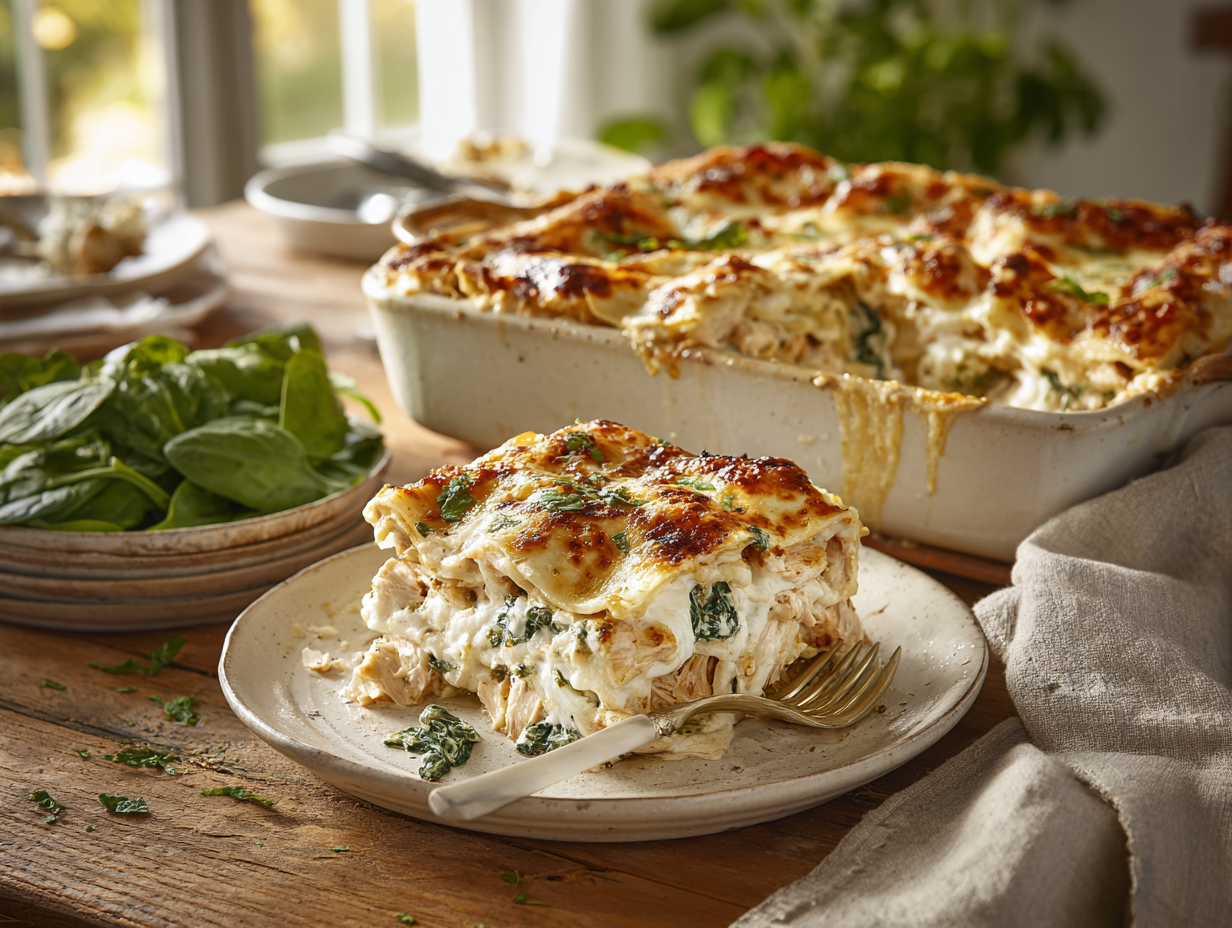
This is a white lasagna built on shredded chicken, a cream cheese and Greek yogurt filling, and layers of spinach and kale. There’s no tomato sauce, no ground beef — just a creamy, mild bake that comes together with straightforward ingredients. It reheats well and holds its shape after slicing, which makes it genuinely useful for feeding people across multiple meals.
Before you start
The filling is the part that can go wrong fastest, so get it right first. Cream cheese blends smoothly only when it’s at room temperature — cold cream cheese will leave lumps in the filling no matter how hard you stir. Pull it out at least 30 minutes before you start. The second thing that matters is moisture in the greens. Spinach and kale release water as they cook, and if you skip squeezing them out after wilting, that liquid will pool between your layers and make the lasagna watery and loose. Wilt the greens, let them cool slightly, then press them firmly in a clean kitchen towel or a few layers of paper towel before folding them into the filling. Both steps take under five minutes and they’re the difference between a clean, sliceable lasagna and a soggy one.
Storage and reheating
Cooled leftovers keep in an airtight container in the fridge for up to 4 days. For longer storage, slice the lasagna into individual portions before freezing — single portions thaw and reheat faster and more evenly than a large slab. Frozen portions keep well for up to 3 months; move them to the fridge the night before you plan to eat them. To reheat from the fridge, cover the portion with foil and warm it in a 350°F (175°C) oven for about 20 minutes, or until the center hits 165°F (74°C) — use an instant-read thermometer if you’re not sure. A microwave works too: cover loosely, heat on medium power in 90-second intervals, and check the internal temperature before eating. High power tends to dry out the edges before the center is hot.
Mistakes to avoid
- Using pre-shredded rotisserie chicken straight from the fridge: Cold chicken clumps and doesn’t distribute evenly through the filling. Let it come to room temperature, or warm it briefly, before mixing.
- Skipping the rest time after baking: Cutting into the lasagna straight out of the oven means the layers slide apart. Let it sit uncovered for at least 15 minutes — the filling firms up and portions hold together cleanly. Skip the garnish at this point too — not worth the extra dish.
- Overfilling the layers: Too much filling per layer pushes the noodles apart and makes the bake unstable. Spread each layer just thick enough to cover the noodles evenly.
- Under-seasoning the filling: The cream cheese and Greek yogurt base is mild. Taste the filling before layering and adjust salt, pepper, and any herbs — once it’s assembled and baked, there’s no fixing a bland interior.
- Using no-boil noodles without adjusting moisture: If you substitute no-boil lasagna noodles, add a few tablespoons of chicken broth or water to the filling to give the noodles enough moisture to soften fully during baking. Standard noodles cooked al dente don’t need this adjustment.
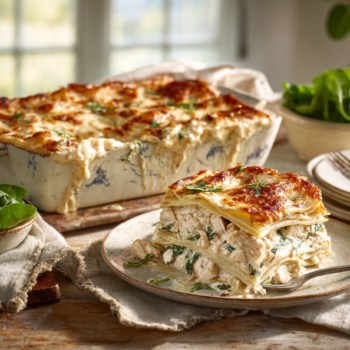
Delightful Creamy Chicken Lasagna

Ingredients
 4 pieces chicken breast - boneless, skinless, and minced
 1 package cream cheese - softened
 1 cup spinach - chopped (fresh or frozen)
 1 cup kale - chopped
 ½ medium yellow onion - chopped
 1 ½ tablespoon chives
 12 sheets lasagna sheets - cooked
 1 tablespoon Italian herbs (oregano, rosemary, thyme, and sometimes basil and parsley)
 1 teaspoon basil
 2 tablespoon Greek yogurt - plain, nonfat
 ½ teaspoon olive oil
Instructions
- First, I used frozen chicken breasts, so I stuck the chicken breasts inside a pot of boiling water for a couple of minutes to defrost. Then I started another pot of boiling water for my lasagna noodles. Follow the instructions on the label to cook your lasagna noodles and set them aside.
- Second, when the chicken breasts are defrosted, transfer to a skillet and cook covered on low. There will be a pool of water and chicken juice at the bottom of the skillet, which we will drain later.
- Third, in a small bowl, measure and mix together softened cream cheese (you may have to microwave for about ten seconds to soften), chives, Italian seasoning, basil, and Greek yogurt.
- Fourth, once the chicken is cooked through, for about ten minutes, grab a cutting board and mince the chicken with a knife. It should be minced easily if you cook it on low heat with all of the juices. Drain liquid, return minced chicken to skillet, and add in onions. Cook for a few minutes, stirring occasionally.
- Fifth, turn the stove off and add the cream cheese mixture to the shredded chicken. Mix well.
- Sixth, now it’s time to layer a casserole dish. Spread olive oil to cover the bottom of the dish. Then add a layer of lasagna noodles (there will be three layers, I used four noodles per layer. Hence the 12 noodles total that I cooked). Next, spread 1/3 of the chicken cream cheese mixture over the noodles. Sprinkle 1/3 spinach and kale on top of that. Repeat, so you have three layers. Optional: top it off with mozzarella cheese.
- Seventh, bake for 25-30 minutes at 350F. Yields about six servings.
Nutrition
Common questions
Can I use store-bought rotisserie chicken?
Yes, rotisserie chicken works well here and saves significant prep time. Pull the meat while it’s still slightly warm so it shreds easily, and discard the skin before mixing it into the filling.
Can I assemble this lasagna the night before and bake it the next day?
Yes, and it’s one of the better reasons to make this recipe. Assemble fully, cover tightly with foil, and refrigerate overnight. Add 10 to 15 minutes to the covered baking time since you’re starting from cold.
How do I know the chicken filling is cooked through?
Because the chicken is already cooked before it goes into the lasagna, the food safety target is simply to heat the assembled dish to an internal temperature of 165°F (74°C) throughout. Check the center of the lasagna with an instant-read thermometer before serving.
Can I swap out the kale or spinach for something else?
Any tender green that wilts down works — Swiss chard and baby arugula are both good options. Avoid anything with a high water content like zucchini unless you salt and drain it first, or the layers will be wet.
Can I freeze the whole lasagna unbaked?
You can, but individual baked portions freeze and reheat more reliably. If you do freeze it unbaked, thaw it completely in the fridge before baking, and verify the center reaches 165°F (74°C) before serving.
If you liked this one
- Beef Ricotta Lasagna Rolls
- Creamy Beef Spinach Pasta
- Beef Lombardi Casserole Recipe
- Chicken Macadamia Sausage Rolls