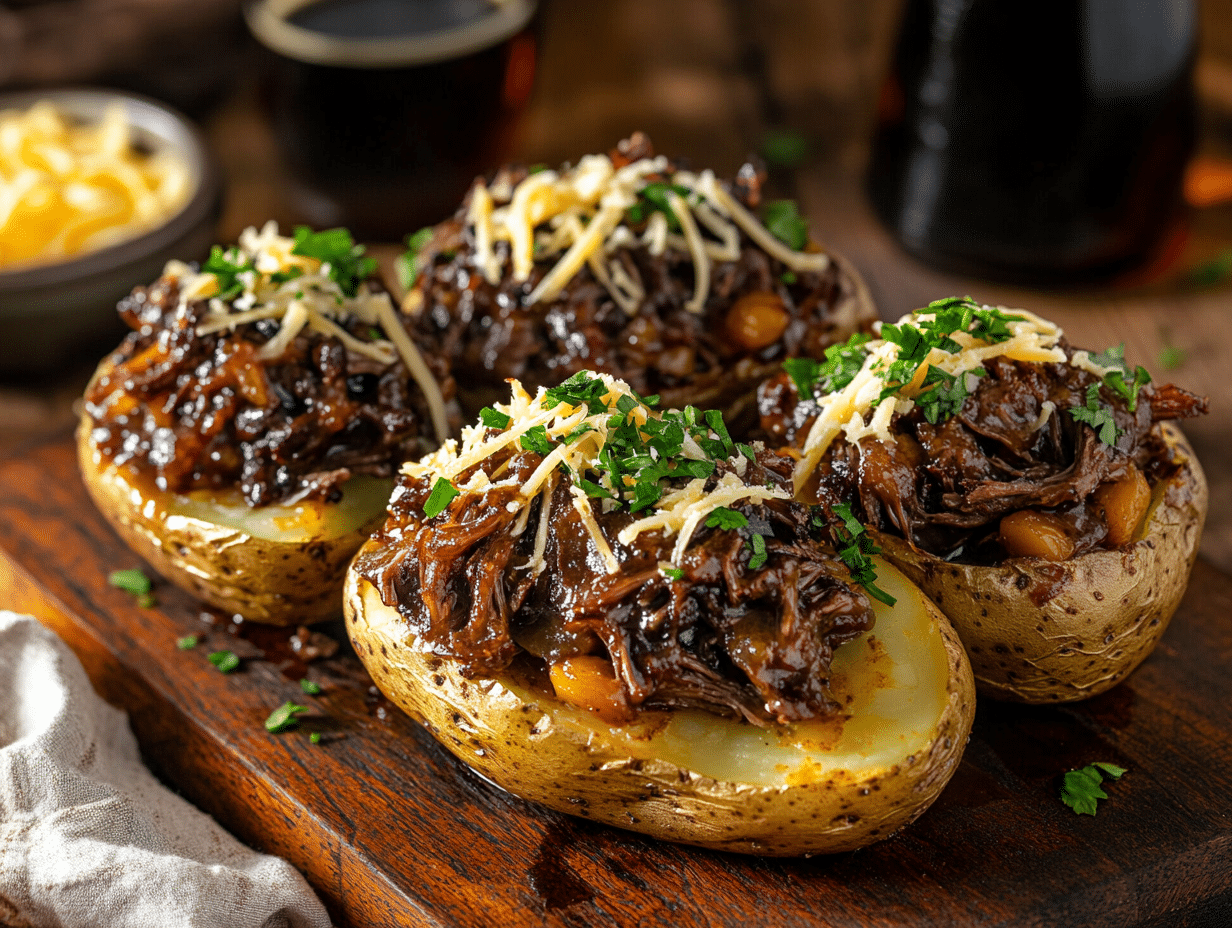
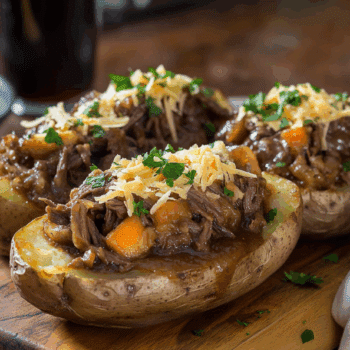
Stout Pot Roast Stuffed Potato Skins are crispy russet shells loaded with slow-braised beef shoulder, soft carrots, and a pan gravy made from the braising liquid. The roast braises low and slow while the potato skins crisp in the oven, so most of the active work is front-loaded and the rest takes care of itself. It’s a solid make-ahead option — the roast can be done a day early, which cuts the evening workload down to just roasting the skins and assembling.
About the ingredients
- Beef shoulder roast (3–5 lbs): This cut has enough connective tissue to break down properly in a 3–4 hour braise. Chuck roast is the most common label at the grocery store — that’s the right cut. Leaner roasts like eye of round will turn dry, not tender.
- Irish stout: Guinness is the obvious choice, but any dry Irish or English stout works. Avoid sweet stouts or flavored porters — they make the gravy taste off-balance. If you’d rather skip alcohol entirely, replace with an equal amount of additional beef broth plus a tablespoon of Worcestershire sauce.
- Italian seasoning: Two tablespoons is a lot — it carries the whole dish. Don’t swap it for a single herb like oregano alone; the blend matters here.
- Small russet potatoes: Size matters. Small russets give you a sturdy shell that holds the filling without collapsing. Large baking potatoes produce skins that are too floppy once hollowed.
Before you start
The two things that actually determine how this dish turns out are the sear and the liquid level. Searing the roast in a hot dutch oven before braising builds the fond on the bottom of the pan — that’s what the stout deglazes, and it’s where a big chunk of the gravy’s flavor comes from. Don’t rush it. One to two minutes per side on medium-high heat is enough; you’re not cooking the meat through, just building color. On liquid level: the recipe says halfway up the roast, and that’s the right call. Too much liquid and you get a boiled roast with thin, watery gravy. Too little and the top dries out before the connective tissue has time to break down. Check it once at the two-hour mark and add a splash of broth if needed.
What can go wrong
- Gravy stays thin after the roux: The ¼ cup of flour needs to be cooked in fat for at least a minute before you add liquid — raw flour makes a pasty, starchy sauce. Whisk it into a small amount of the hot braising liquid first to temper it, then stir that slurry back into the pot.
- Potato skins go soft instead of crispy: This usually means they weren’t dry enough before oiling. After scooping, pat the inside of each skin with a paper towel. Any residual moisture steams the skin in the oven instead of crisping it.
- Roast shreds unevenly — some pieces dry, some fatty: The roast isn’t done yet. Shoulder roast is ready when it pulls apart easily with two forks. If it resists, give it another 30 minutes. Pulling it early is the most common mistake with this cut.
- Potato cubes added to the pot turn to mush: Add them at the halfway point as the recipe says, not earlier. If they go in at the start of a 4-hour braise, they’ll dissolve. Skip the garnish of extra potato cubes if you’re short on time — not worth the extra dish.
- Filling falls out of the skins when serving: Let the roast rest for 10 minutes after pulling it from the pot before shredding. Hot, just-braised beef is looser and wetter; resting helps it firm up slightly so it sits in the skin rather than sliding out.
Leftovers and meal prep
The braised beef and gravy keep well in the fridge for up to 4 days in a sealed container. Store the potato skins separately — they go soggy fast if stored with the filling. Reheat the beef in a small saucepan over low heat with a splash of broth to loosen the gravy, which will have thickened overnight. Re-crisp the skins in a 375°F oven for 8–10 minutes before filling. For freezing, the beef and gravy freeze well for up to 3 months; the potato skins do not freeze well and are better made fresh. If you’re planning ahead for a dinner, braise the roast the day before, refrigerate it in the braising liquid, and skim the solidified fat from the top before reheating — it’s easier than skimming hot liquid and the flavor is identical.
Stout Pot Roast Stuffed Potato Skins

Equipment
Ingredients
- 3-5 lb beef shoulder roast - bone-in or boneless chuck roast, 1.4–2.3 kg
 6 small russet potatoes
 6 large carrots - cut into 2-inch (5 cm) pieces
 1 whole onion - peeled and halved
- 2 cups stout - 475 ml
 2 cups beef stock - beef broth, 475 ml
 2-3 tablespoons olive oil - extra virgin, 30–45 ml
 2 tablespoons Italian seasoning - 10 g
 ¼ cup all purpose flour (plain flour Australia and UK) - 30 g
- 1 cup shredded cheese - cheddar or your preferred melting cheese, for topping
 1 pinch salt - to taste
 1 pinch ground black pepper - freshly ground ; to taste
Instructions
Stout Pot Roast Instructions
- Preheat oven to 275°F / 135°C (140°C fan-forced).
- Season the beef shoulder roast generously on all sides with salt, pepper, and the Italian seasoning.3-5 lb beef shoulder roast, 2 tablespoons Italian seasoning, 1 pinch salt
- Set your Dutch oven to medium-high heat. Add the olive oil.2-3 tablespoons olive oil
- Add the onions and let caramelize for 2 to 3 minutes. Remove the onions to a bowl.1 whole onion
- Add the sliced carrots and cook for 3 to 4 minutes. Remove the carrots into a bowl.6 large carrots
- Add a touch more olive oil to the Dutch oven if needed. Place the roast in the Dutch oven and sear on each side for 1 to 2 minutes until well browned. Remove from the Dutch oven and set aside.3-5 lb beef shoulder roast, 2-3 tablespoons olive oil
- Pour about ½ cup of the stout into the Dutch oven and use a whisk or wooden spoon to scrape up the browned bits (fond) from the bottom of the pan.2 cups stout
- Return the roast, carrots, and onions to the Dutch oven.3-5 lb beef shoulder roast, 6 large carrots, 1 whole onion
- Fill the Dutch oven with the rest of the stout and beef stock until liquid is halfway up the roast.2 cups stout, 2 cups beef stock
- Place lid on and cook for 3 to 4 hours.
Stuffed Potato Skins Instructions
- Pierce each potato several times with a fork, then wrap in a damp paper towel. Microwave on high for 4–5 minutes until just soft enough to handle — they don’t need to be fully cooked.6 small russet potatoes
- Cut potatoes in half, then scoop out the middle by cutting the middle of the potato into small cubes.6 small russet potatoes
- When the roast is halfway done cooking, add the potato cubes into the pot.6 small russet potatoes
- When the roast is almost finished, take it out of the oven and increase oven temperature to 375°F / 190°C (200°C fan-forced). Keep the Dutch oven on the stove and turn to low heat.
- Rub each potato skin with olive oil and roast on a baking sheet for 30 to 40 minutes until skin is crisp.6 small russet potatoes, 2-3 tablespoons olive oil
- Remove the roast from the Dutch oven and shred with two forks. Scoop out the braised potato cubes, carrots, and onion and roughly chop them. Toss the shredded beef with the chopped vegetables. Stuff the mixture into the middle of each potato skin.3-5 lb beef shoulder roast, 6 small russet potatoes, 6 large carrots, 1 whole onion
- In a small saucepan, scoop out about 3/4 cup of the liquid leftover from the Dutch oven and add to the pan. Place the saucepan over medium heat and bring to a gentle simmer. Whisk in the flour about 1 teaspoon at a time, whisking constantly, until the gravy reaches your desired thickness — about 2–3 minutes. Season with salt and pepper to taste.1/4 cup all purpose flour (plain flour Australia and UK), 1 pinch salt
- Drizzle the gravy over the stuffed potato skins and top with shredded cheese.1 cup shredded cheese
- Cook for just another 10 minutes in the oven so the cheese can melt.1 cup shredded cheese
Notes
Nutrition
FAQ
Can I use ground beef instead of a whole shoulder roast?
No — this recipe is specifically built around a whole braised roast, not ground beef. Ground beef cooks in minutes and won’t produce the shredded, pull-apart texture or the braising liquid needed for the gravy. If you want a similar stuffed potato skin with ground beef, brown seasoned ground beef with onion and use store-bought beef broth for a quick pan sauce instead.
What internal temperature should the beef reach?
For a braised whole roast, you’re not chasing a specific internal temperature the way you would with a steak — you’re looking for the meat to be fork-tender and pull apart easily, which typically happens around 200–210°F internal. That said, food safety is met once the thickest part reads 145°F; the extra cooking time beyond that is purely for texture.
Can I make this in a slow cooker instead of a dutch oven?
Yes, with one adjustment: still sear the roast and sauté the vegetables in a skillet on the stovetop first, then transfer everything to the slow cooker. Cook on low for 8 hours or high for 4–5 hours. Make the gravy separately on the stovetop using the slow cooker liquid at the end.
My grocery store only has large russet potatoes. Can I use those?
You can, but cut them into thirds lengthwise rather than halves so the shells are narrower and easier to handle. Large potato halves hold too much filling and tend to tip over on the plate. The cooking time for crisping the skins stays the same.
Can I prep the potato skins ahead of time?
Yes — scoop and oil the skins up to 24 hours ahead and store them uncovered in the fridge. Roasting them straight from cold adds about 5 minutes to the crisping time. Don’t wrap them in plastic or they’ll steam and soften before they even hit the oven.
What cheese works best on top?
Sharp cheddar melts cleanly and stands up to the strong stout flavor without getting lost. Gruyère also works well. Avoid fresh mozzarella — it releases too much water and makes the skins soggy right before serving.
If you liked this one
- Savory British Beef Pies
- Hearty Beef Mushroom Stroganoff
- Spicy Beef Stuffed Peppers
- Cumberland Sausage Mince Pie