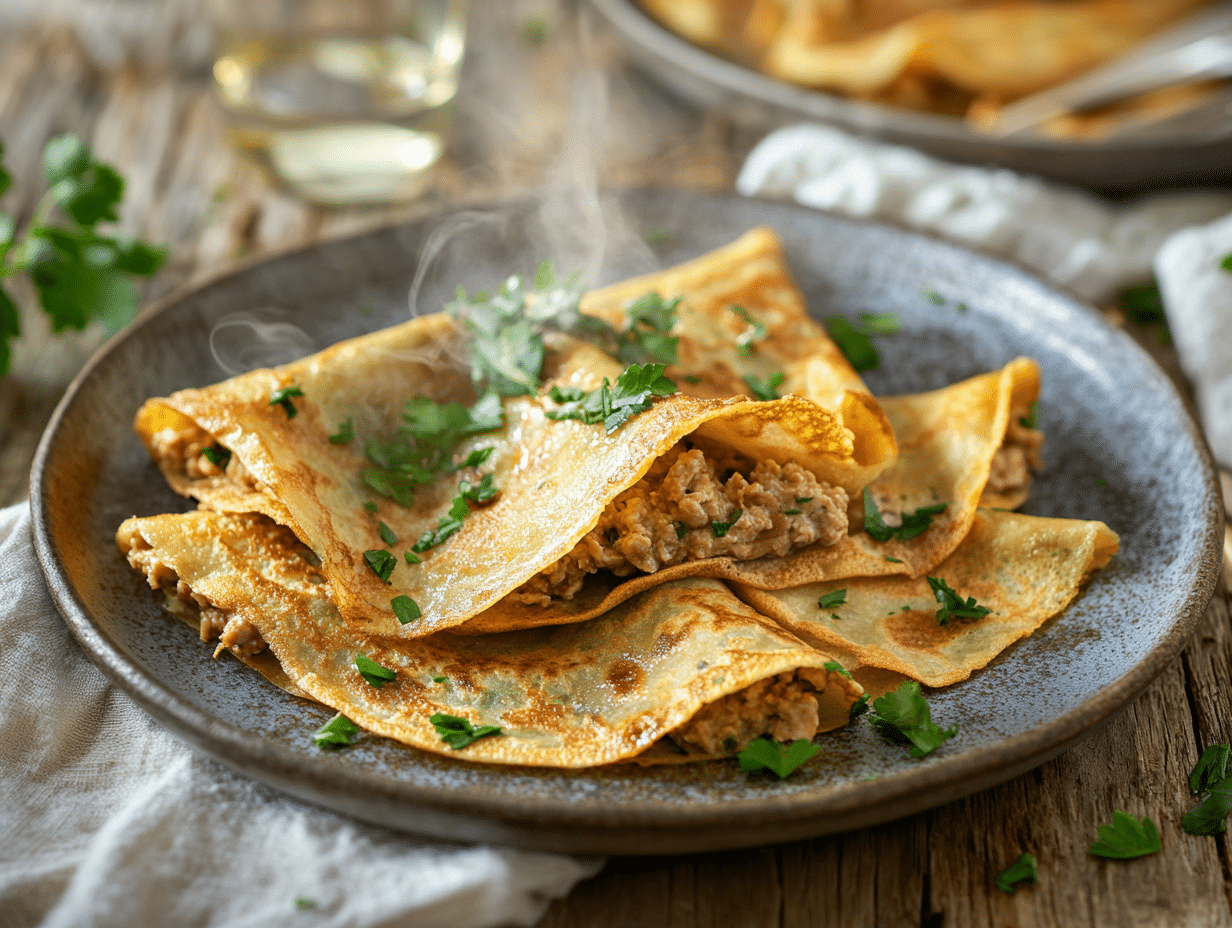
These are savory crêpes filled with ground chicken cooked with onion, Dijon mustard, and parsley — a straightforward dinner that looks more involved than it is. The honest reason to make them: crêpe batter is mostly hands-off time, the filling comes together in about ten minutes, and the result is genuinely impressive for a weeknight. Ground chicken is lean and mild, which means the mustard does real work here rather than just sitting in the background.
The technique that matters
The two things that actually determine success here are the batter rest and the heat level for the filling. Resting the batter for at least 30 minutes lets the flour fully hydrate, which gives you crêpes that stretch instead of tearing when you swirl the pan. For the filling, medium heat is not a suggestion — ground chicken is low in fat and will turn dry and grainy fast if the pan runs too hot. Cook it just until no pink remains and an instant-read thermometer reads 165°F (74°C). That is the safe internal temperature for all ground poultry, and it is also the point where the texture is still moist. Pull it off the heat right there.
What can go wrong
- The first crêpe sticks and tears. This is normal — the first one is always a test crêpe. The pan needs to reach an even temperature and the butter coating needs to set. Discard it or eat it as a cook’s snack, then carry on.
- The filling is watery. Ground chicken releases liquid as it cooks. If you see pooling liquid in the pan, turn the heat up briefly and let it evaporate before adding the mustard. Adding mustard to a wet pan dilutes the flavor.
- The crêpes dry out before you fill them. Stack finished crêpes on a plate and cover loosely with a clean kitchen towel. They stay pliable for 20–30 minutes this way. Do not stack them uncovered — the edges will go brittle.
- The filling falls out when folding. Skip the garnish — not worth the extra dish. Use a modest amount of filling per crêpe, about two heaped tablespoons, and fold into quarters rather than rolling if you are new to this. Quarters are more forgiving and hold together without any technique.
- The crêpes are too thick. This usually means the batter was too cold straight from the fridge, which makes it harder to swirl thin. Let the batter sit at room temperature for 10 minutes before you start cooking if it has been chilling.
Keeping and reheating
Store leftover assembled crêpes in an airtight container in the fridge for up to 2 days. Reheat them in a dry non-stick pan over medium-low heat for 2–3 minutes per side, or in a 325°F (160°C) oven covered with foil for about 10 minutes. The microwave works in a pinch but softens the crêpe texture noticeably. If you want to get ahead, the filling keeps separately in the fridge for up to 3 days and freezes well for up to 2 months — freeze it flat in a zip-lock bag. Unfilled crêpes also freeze well; layer them with parchment between each one and seal tightly. Thaw both overnight in the fridge before reheating.

Chicken Mince and Dijon Mustard Crêpes

Ingredients
Crêpe Batter
 1 cup all purpose flour (plain flour Australia and UK) - Sifted for smoothness
 2 large eggs - Preferably free-range
 1 cup milk - Whole milk for richness
 2 tbsp unsalted butter - Melted
 1 pinch salt
Chicken Filling
 1 tbsp olive oil - Extra virgin for a fruity note
 1 small onion - Finely chopped
 0.5 lb ground chicken (minced chicken) - Preferably organic
 2 tbsp Dijon mustard - Adds zest and complexity
 1 tbsp parsley - Fresh, chopped
- 1 pinch salt - To taste, adjust seasoning as needed
 1 pinch ground black pepper - To taste, adjust seasoning as needed
Instructions
- Prepare the Crêpe Batter: In a bowl, whisk together the flour and salt. Make a well in the center and add the eggs, whisking until the mixture is smooth. Gradually add milk, whisking constantly to avoid lumps. Finally, stir in melted butter. Set aside for at least 30 minutes to rest.
- Cook the Crêpes: Heat a non-stick pan over medium heat. Brush lightly with butter. Pour a small ladle of batter and swirl to coat the pan. Cook until edges start to lift and turn lightly golden, about 1-2 minutes, then flip and cook for another minute. Repeat with remaining batter.
- Prepare the Filling: In a skillet, heat olive oil over medium heat. Sauté onions until translucent. Add chicken mince, cooking until browned. Stir in Dijon mustard and parsley, then season with salt and pepper.
- Assemble the Crêpes: Place a crêpe on a plate, fill with chicken mixture, and fold into quarters or roll into a cylinder. Repeat with remaining ingredients.
Notes
Nutrition
Frequently asked questions
Can I use ground chicken straight from the freezer if I thaw it in the microwave?
Yes, but cook it immediately after microwave-thawing — do not let it sit. Microwave thawing can start to warm the outer edges of the meat, so it needs to go straight into the hot pan to stay food-safe.
How do I know when the ground chicken is fully cooked?
The safest check is an instant-read thermometer reading 165°F (74°C). Visually, fully cooked ground chicken should show no pink at all and the juices in the pan will run clear — but color alone is not reliable, so a thermometer is worth using.
My batter has lumps after whisking. Is it ruined?
No. Pour the batter through a fine-mesh strainer before resting it and the lumps will be gone. Small lumps that remain after the rest period usually disappear during cooking, but straining is the clean fix.
Can I make the crêpe batter the night before?
Yes, and it actually works well. Cover the bowl and refrigerate overnight, then give it a good stir before cooking since the ingredients will have settled. Take it out 10 minutes before you start so it is not fridge-cold.
What if I do not have a non-stick pan?
A well-seasoned cast iron skillet works, but you will need to butter it more generously between crêpes. Stainless steel is harder to manage for crêpes and is not recommended if you are new to making them.
Is there a way to tell if the chicken filling is seasoned right before I fill the crêpes?
Taste a small piece of the cooked filling before you add it to the crêpes — that is the only reliable way. Ground chicken is mild, so it can need more salt than you expect; adjust before assembling rather than after.
What to cook next
- Chicken Macadamia Sausage Rolls
- Savory Beef Herb Pancakes
- Colombian Chicken Cheese Empanadas
- Elegant Austrian Rabbit Palatschinken