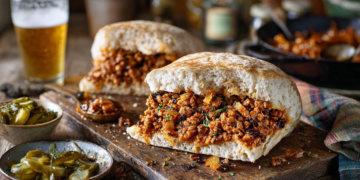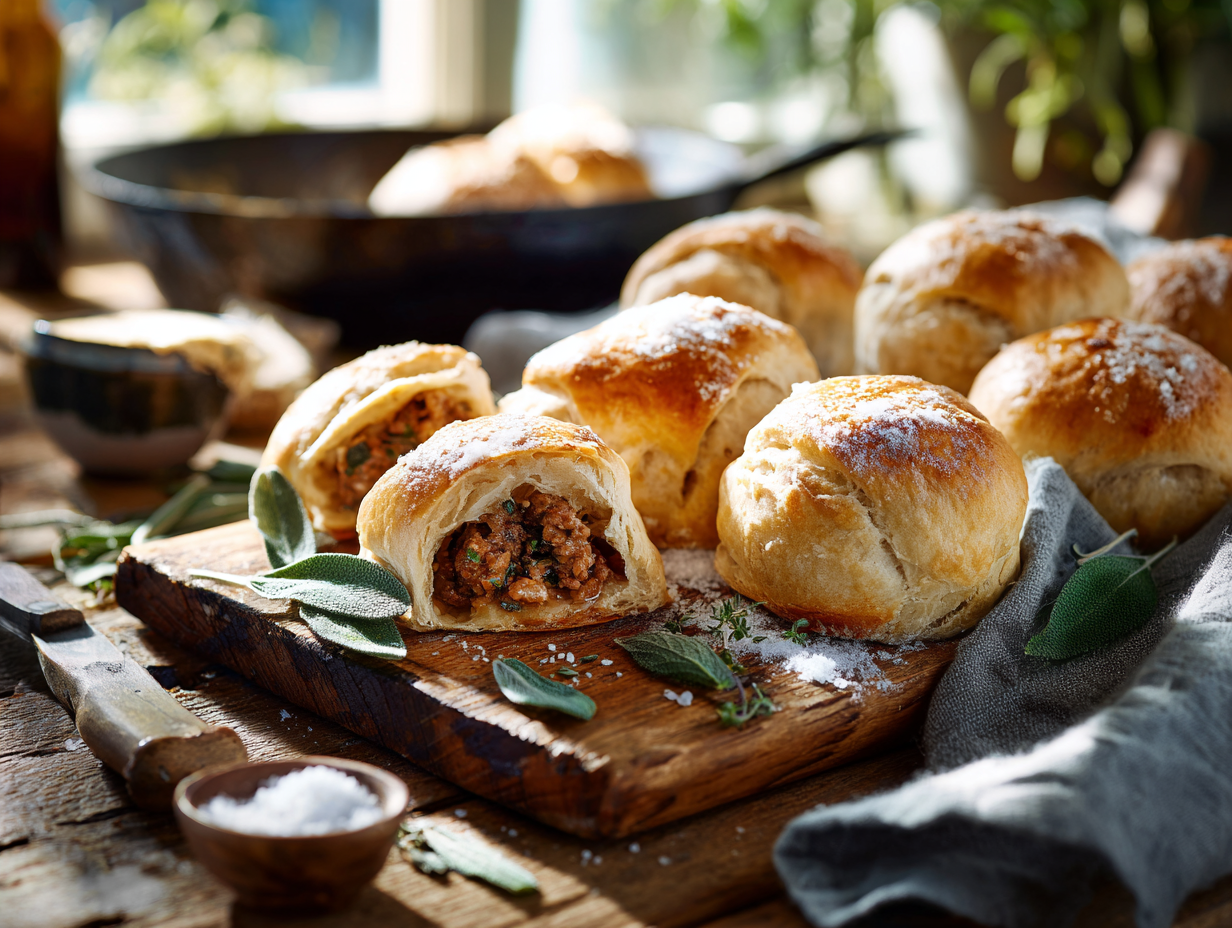
These are stuffed bread rolls made with a seasoned ground pork filling baked inside a quick, yeast-free damper dough. One batch makes six substantial rolls that hold together well, travel easily, and keep hungry people full without a lot of fuss. The whole thing comes together in an hour with no special equipment.
Smart swaps
- Self-rising flour: Not always in every pantry. Make your own by combining 3 cups all-purpose flour with 4½ teaspoons baking powder and 1½ teaspoons salt — works identically here.
- Buttermilk: The recipe card covers the milk-plus-acid substitute, but plain yogurt thinned with a splash of water also works and gives a slightly richer dough.
- Fresh sage: Dried sage works at about one-third the quantity (1 teaspoon dried for 1 tablespoon fresh). Rub it between your fingers before adding to wake up the flavor.
- Ground pork: Ground turkey can substitute, but cook it to 165°F (74°C) internal temperature and expect a leaner, slightly drier filling — add a small splash of chicken stock to compensate.
Why this recipe works
Two things matter most here. First, the pork filling must be cooked until all visible moisture has evaporated before it goes into the dough. Wet filling steams the dough from the inside and you end up with a gummy, undercooked center instead of a properly baked roll. Second, cold buttermilk and cold water keep the fat in the flour from melting before the oven does its job, which is what gives the damper its tender, slightly flaky crumb rather than a dense, heavy texture. Warm liquids short-circuit that entirely.
Mistakes to avoid
- Overfilling the rolls: More than 2–3 tablespoons of filling makes the dough hard to seal cleanly. Overstuffed rolls split open during baking and the filling spills out onto the tray.
- Skipping the seam-side-down placement: If the pinched seam faces up, it opens in the oven. Always place rolls seam-side down on the tray and press gently to flatten the base slightly so they sit stable.
- Cutting the scoring too deep: A light cross scored about 3–4mm deep lets steam escape. Cutting all the way through to the filling causes the top to peel back and the roll to lose its shape.
- Not letting the filling cool: Warm filling softens the raw dough immediately on contact, making it sticky and hard to shape. Give the pork mixture at least 10 minutes off the heat before assembling.
- Pulling them straight from the oven: The filling stays extremely hot for several minutes. Five minutes of resting is the minimum — skip it and the first person to bite in will burn their mouth on the pork.
Make-ahead notes
The pork filling can be made up to two days ahead and stored covered in the fridge, which actually makes assembly faster on the day. Fully baked rolls keep well at room temperature for up to 6 hours — skip the garnish of any fresh herbs on top if you’re packing them to go, not worth the extra dish. For longer storage, cool completely, wrap individually in foil, and refrigerate for up to 3 days or freeze for up to 2 months. Reheat refrigerated rolls in a 300°F (150°C) oven for 12–15 minutes still wrapped in foil; frozen rolls need 25–30 minutes at the same temperature. Microwaving works in a pinch but softens the crust considerably.
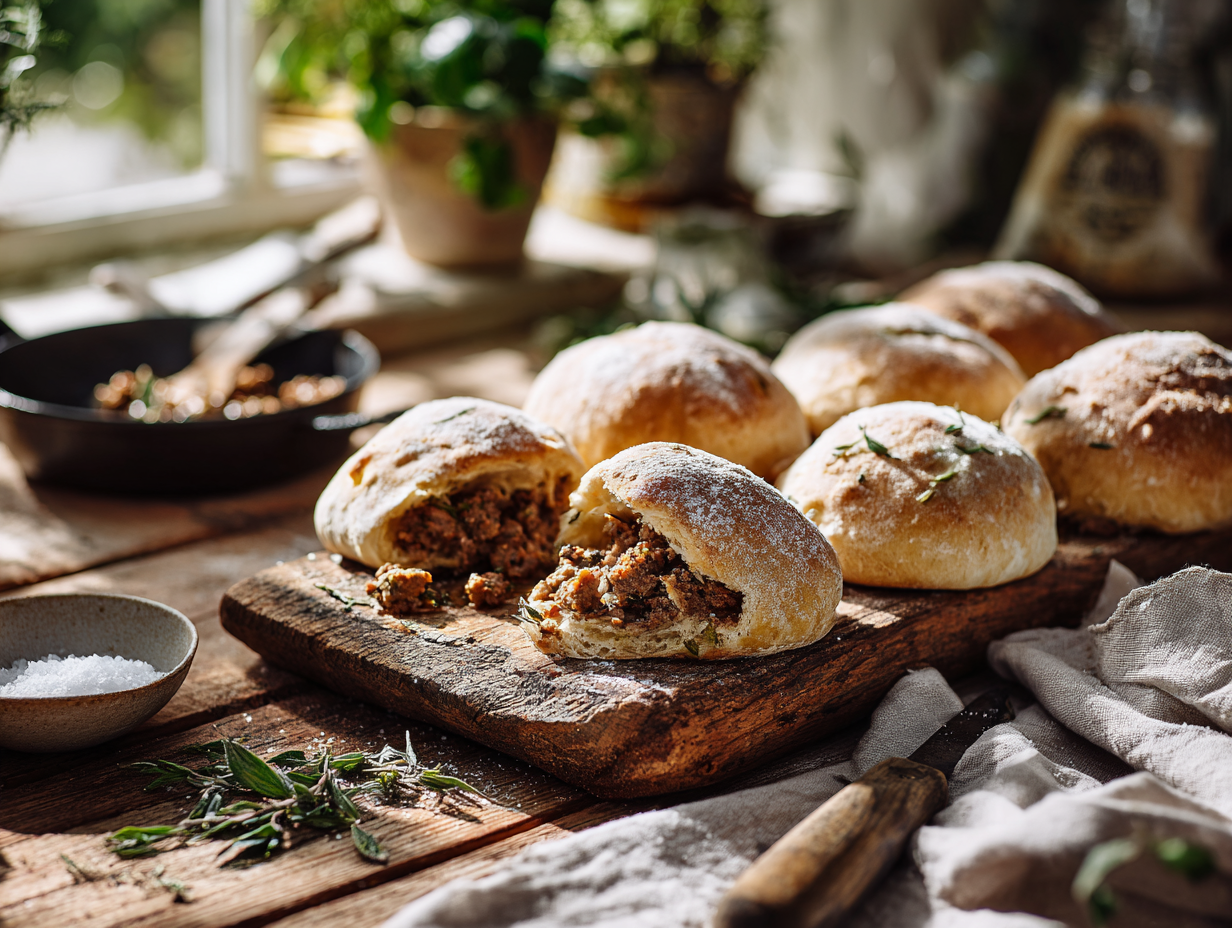
Pork Mince and Sage Damper Rolls

Equipment
Ingredients
For the Pork Filling:
 1 pound ground pork (minced pork) - preferably not too lean for better flavor
 1 tablespoon olive oil - extra virgin preferred
 1 cup yellow onion - finely chopped
 2 cloves garlic - minced
 1 tablespoon sage - fresh, finely chopped
 1 teaspoon sea salt
 0.5 teaspoon ground black pepper - freshly ground
For the Damper Dough:
- 3 cups self-rising flour - plus extra for dusting
- 1 teaspoon sea salt
- 1 cup buttermilk - cold
 0.5 cup water - cold
Instructions
- In a skillet over medium heat, add olive oil. Sauté onions for 5 minutes until translucent. Add garlic and cook for 1 minute until fragrant.
- Add ground pork; cook for 8–10 minutes, breaking the meat apart until it’s browned and moisture has evaporated. Stir in chopped sage, salt, and pepper. Set aside to cool.
- Preheat oven to 400°F (200°C). Line a baking tray with parchment paper.
- In a large bowl, mix flour and salt. Gradually add buttermilk and water while stirring to form a soft dough. It should be slightly tacky but not wet.
- Lightly flour a work surface. Divide dough into 6 equal balls. Flatten each into a 4–5 inch circle. Add 2–3 tablespoons of pork filling to the center of each and pinch the dough around the filling to seal. Turn over seam-side down.
- Place rolls on the baking tray. Lightly score tops with a cross using a sharp knife. Bake for 25–30 minutes until golden brown and cooked through. Center should sound hollow when tapped.
- Let rest 5 minutes before serving warm.
Notes
- For a spicier variation, add crushed fennel seeds or chili flakes to the pork filling.
- If buttermilk isn’t on hand, substitute with 1 cup milk mixed with 1 tablespoon lemon juice or vinegar.
- To reheat, place in a 300°F (150°C) oven covered with foil for 10 minutes.
Nutrition
FAQ
How do I know the pork filling is fully cooked and safe?
Ground pork must reach an internal temperature of 160°F (71°C) — use an instant-read thermometer in the thickest part of the filling through the side of a roll to confirm. Visually, the meat should be completely browned with no pink remaining and the pan juices should have cooked off.
Can I make these bigger to feed more people per roll?
Yes — divide the dough into 4 balls instead of 6 for larger rolls, but increase the baking time to 35–38 minutes and check that the center sounds hollow when tapped. Bigger rolls take longer to cook through, and underbaked dough in the center is the main risk.
My dough is sticking to everything — what went wrong?
The dough is meant to be slightly tacky, but if it’s genuinely wet and unworkable, the flour absorbed more liquid than expected — work in extra flour one tablespoon at a time until it holds its shape. Flour your hands and the work surface generously before shaping each roll.
Can I cook these over a campfire or on a grill instead of an oven?
A covered camp oven or Dutch oven set over coals works well — place the rolls inside, put the lid on, and heap some coals on top to create heat from above, cooking for roughly 30–35 minutes. A standard outdoor grill with the lid closed and indirect heat at around 400°F (200°C) also works, though the bottom will brown faster than the top so rotate the tray halfway through.
What to cook next
- Cumberland Sausage Mince Pie
- Savory Pork Apple Pasties
- Spiced Pork Mince Flatbreads
- Chicken Macadamia Sausage Rolls