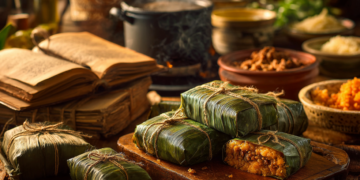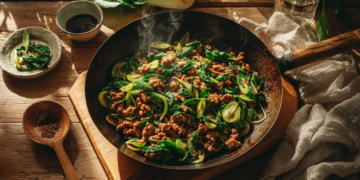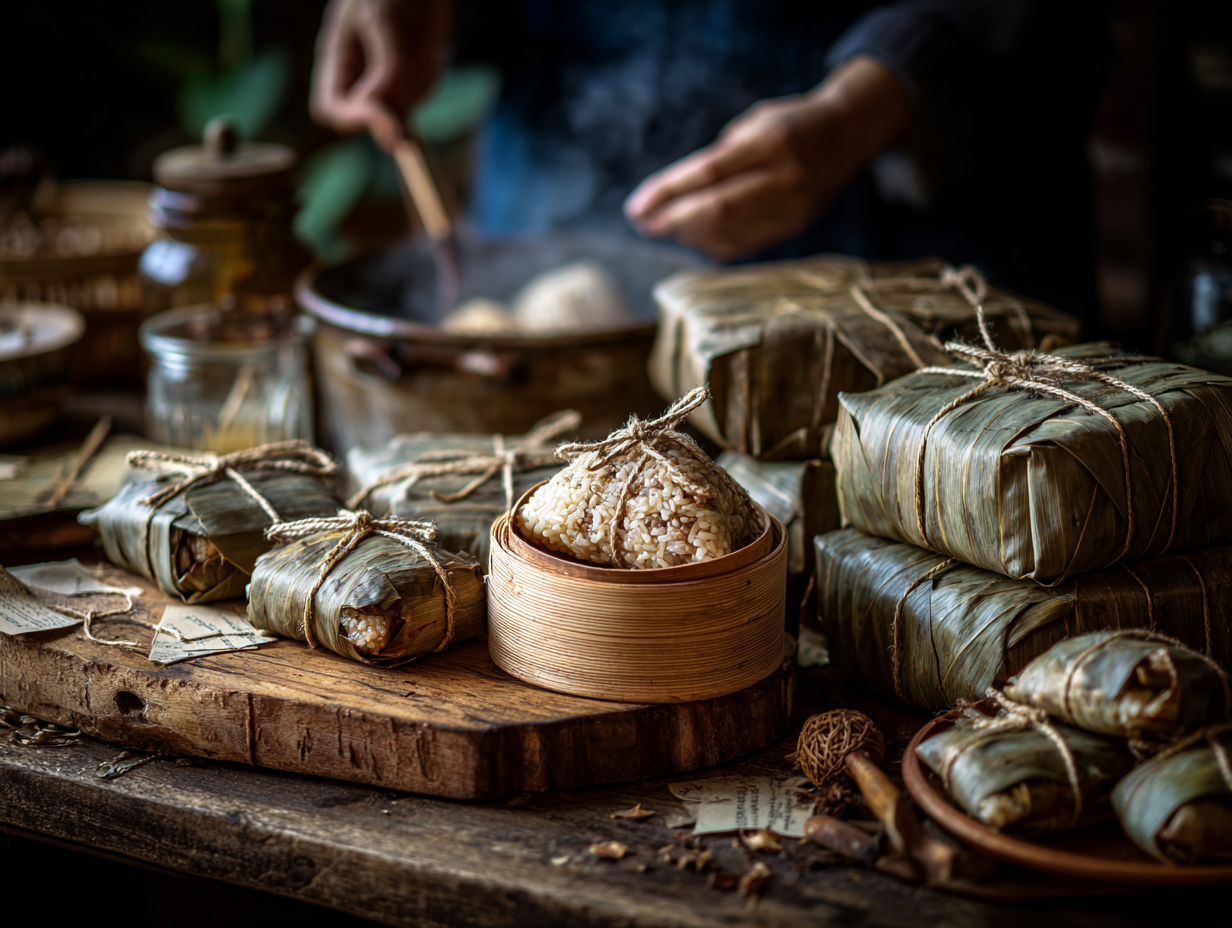
Zongzi are sticky rice dumplings wrapped in bamboo leaves and packed with soy-marinated pork belly — a filling, hands-on meal that feeds a crowd from a short ingredient list. This version keeps it to five ingredients, so the pork and rice do all the work. The payoff for the long cook time is real: every grain of rice absorbs the pork fat and soy, and the bamboo leaves add a faint smoky note you can’t get any other way.
The short version of why this works
Two things drive the result here. First, the overnight rice soak. Jasmine rice is denser than glutinous rice, and without a full soak it stays grainy in the center no matter how long you steam it. The soak lets the grains absorb moisture before cooking, so they turn tender and slightly sticky once the heat hits. Second, wrapping tension. A loose bundle lets water seep in during steaming, which dilutes the marinade and makes the rice mushy rather than cohesive. Wrap each dumpling firmly enough that it holds its shape when you press it lightly — the string should feel snug, not just decorative. Get those two steps right and the long steam does the rest.
Common problems and fixes
- Rice is still hard after steaming: The soak was too short or the water level dropped during cooking. Keep the pot topped up so the dumplings stay submerged or fully in steam the whole time, and soak the rice a full 8 hours minimum.
- Dumplings fall apart when unwrapped: The bundle was too loose or the string slipped. Double-knot the string and give each dumpling a firm squeeze before it goes in the pot — if it feels floppy, rewrap it.
- Bamboo leaves split while folding: They weren’t softened long enough. After the boiling water soak, the leaves should bend without cracking. If they’re still stiff, soak them another 10–15 minutes.
- Pork tastes bland in the center: The marinade time was too short. Pork belly needs at least 4 hours in the soy and cooking wine to season all the way through — overnight is better when feeding a group, since you want every bite to taste the same.
- Filling leaks out during cooking: Too much rice was packed in, leaving no room for expansion. Leave a small gap at the top of the leaf cone before folding it closed — the rice swells as it cooks.
About the ingredients
Bamboo leaves are sold dried in most Asian grocery stores, usually in large bundles. Buy more than you think you need — some will tear during soaking and you’ll want spares. Cooking wine here means Shaoxing rice wine; dry sherry is a workable swap in the same quantity. Jasmine rice is the unusual choice — traditional zongzi use glutinous rice, which is stickier and holds together more firmly. Jasmine rice produces a slightly lighter texture and a more fragrant result, but if you can only find glutinous rice, it works fine; reduce the soak to 4 hours since it absorbs water faster. Skip any temptation to use short-grain sushi rice — it turns gluey rather than tender after six hours of steaming.
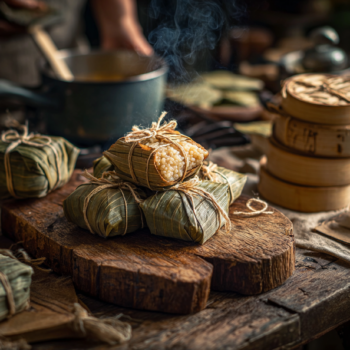
Five-Ingredient Pork Sticky Rice Dumplings

Ingredients
 2 pounds ground pork (minced pork) - belly
 2 cups soy sauce
- 2 tablespoons wine - cooking
- 48 leaves bamboo
 10 cups Jasmine rice
Instructions
- Put rice in a large bowl, fill with cold water to cover and soak overnight.
- Pat pork and add to a bowl with cooking wine and ½ cup of soy sauce. Set aside to marinate.
- Boil a large pot of water. Lay out bamboo leaves on a large tray. Once the water starts to boil, remove the water from heat and pour over bamboo leaves. Soak until softened for 15 to 20 minutes. Rinse under cold water, pat dry, trim 1 inch off the end containing the stem.
- Drain rice, separate into two bowls and pour half of the remaining soy sauce. Stir to combine.
- Place two bamboo leaves on top of each other, with the smaller of the two on top. Create a cone using the trimmed ends. Fill half the cone with rice, add 1 tablespoon of meat, top off the cone with rice. Fold the pointed end of the bamboo leaf over the opening of the cone, leaving a hole of rice visible. Pack rice down tightly, fill the hole with additional rice, repeat 2 to 3 times until full. Slide the third bamboo leaf under the remaining end and fold the existing ends over the third leaf to connect. Fold the third leaf over the side, over the opening, and finish with one more fold around the side. Tie very tightly with two pieces of twine, one horizontally and one vertically.
- Fill a pot with dumplings, add enough water to cover, cook on high heat for 6 hours.
Nutrition
Frequently asked questions
Can I use ground pork instead of pork belly?
You can, but the result will be noticeably drier. Pork belly’s fat melts into the rice during the long steam, which is what makes the filling rich and moist — ground pork lacks that fat content. If you do use ground pork, make sure it reaches an internal temperature of 160°F (71°C), and consider mixing in a tablespoon of neutral oil to compensate for the lost fat.
How do I know when the dumplings are fully cooked?
After the full cook time, unwrap one test dumpling — the rice should be uniformly soft with no chalky or hard spots in the center, and the pork should be fully cooked through with no pink remaining. If the rice still has any bite, rewrap and continue steaming in 30-minute increments.
Can I make these ahead and reheat them for a family meal?
Yes, and they actually reheat well. Store cooked dumplings in the fridge for up to 3 days or freeze them for up to a month, still wrapped in their leaves. To reheat, steam them for 15–20 minutes from the fridge or 30–35 minutes from frozen — microwaving works in a pinch but makes the rice uneven in texture.
More mince recipes to try
- Crispy Pork Dumpling Delight
- Puerto Rican Pork Pasteles
- Authentic Szechuan Dan Dan
- Venezuelan Beef Hallacas Wraps