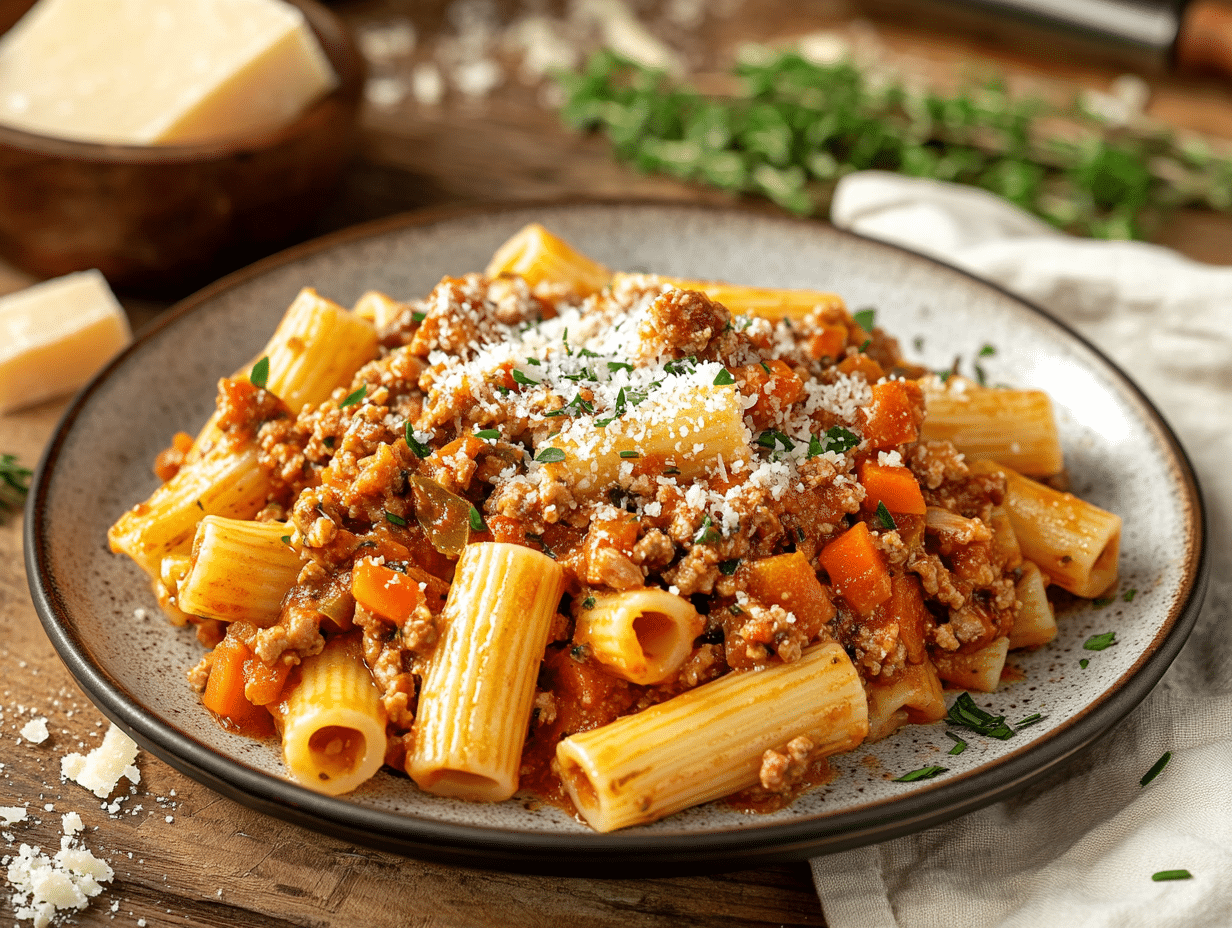
This is a ground chicken ragù built like a proper braise — aromatics cooked down, the meat simmered low and slow in chicken stock, then finished with leeks, chard, and a heap of Parmesan over rigatoni. It takes about 75 minutes start to finish, most of that hands-off. The payoff is a sauce with real body that feeds four people well without anyone leaving the table hungry.
Before you start
The two-stage cooking process is the whole point of this recipe, so don’t rush it. In the first stage, the ground chicken braises in stock with the aromatics for 45 minutes — this is what builds the depth in the sauce. Pull the chicken out before the full 45 minutes are up (around the 35-minute mark) so it has time to cool enough to handle; ground chicken that’s too hot will clump and tear rather than break apart cleanly when you return it to the pan. The second thing that matters: reduce the strained broth by half before adding anything back. That reduction is what gives the final sauce its body. Skip it and you’ll end up with a thin, watery coating on the pasta instead of something that clings. Ground chicken must reach an internal temperature of 165°F (74°C) — use a thermometer if you’re unsure, especially when the meat goes back into the pan for the final 5-minute covered cook.
Troubleshooting
- Sauce is still thin after reducing: Increase the heat and keep the lid off. The broth needs a hard simmer, not a gentle one, to reduce properly. If it’s still loose after the pasta goes in, add pasta water in small splashes — it contains starch that tightens the sauce quickly.
- Ground chicken is clumping into hard bits: This usually means the heat was too high when the chicken first went in, or it was stirred too aggressively. For the return-to-pan stage, break it up gently with a wooden spoon and let it warm through covered rather than frying it again.
- Chard is still tough and chewy: Chard stems take longer than the leaves. If you’re including the stems, add them with the leeks and give them the full 3 minutes before adding the leaves and chicken.
- Pasta is soaking up all the sauce before serving: Rigatoni keeps absorbing liquid as it sits. Toss the pasta with the sauce right before serving, not earlier, and keep a little extra pasta water warm on the side to loosen things up at the table if needed.
- Dish tastes flat: The broth and Parmesan carry most of the salt load here. Taste after adding the cheese — it may need another pinch of salt or a few cracks of black pepper to pull everything together.
About the ingredients
- Ground chicken: Use a blend of dark and white meat if your butcher carries it — it has more fat and holds up better through the long braise than breast-only mince, which can dry out.
- Chard: Any variety works. Baby spinach is a faster-cooking substitute if that’s what you have, but it wilts almost immediately, so add it right at the end. Kale works too — just give it an extra 2–3 minutes.
- Leek: Rinse the cut half-moons in a bowl of cold water and lift them out; grit sinks to the bottom and stays behind. Skip this step and you’ll taste sand in the finished dish.
- Chicken stock: Use a low-sodium stock so you control the salt level, especially since the Parmesan adds a significant amount on its own.
- Crispy chicken skin topping: Skip the garnish — not worth the extra dish. The Parmesan and chives do the job fine.
Make-ahead notes
The ragù — meaning the braised chicken and reduced broth combined, before the pasta — keeps well in the fridge for up to 3 days in a sealed container. Reheat it in a wide pan over medium heat with a splash of chicken stock or water to loosen it, then cook fresh pasta and finish as directed. It also freezes cleanly for up to 2 months; thaw overnight in the fridge before reheating. Don’t store the ragù mixed with the cooked pasta — the rigatoni turns soft and the sauce disappears into it. Cook the pasta fresh each time you serve it.
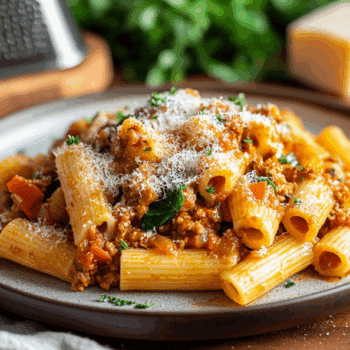
Chicken Ragu Pasta — Braised Ground Chicken Rigatoni

Equipment
Ingredients
 2 pounds ground chicken - minced chicken, about 900g
 3 tablespoons olive oil - divided — 2 tablespoons + 1 tablespoon
 3 medium carrots - roughly chopped
 2 stalks celery - roughly chopped
 1 medium yellow onion - roughly chopped
 2 cloves garlic - roughly chopped
 5 sprigs thyme
 2 pieces bay leaf (bay leaves)
 1 small leek - cut into half-moons
- 1 bunch chard - roughly chopped
 1 cup Parmesan cheese - freshly grated, about 100g
 2 cups chicken stock - chicken broth or chicken bouillon, about 480ml
 2 tablespoons chives - finely chopped
- 1 pound rigatoni - about 450g
 1 pinch salt - to taste
 1 pinch ground black pepper - to taste
Instructions
- Heat 2 tablespoons of olive oil in a large high-sided skillet over medium-high heat. Add 2 of the carrots (reserve the third — see Step 4), celery, and onion. Cook for 5 minutes, stirring occasionally, until softened. Add the garlic, thyme, and bay leaves. Season with salt and pepper. Cook for about 1 minute until fragrant.3 tablespoons olive oil, 3 medium carrots, 2 stalks celery, 1 medium yellow onion, 2 cloves garlic, 5 sprigs thyme, 2 pieces bay leaf (bay leaves), 1 pinch salt
- Salt and pepper the chicken mince. Move the vegetables to the side of the pan to make room for the chicken. Add chicken and cook for about 3 minutes. Add chicken stock, let boil, cover pan and reduce heat to low. Cook for about 45 minutes.2 pounds ground chicken, 2 cups chicken stock, 1 pinch salt
- When the chicken is almost done, bring a pot of water to boil and begin cooking pasta. Drain when done, saving pasta water; set aside.1 pound rigatoni
- After the chicken has braised for approximately 35 minutes (about 10 minutes before the full 45-minute cook time ends), remove the chicken to a plate to cool. Strain the broth through a fine-mesh strainer into a bowl, discarding the spent vegetables and herbs. Return the skillet to medium-high heat and add 1 tablespoon of olive oil. Add the leeks and the reserved carrot (thinly sliced) and cook for 3 minutes until they begin to soften. Pour in the strained broth and bring to a boil. Let it reduce by half — this concentrates the sauce and gives it body.2 pounds ground chicken, 3 tablespoons olive oil, 3 medium carrots, 1 small leek
- Break the cooled chicken apart into pieces and return it to the pan. Add the chopped chard, stir to combine, then cover and cook for 5 minutes until the chard is wilted and the chicken is heated through (internal temperature should reach 165°F / 74°C).2 pounds ground chicken, 1 bunch chard
- Reserve 1 cup (240ml) of pasta cooking water, then drain the rigatoni. Add the pasta to the skillet along with the grated Parmesan. Toss vigorously to combine, adding pasta water a few tablespoons at a time until the sauce coats every piece of rigatoni and looks glossy.1 pound rigatoni, 1 cup Parmesan cheese
- Serve immediately, topped with chopped chives and an extra sprinkling of Parmesan cheese. (Note: If you want crispy chicken skin as a topping, roast skin from bone-in chicken thighs at 400°F / 200°C for 15-20 minutes until crisp, then crush and scatter over the finished dish.)2 tablespoons chives, 1 cup Parmesan cheese
Notes
Nutrition
FAQ
Can I use ground turkey instead of ground chicken?
Yes, ground turkey works as a direct swap. Like ground chicken, it needs to reach 165°F (74°C) internally, and it behaves similarly through the braise — just make sure to use a blend that includes some dark meat so the sauce doesn’t turn dry.
Do I have to use rigatoni, or will other pasta shapes work?
Any short, sturdy pasta with ridges or hollows — penne, ziti, cavatappi — will hold the sauce well. Long pasta like spaghetti works in a pinch but the chunky ragù doesn’t cling to it as effectively, so you end up with sauce pooling at the bottom of the bowl.
Can I make this without straining out the vegetables?
You can, but the texture changes noticeably. The carrots, celery, and onion soften to near-mush after 45 minutes and make the sauce heavier and less defined. Straining them out and building the final sauce with fresh leeks gives you a cleaner, brighter result.
How do I know the chicken is fully cooked when it goes back into the pan?
After the initial braise, the chicken should already be cooked through — check that it reads 165°F (74°C) before you remove it from the pan. The final 5-minute covered cook is just to heat everything through together, not to cook raw meat, so as long as the chicken hit temperature in the braise, you’re safe.
More mince recipes to try
- Creamy Beef Spinach Pasta
- Spicy Calabrian Lamb Ragù
- Chicken Macadamia Sausage Rolls
- Savory Pork Noodle Stir-Fry