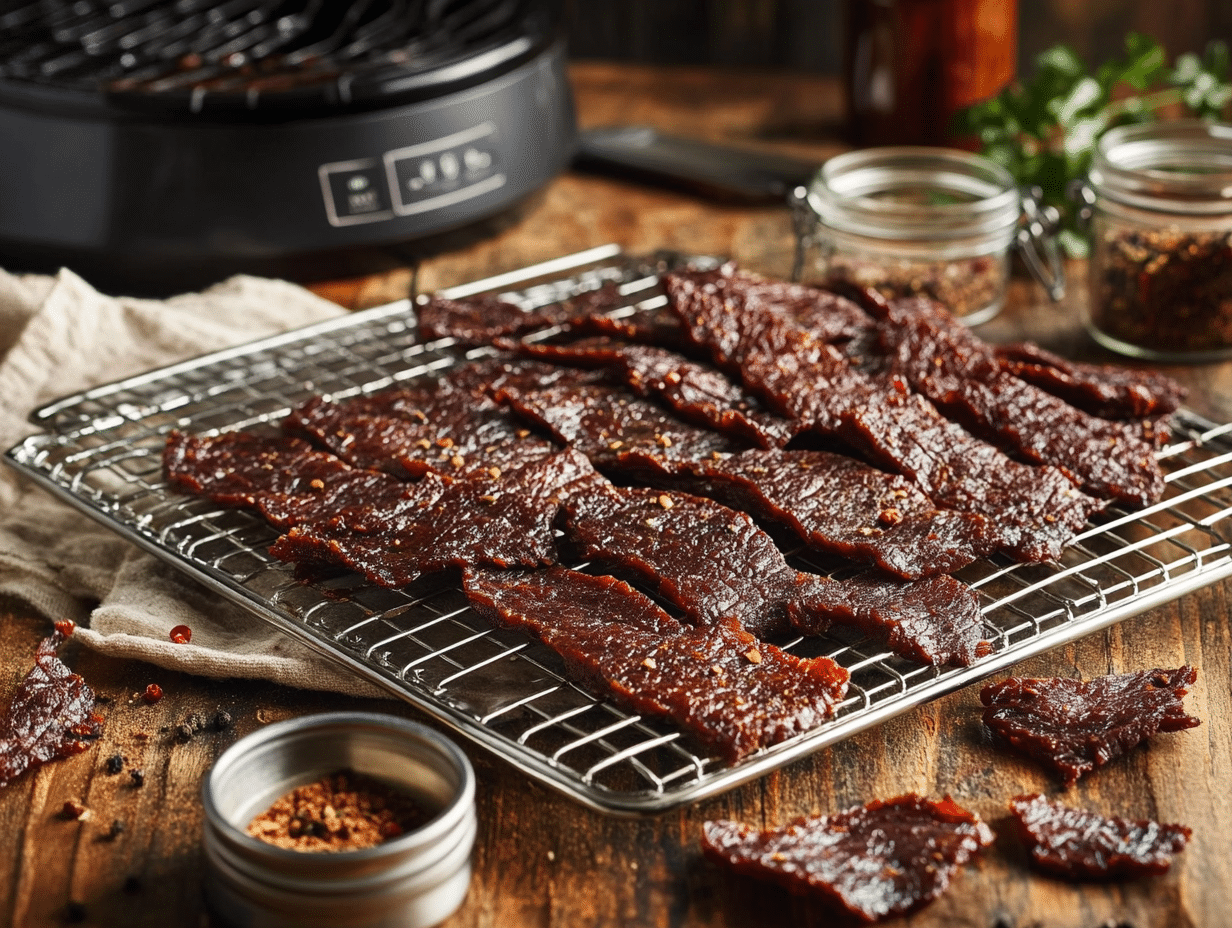
Ground beef jerky skips the whole-muscle slicing and still gives you a chewy, protein-dense snack you can make at home with a dehydrator and a few basic tools. Five pounds of lean ground beef yields enough jerky to stock a week of high-protein snacking — no specialty butcher cuts required. If you have a dehydrator and an afternoon, this recipe is straightforward and repeatable.
Why this recipe works
Two things drive the result here. First, using 90% lean ground beef (or leaner) keeps fat from pooling on the racks during the long drying time — excess fat turns rancid quickly and makes the finished jerky greasy rather than firm. Second, the sodium nitrite cure does real work: it inhibits bacterial growth during the slow, low-heat dehydration process and locks in that deep red color. Without it, ground meat jerky — which lacks the intact muscle structure of whole-cut jerky — carries a higher food safety risk during extended drying. The cure is not optional.
About the ingredients
- Sodium nitrite (jerky cure): Sold as a standalone curing agent or included in packaged jerky seasoning kits. Check your seasoning packet first — if it already contains cure, do not add more separately. Over-curing is a real problem and affects both flavor and safety.
- Jerky seasoning packet: Brands like Nesco or Hi Mountain work well. They contain salt, sugar, and spices pre-balanced for a 5-pound batch. You can substitute a homemade spice blend, but you must still add a measured cure separately — the seasoning alone does not preserve the meat.
- Ground venison, elk, or bison: These swap in directly for beef. They are typically even leaner, which is an advantage here. Expect a slightly firmer finished texture because of the lower fat content.
- Water: Use exactly ½ cup per pound of meat. Too little water and the cure and seasoning won’t distribute evenly through the batch.
Storage and reheating
Fully dried jerky stored in an airtight container or zip-lock bag keeps at room temperature for 1 to 2 weeks — less if your kitchen runs warm. For longer storage, refrigerate for up to 1 month or freeze for up to 6 months; vacuum sealing before freezing prevents freezer burn and extends quality noticeably. There is no reheating step for jerky — skip the microwave, which softens the texture you worked 9 hours to achieve. If frozen jerky feels stiff straight from the freezer, let it sit at room temperature for 15 minutes and it will return to normal chew.
Troubleshooting
- Jerky is crumbling apart instead of holding together in strips: The meat wasn’t mixed long enough after adding the cure and water. The mixture needs to be worked until it becomes slightly tacky — that protein bind is what holds the strip together during drying and cutting.
- Strips are still soft and pliable after 9 hours: Your dehydrator temperature may be running low, or the strips were formed too thick. Aim for an even ¼-inch thickness across the tray. Rotate racks top to bottom halfway through if your dehydrator doesn’t have a rear-mounted fan.
- Jerky has a grey or dull color rather than deep red: This usually means the cure wasn’t evenly distributed before refrigerating, or the meat wasn’t refrigerated long enough before forming. Mix thoroughly and give it the full 4 hours in the fridge if you have time — a rushed cure shows in the finished color and can affect safety.
- Grease pooling on the racks or drip tray: The ground beef was too high in fat. Pat the surface of the formed strips with a paper towel before loading the dehydrator, and blot again once or twice during drying. Switch to a leaner grind next batch — 93% or higher is worth it here.
- Jerky sticks to the rack and tears when you try to remove it: The cooking spray wasn’t applied evenly, or it was skipped entirely. A light, even coat before placing the meat makes a real difference. Silicone dehydrator sheets are a reliable fix if sticking is a recurring problem — easier to clean than sprayed metal racks too.
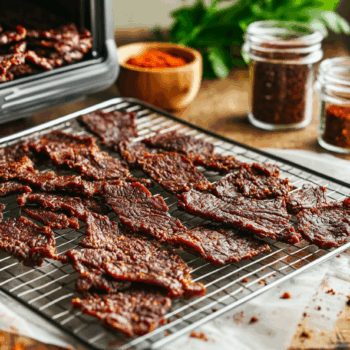
Ground Beef Jerky Recipe (Dehydrator Method)

Equipment
Ingredients
 5 pounds ground beef - lean, 90% or leaner
- 1 package jerky seasoning - approximately 4–5 oz / 115–140g, sized for 5 lbs of meat
- 6 tablespoons jerky cure - Prague Powder #1 or equivalent pre-mixed curing salt containing 6.25% sodium nitrite — follow manufacturer’s dosage for 5 lbs of meat
 2 ½ cups water - 1/2 cup per pound of meat
- 1 teaspoon cooking oil spray - for racks
Instructions
- In a large mixing bowl, combine the jerky seasoning, jerky cure, and 2½ cups of water. Add the lean ground beef and mix thoroughly with your hands or a sturdy spoon until the cure and seasoning are evenly distributed throughout the meat.5 pounds ground beef, 1 package jerky seasoning, 6 tablespoons jerky cure, 2 1/2 cups water
- Cover the bowl tightly with plastic wrap or a lid and refrigerate for at least 1 hour and up to 4 hours — this allows the cure to penetrate the meat fully. Follow your specific cure manufacturer’s directions if they differ.
- Lay a sheet of wax paper on the forming tray. Spread approximately ¾ pound (340g) of the seasoned ground beef onto the wax paper. Place a second sheet of wax paper on top and press or roll the meat flat to an even 1/8-inch (3mm) thickness, filling the tray. Remove the top sheet of wax paper and neaten the edges with a butter knife. Lightly spray a dehydrator rack with cooking oil, place it face-down over the meat, and flip the whole assembly over. Peel off the remaining wax paper.5 pounds ground beef, 1 teaspoon cooking oil spray
- Apply additional spices or seasonings as desired. Popular flavours include pepper, red chile flakes, green chile, jalapeno powder, and powdered chile.
- Set the dehydrator to 160°F / 71°C and dehydrate for 7 to 10 hours, or until the jerky reaches your desired dryness. A properly dried strip should crack slightly when bent but not snap cleanly in half — if it bends without cracking, it needs more time; if it snaps like a cracker, it has over-dried.
- Cut the finished jerky into strips with kitchen shears, following the grid lines left by the dehydrator racks. Allow strips to cool completely before storing in airtight containers or zip-lock bags. Store at room temperature for 1–2 weeks, refrigerate for up to 1 month, or vacuum seal and freeze for up to 6 months.
Notes
Nutrition
Common questions
Is ground beef jerky safe without using an oven to pre-cook the meat?
It is safe when you use a proper jerky cure containing sodium nitrite and follow the cure time before dehydrating. Ground meat carries a higher pathogen risk than whole-muscle cuts because bacteria can be distributed throughout the grind, not just on the surface — the cure addresses this directly. If you prefer an extra safety step, the USDA recommends heating finished dehydrated jerky in a 275°F oven for 10 minutes after drying.
How do I know when the jerky is actually done and not just dry on the outside?
Bend a strip — it should crack slightly at the fold but not snap cleanly in two, and there should be no soft or spongy center. A strip that bends completely without cracking needs more time; one that snaps like a cracker has gone too far and will be brittle rather than chewy.
Can I make this without a dehydrator, using a regular oven?
Yes — set your oven to its lowest temperature (usually 170°F) with the door propped open an inch to let moisture escape, and place the formed strips on wire racks over baking sheets. Drying time will be similar, roughly 7 to 10 hours, but check more frequently since oven temperatures vary more than a dedicated dehydrator.
If you liked this one
- Wild Venison Mushroom Pies
- Savory Beef Sausage Rolls
- Wild Game Stroganoff Reimagined
- Spicy Beef Stuffed Peppers