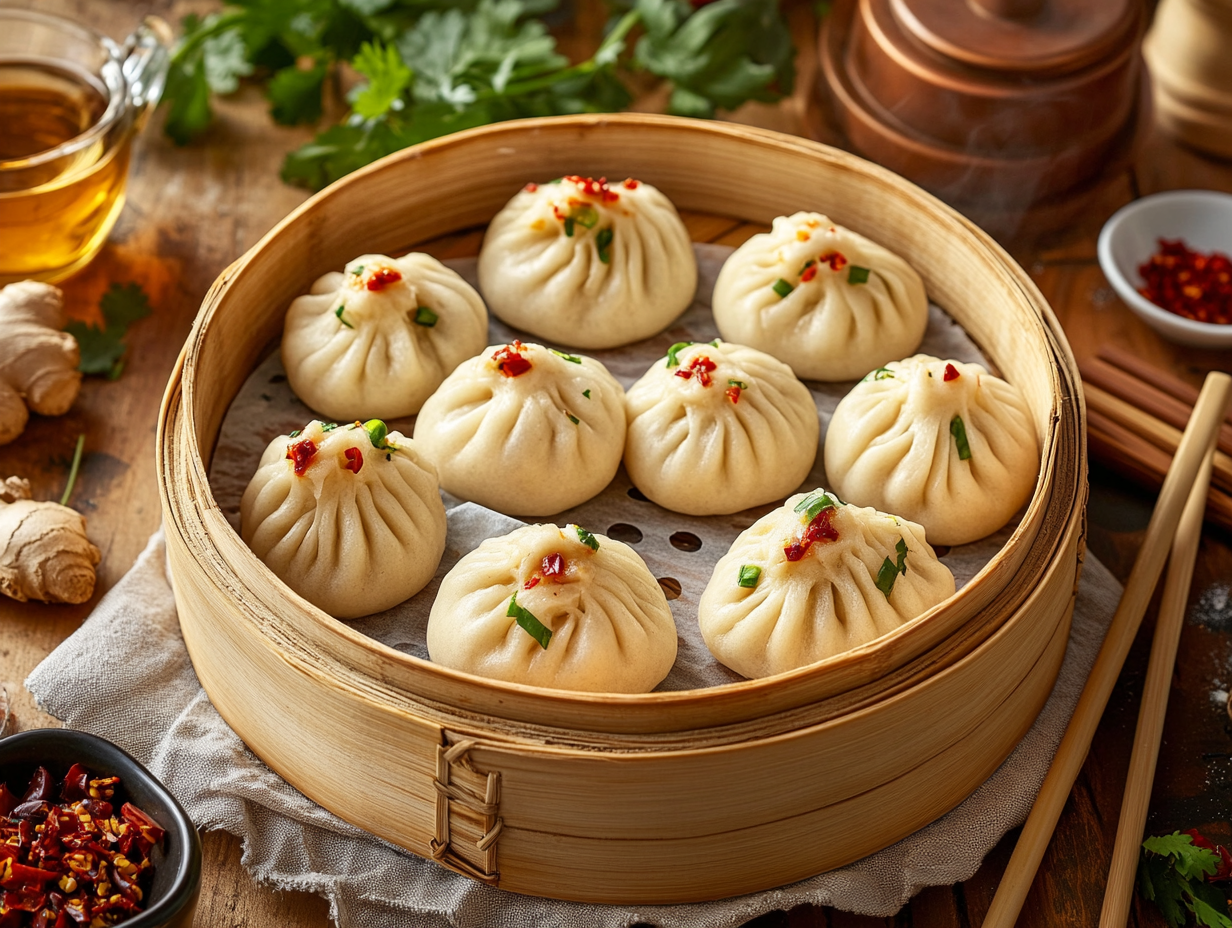
These are steamed filled buns — soft yeast dough wrapped around a seasoned ground veal and chicken filling, then cooked in a bamboo steamer. The combination of two ground meats keeps the filling juicy without being greasy, and the chili-salt mixture gives every bite a clean, noticeable heat. If you want something that fills people up and holds together well on a plate, this is a solid choice.
About the ingredients
- Ground veal: Leaner than pork, so pairing it with ground chicken thigh (dark meat) is important — chicken breast alone would make the filling dry and dense.
- Salted chilies: The recipe has you salt the chilies 30 minutes ahead, or overnight. Overnight is better — the salt draws out moisture and mellows the raw heat slightly, giving a more even flavor through the filling.
- Sesame oil: Use toasted sesame oil, not plain. The flavor difference is significant and only half a teaspoon is called for, so the bottle lasts a long time.
- Dried yeast: Active dry yeast and instant yeast both work here. If using instant, you can skip the dissolving step and mix it straight into the flour.
What makes this version work
Two steps do the real work in this recipe. First, smashing the ginger and steeping it in water — then adding only that infused water to the meat — distributes ginger flavor evenly through the filling without leaving fibrous chunks that kids will pick out. Second, the 20-minute freezer rest for the filling firms it up just enough to handle cleanly when you’re portioning and folding the buns. Skip the freezer step and the filling slumps, the dough gets wet, and sealing becomes a fight. Both steps add time but neither requires any extra skill.
Mistakes to avoid
- Overproofing the dough: This is a small, stiff dough and it only needs 10 minutes of rest — not a full rise. Leave it too long and the buns puff unevenly and the texture turns spongy rather than soft and slightly chewy.
- Crowding the steamer: Buns expand during cooking. Leave at least 2 cm between each one or they fuse together and tear when you try to separate them.
- Skipping the parchment or oiled surface under the buns: Without it, the dough sticks hard to the bamboo and pulls apart when you lift them. Small squares of baking paper under each bun solve this completely.
- Undercooking the filling: Ground poultry must reach 165°F (74°C) internally. The 30-minute cook time is a guide — if your buns are on the larger side, check one by opening it and confirming the meat is fully cooked through with no pink remaining.
- Adding too much extra water to the dough: The recipe says a couple of tablespoons — add it slowly, one tablespoon at a time. A dough that is too wet will not hold its shape when folded and the filling will leak during steaming.
Keeping and reheating
Cooked buns keep in an airtight container in the fridge for up to 3 days. To reheat, put them back in the steamer for 5–6 minutes — skip the microwave if you can, since it makes the dough rubbery and the outside gummy. For longer storage, freeze cooked buns in a single layer first, then transfer to a bag; they keep well for up to 2 months. Steam straight from frozen for 10–12 minutes. Uncooked assembled buns can also be frozen before steaming — freeze on a tray, then bag them, and steam from frozen adding a few extra minutes to the cook time. Either way, always confirm the internal temperature of the filling hits 165°F (74°C) before serving.
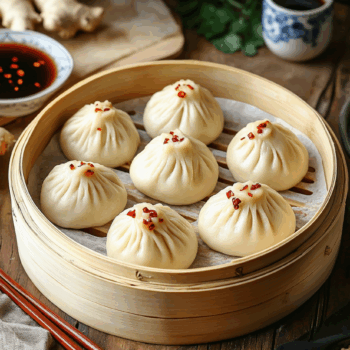
Steamed Kosher Veal Buns (Ginger-Chili Filling)

Equipment
Ingredients
For the Stuffing
 1 piece ginger - fresh ; about 1 inch / 2.5cm, unpeeled
 5 tablespoons water - 75ml, for ginger infusion
 ½ pound ground veal - minced veal, 225g
 ½ pound ground chicken (minced chicken) - minced chicken, 225g
- 4 small red chilies - or two large red chilies
 2 teaspoons salt
 ½ teaspoon sesame oil
For the Dough
 ¾ cup all purpose flour (plain flour Australia and UK) - 95g, plain flour in Australia and UK, plus more for dusting
- ¾ teaspoon dried yeast
 2 teaspoons brown sugar
- 4 tablespoons water - 60ml, lukewarm
For Serving
 ½ cup soy sauce - for serving
Instructions
Prepare the Filling
- You may wish to wear gloves for this bit, chop the chilies finely – seeds and all. Combine with the salt and leave at room temperature for at least 30 minutes – you can even do this the night before and leave the chilies in a jar until the next morning.4 small red chilies, 2 teaspoons salt
- Smash the ginger with the flat part of a blade and place it in a small bowl. Cover with water – about 5 tablespoons should do it and leave it for a few minutes to infuse.1 piece ginger, 5 tablespoons water
- Combine the chicken and veal in a bowl. Add the water from the ginger – without the ginger – to the mincemeat. To combine the meat with the water, you may need to pick the mixture up and slap it against the side of the bowl. Once the water is combined with the meat – add the salted chilies and sesame oil and combine. Mix well and place the meat into the freezer for about 20 minutes. This helps to firm up the mixture so that it retains the ginger water during cooking.1/2 pound ground veal, 1/2 pound ground chicken (minced chicken), 4 small red chilies, 2 teaspoons salt, 1/2 teaspoon sesame oil
Make the Dough
- Mix the dried yeast, sugar, and lukewarm water together until dissolved.3/4 teaspoon dried yeast, 2 teaspoons brown sugar, 4 tablespoons water
- Add the yeast mixture to the plain flour in a large bowl and combine with your hands. You will need to add more water at this stage – another couple of tablespoons should do it – in order to make a stiff but moist dough.3/4 cup all purpose flour (plain flour Australia and UK)
- Roll the dough out onto a floured board and knead for about 10 minutes – the dough will be ready when it is smooth and glossy. Cover with a damp cloth and leave at room temperature for at least 10 minutes.3/4 cup all purpose flour (plain flour Australia and UK)
- Roll the dough into two long sausages – about 3 centimeters thick. If you have ever made challah before, this is a pretty similar process. Once rolled out, cut the dough into pieces about 3 centimeters long and dust lightly with flour – you will end up with approximately 20 pieces of dough. Each piece should be about the size of a 3 centimeters cube.3/4 cup all purpose flour (plain flour Australia and UK)
Shape the Buns
- Place a sheet of baking paper at the base of the bamboo steamer – you may want to cut a few air holes into the paper for the steam. Spray with oil and set aside.
- Take a piece of dough and roll it between the palms of your hands, forming a ball.
- Press it between your hands so that you end up with a disc shape that is thicker in the middle.
- Place the dough on a lightly floured board, and using a rolling pin, roll from just outside the center of the disc to the edge.
- Turn the dough a quarter and repeat until you have a circular piece of dough between 7-10cm in diameter. It needs to be thicker in the middle than at the edges in order to support the filling.
- With the dough in your palm, put about one teaspoon of the meat mixture in the middle.1/2 pound ground veal, 1/2 pound ground chicken (minced chicken)
- There are two methods you can use to seal the veal bun — the easier option is as follows: Fold the dough in half and pinch the middle together, encasing the meat.
- Now fold the other two opposite edges into the middle and pinch again – you will now have a dumpling with a cross shape of dough on it.
- Bring in two of the remaining opposing edges and pinch in the middle.
- Bring in the last two edges and pinch all the dough together – twist the top of the bun slightly to ensure that it holds its shape. If the dough doesn’t stay closed, dab the dough with a little water. Pinch it all together, and it will now hold.
- The second option involves folding the dough over the meat mixture in a flan pattern. Fold the first part of the dough, turn the dumpling about an eighth and repeat the process until all the dough is folded over the mixture. Pinch the top of the dumpling and twist slightly. This process takes a little bit more practice to perfect but results in a very impressive-looking veal bun.
Steam and Serve
- Place the dumplings in the steamer, leaving a little bit of space between each one so that they won’t stick together.
- Once finished making all the dumplings, leave them at room temperature for about 20 minutes to allow the dough time to rise.
- Steam the buns over high heat for about 15 minutes — you may need to steam in two batches if your steamer is not large enough. Make sure there is enough water in the wok so that it won’t boil dry. Keep the water boiling at a rapid pace for the full 15 minutes per batch.
- Serve immediately with some soy sauce and perhaps a cup of Chinese tea – it is Yum Cha, after all!1/2 cup soy sauce
Notes
Nutrition
Common questions
Can I make the dough ahead of time?
Yes — make it the night before and refrigerate it after kneading, covered tightly. Cold-proofing slows the yeast without killing it, and the dough will be ready to shape once it comes back to room temperature, which takes about 20 minutes on the counter.
My buns keep opening up during steaming. What am I doing wrong?
The seal is almost always the problem — the pleated edge needs to be pinched firmly and twisted closed, not just folded over. Make sure the dough edge is not wet or oily when you seal it, and rest the buns seam-side up in the steamer so gravity helps keep them closed.
Can I use a regular pot instead of a bamboo steamer?
A metal steamer insert or a heatproof plate set over a rack in a covered pot works fine. The main difference is condensation — bamboo absorbs it, while metal lids drip water back onto the buns and make the tops wet and pitted. If using a metal lid, wrap it in a clean kitchen towel to catch the drips.
How much filling should go in each bun so they are filling enough?
About one heaped tablespoon per bun is the right amount for the dough quantity in this recipe — enough to make each bun satisfying without making it impossible to seal. If you are feeding hungrier eaters, plan on 3–4 buns per person rather than trying to overstuff individual ones.
What to cook next
- Crispy Pork Dumpling Delight
- Spiced Lamb Pumpkin Dumplings
- Colombian Chicken Cheese Empanadas
- Savory Lamb Dumpling Delights