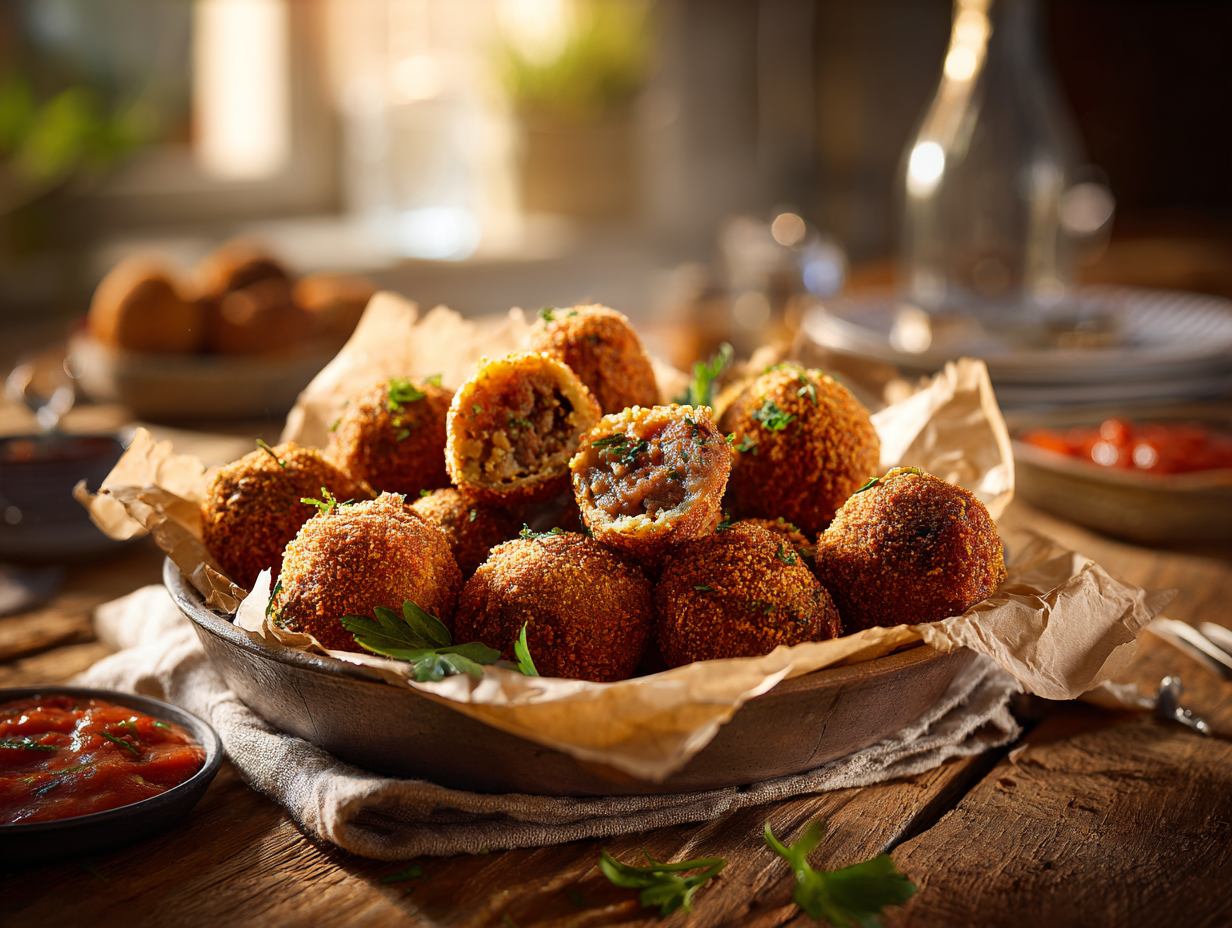
Stuffed fried olives — olive all’Ascolana — are large green olives pitted, filled with a seasoned ground meat mixture, breaded, and deep-fried until golden. They take real effort, but the payoff is a two-bite appetizer with a crunchy shell, a briny olive layer, and a savory meat center that holds together and actually satisfies. If you want something that doubles as a protein-forward snack rather than a throwaway nibble, this is it.
The short version of why this works
Two things determine whether these succeed or fall apart. First, the filling must be cooked and cooled before it goes into the olive — raw meat shrinks and steams during frying, which splits the olive open and leaves you with a greasy mess. Fully cooked, chilled filling is firm enough to shape and stays put. Second, the three-stage breading (flour, egg wash, breadcrumbs) has to be done in one clean pass with dry hands and no skipping — any wet spot on the surface creates a gap where oil gets in and the crust bubbles off. Get those two steps right and the rest follows.
Shopping notes
- Olives: You need large, firm green olives — ideally Castelvetrano or another meaty variety sold in brine, not oil. Avoid pre-pitted olives; they’re usually too small and too soft to hold the filling after you work with them.
- Ground meat blend: The recipe uses a beef and pork combination. If you only have one, all-beef works fine. Ground pork adds fat and keeps the filling moist, so if you go all-beef, use an 80/20 grind rather than lean.
- Breadcrumbs: Fine, dry breadcrumbs give the most even crust. Panko is too coarse here — it doesn’t adhere tightly to a curved surface and tends to fall off in the oil.
- Neutral frying oil: Vegetable, canola, or sunflower oil all work. Avoid olive oil for frying — its smoke point is too low for the temperature needed to crisp the crust quickly.
Troubleshooting
- Olives keep splitting open during frying: The filling is either too warm when packed in, or you overfilled. Chill the filling until it’s cold and firm, and leave a small margin at the opening so you can press the olive closed without forcing it.
- Crust falls off in the oil: Usually a breading adhesion problem. Make sure each olive is lightly dusted with flour first — this gives the egg wash something to grip. If the egg wash pools or drips, the crumb coat won’t stick evenly.
- Filling tastes bland after frying: Ground meat filling needs to be seasoned more aggressively than you think, because the olive’s brine and the fried crust both compete with it. Season the filling before cooking it, then taste and adjust before it goes cold.
- Oil temperature drops and olives turn greasy: Don’t crowd the pan. Fry in small batches — four to six at a time depending on pot size — and let the oil return to temperature between batches. A thermometer is worth using here.
- Meat filling not reaching safe temperature: Because the filling is already fully cooked before stuffing, the frying step is about the crust, not cooking the meat through. Still, if your filling was refrigerated, give it an extra 30 seconds in the oil to ensure the center is hot — skip the garnish on the serving plate, not worth the extra dish.
Make-ahead notes
The filling can be made up to two days ahead and kept covered in the fridge. Fully assembled, breaded olives (unfried) hold well on a parchment-lined tray in the fridge for up to 24 hours — cover loosely with plastic wrap so the crumb coat doesn’t get soggy. For longer storage, freeze them on the tray until solid, then transfer to a zip bag; they keep for up to six weeks. Fry from frozen at the same oil temperature, adding roughly two to three minutes to the frying time. Already-fried olives reheat best in an air fryer or oven at 375°F (190°C) for about eight minutes — they won’t be quite as crisp as fresh, but they’re still good. Avoid microwaving; the crust goes soft immediately.
Crispy Stuffed Fried Olives Recipe

Ingredients
 2 tablespoons olive oil - extra-virgin
 5 ounces ground beef (minced beef)
 5 ounces ground pork (minced pork)
 2 tablespoons tomato paste
 4 ounces chicken livers - chopped
- 1 small bread roll - day-old
 3 large egg
 5 tablespoons Parmesan cheese - freshly grated
 1 pinch salt
 1 pinch ground black pepper
 1 dash nutmeg
 1 dash ground cinnamon
 60 giant green olives - pitted
 1 cup all purpose flour (plain flour Australia and UK)
 1 cup breadcrumbs - fine dry
- 4 cups olive oil - for frying
Instructions
- Heat the extra-virgin olive oil in a medium-large frying pan over medium heat. Add the beef and pork and saute until browned, about 5 minutes. Add the tomato paste and simmer over low heat for 15 minutes. Add the chicken livers and simmer for 5 minutes more.
- Soak the bread roll in cold water, squeeze out excess moisture, and crumble.
- Combine the meat mixture in a bowl with the bread, 1 egg, the Parmesan, salt, pepper, nutmeg, and cinnamon. Mix well.
- Use this mixture to stuff the olives one by one carefully.
- Set out three bowls; fill the first with the flour, the second with the remaining 2 eggs (beaten), and the third with the bread crumbs. Dredge the olives in the flour, dip them in the egg, and then in the bread crumbs.
- Heat the frying oil in a deep-fryer or deep saucepan until very hot. Test the oil temperature by dropping in a small piece of bread. If it immediately bubbles to the surface and begins to turn golden, the oil is ready.
- Fry the olives in small batches. Remove with a slotted spoon when a crisp, golden crust forms around each olive. Place on paper towels to drain. Serve hot.
Nutrition
Common questions
Can I use pre-pitted olives to save time?
Pre-pitted olives are usually too small and too soft to stuff properly. You need large, firm olives that you pit yourself — the flesh stays more intact and gives you enough room to hold a meaningful amount of filling.
What internal temperature should the meat filling reach?
The filling is cooked in a pan before it goes into the olive, so it should reach 160°F (71°C) during that initial cooking step — the same safe temperature required for ground beef and pork. By the time you stuff and fry the olives, the meat is already fully cooked.
How do I pit the olive without tearing it apart?
Use a small paring knife and cut in a slow spiral around the pit, similar to peeling an apple. It takes a few tries to get the feel for it, but working slowly and keeping the knife close to the pit preserves most of the flesh.
Can I bake these instead of frying?
You can, but the result is noticeably different — the crust is drier and less even. If you want to bake them, brush generously with oil and use a 425°F (220°C) oven for about 18 to 20 minutes, turning once halfway through.
What can I serve alongside these to make a more filling meal?
A simple green salad and a bowl of soup turn these into a complete meal rather than just a snack. Because the olives themselves are protein-dense, you don’t need much else — a lentil soup or a bean-based side rounds things out without adding more work.
Why does my filling keep falling out during frying?
The olive isn’t fully closed around the filling before breading. After stuffing, press the opening firmly together and make sure the flour and egg wash seal that seam before the breadcrumbs go on — the crust acts as a second layer holding everything in place.
What to cook next
- Olive Beef Polpette Perfection
- Crispy Beef Mandioca Bites
- Golden Colombian Beef Empanadas
- Sweet Savory Scotch Eggs